

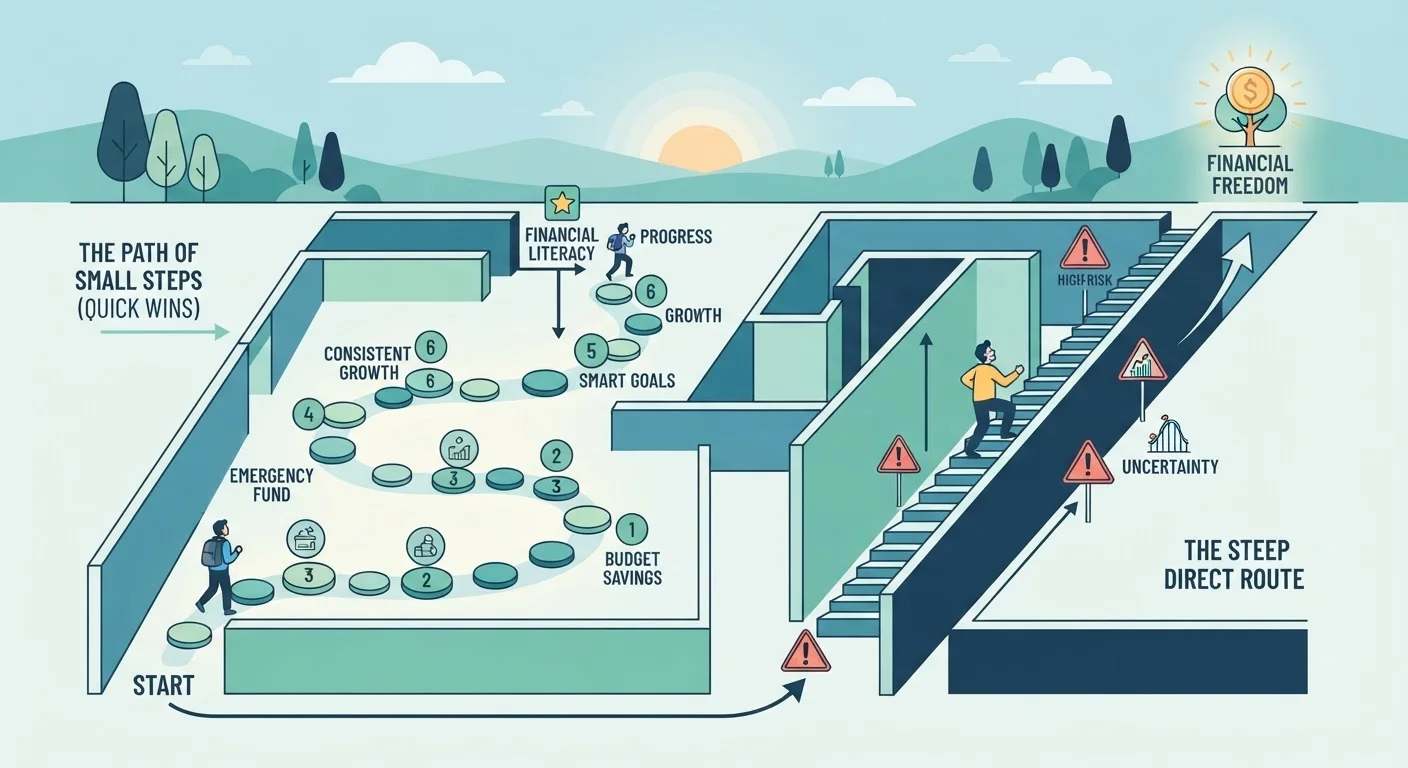
Key Takeaways
Option A
Debt Snowball
The motivation-first method built on quick wins.
Best for: People who need psychological momentum to stay consistent with debt repayment.
Option B
Debt Avalanche
The math-first method that minimizes total interest paid.
Best for: People who are disciplined and want to pay as little interest as possible over time.
If you need visible progress to stay motivated
Debt Snowball
Paying off smaller balances quickly creates a sense of accomplishment that helps many people stay on track for the long haul.
If minimizing total interest is your top priority
Debt Avalanche
Attacking high-interest debt first mathematically reduces the total amount you pay over time, which can be significant with large balances.
If you have one very large, high-interest debt dominating your finances
Debt Avalanche
When a single high-rate account is costing you the most each month, tackling it directly limits how much interest accumulates before you make real progress.
If you have many small balances spread across multiple accounts
Debt Snowball
Eliminating several accounts relatively quickly simplifies your financial picture and reduces the mental load of juggling many creditors.
If you have tried other methods before and quit partway through
Debt Snowball
The frequent early wins of the snowball method may provide the reinforcement needed to maintain effort longer than previous attempts.
How Each Method Works
Both the debt snowball and the debt avalanche share the same basic mechanics: you make minimum payments on all your debts, then direct any extra money toward one target debt at a time. When that target is paid off, you roll its payment into the next target. The difference is purely in how you choose the order.
With the debt snowball, you rank your debts from smallest balance to largest and attack the smallest first, regardless of interest rate. As each balance hits zero, you gain a freed-up payment to apply to the next debt - the "snowball" that grows as you go.
With the debt avalanche, you rank your debts from highest interest rate (APR) to lowest. The highest-rate debt gets all your extra payment until it's gone, then you move down the list. Because high-APR debt grows fastest, eliminating it first slows how quickly your total debt grows.
For plain-language definitions of terms like APR, minimum payment, and balance, see the Personal Debt Glossary for a useful reference.
| Criterion | Debt Snowball | Debt Avalanche |
|---|---|---|
| Repayment order | Smallest balance first | Highest interest rate first |
| Total interest paid | Typically higher | Typically lower |
| Speed of first payoff | Faster (small balances go quickly) | Can be slower if top debt is large |
| Psychological reward | High - frequent early wins | Lower early on; payoff delayed |
| Best debt profile | Multiple small balances | Few large, high-APR balances |
| Requires discipline over time | Moderate - motivation helps | Higher - longer wait for first win |
| Math complexity | Simple - just sort by balance | Simple - just sort by APR |
The Real Cost Difference - and Why Motivation Matters
Mathematically, the avalanche almost always results in less total interest paid. The gap can be modest or substantial depending on how different your interest rates are and how long repayment takes. If your balances all carry similar rates, the difference may be negligible.
What the math doesn't capture is behavior. Research in consumer psychology consistently finds that people respond strongly to the experience of completing a goal - even a small one. The snowball leverages this: eliminating a balance, however small, provides a concrete reward that can reinforce the habit of continued repayment. For people who have previously started and abandoned debt plans, that reinforcement may be worth more than the interest savings the avalanche would deliver.
~$6,000
Average US credit card balance per holder
According to Federal Reserve consumer credit data, the average revolving credit balance carried by US households has remained in the several-thousand-dollar range in recent years.
20%+
Typical credit card APR in recent years
The Federal Reserve reports that average credit card interest rates have exceeded 20% APR in recent periods, making high-rate debt especially costly to carry long-term.
33%
Adults carrying credit card debt month to month
Surveys by the American Bankers Association and similar bodies consistently find roughly a third of US adults carry a revolving credit card balance rather than paying in full each month.
If you're trying to understand why certain financial habits quietly make debt harder to escape, the article on financial moves that deepen debt is worth reading alongside this one.
Choosing the Right Fit for Your Situation
There is no universally superior method. The right choice depends on two things: your debt profile (how many accounts you have, how balances and rates compare) and your behavioral tendencies (how you've responded to financial challenges in the past).
If you have a handful of small balances alongside one or two large, high-rate accounts, a hybrid approach is also reasonable - use the snowball to clear the small balances quickly, then switch to avalanche logic for the remaining high-rate debt. The goal is sustainable progress, not methodological purity.
Whichever method you choose, the underlying budget matters just as much. The Budgeting Basics hub covers how to build a workable household budget that can support consistent extra payments, and saving money strategies can help you find room in a tight budget to increase those payments over time.
For those with irregular income - freelancers, gig workers, or anyone with variable pay - applying either method consistently takes extra planning. The guide on managing debt with irregular income addresses those specific challenges directly.
If your debt situation is more complex, it may also be worth understanding how other strategies compare. The article on what debt consolidation actually does explains a different path that some households consider.
This article is for general informational and educational purposes only and does not constitute personalized financial, legal, or tax advice. Consult a qualified financial professional before making decisions about your specific financial situation.