

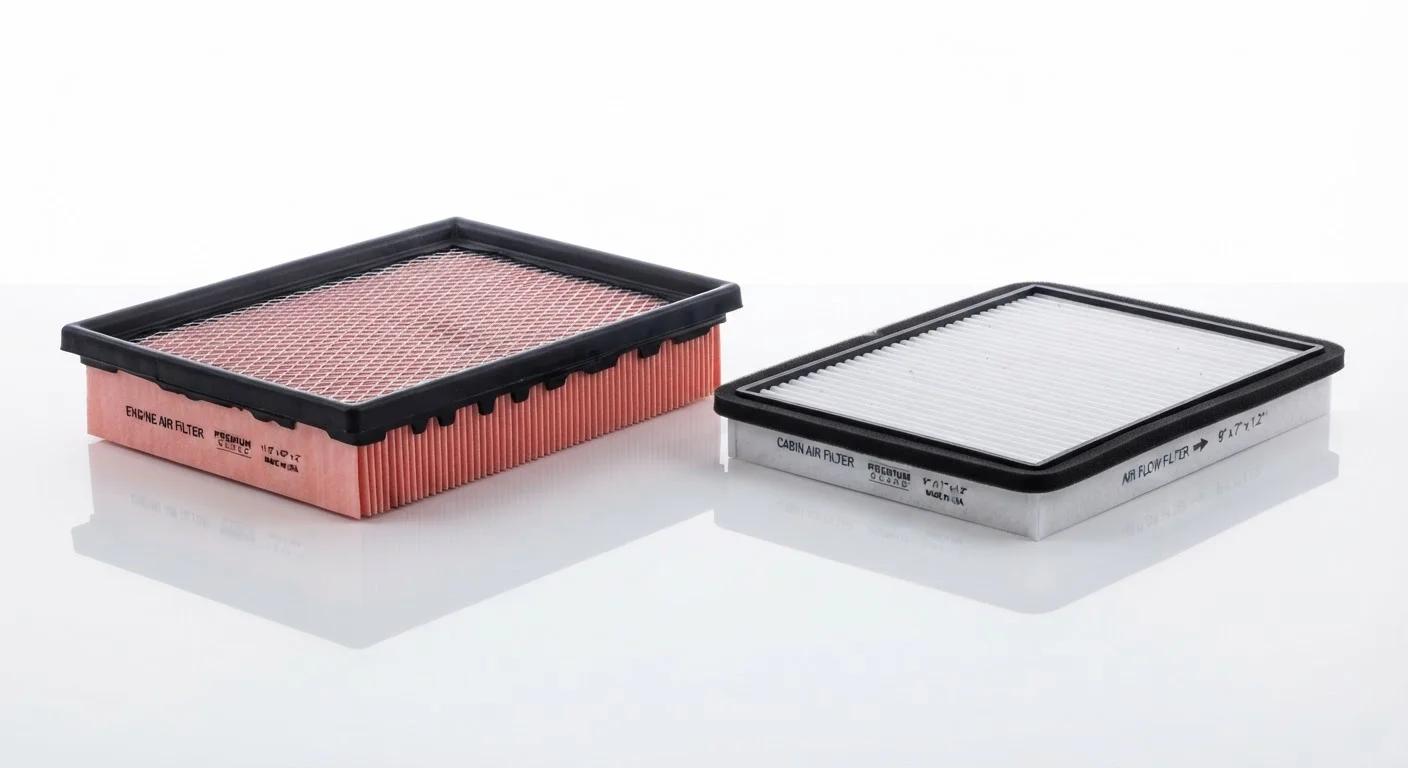
Key Takeaways
Option A
Cabin Air Filter
The air quality guardian for your passenger compartment.
Best for: Drivers who want cleaner, fresher air inside the car - especially important for allergy sufferers and commuters in urban or dusty environments.
Option B
Engine Air Filter
The combustion protector that keeps your engine breathing clean.
Best for: Every driver who wants to protect engine longevity, maintain fuel efficiency, and avoid costly internal engine wear from airborne debris.
If you or your passengers suffer from allergies or live in a high-pollution area
Cabin Air Filter
Prioritizing cabin filter replacement ensures the air circulating through your vents is free of pollen, dust, and fine particulates that trigger respiratory irritation.
If your vehicle feels sluggish or fuel economy has dropped unexpectedly
Engine Air Filter
A restricted engine air filter starves the combustion chamber of clean airflow, reducing power and efficiency - swapping it is one of the easiest performance fixes available.
If you drive in dusty, rural, or unpaved-road conditions
Engine Air Filter
Heavy dust loading clogs engine air filters far faster than typical highway miles, making more frequent inspection and replacement essential for engine protection.
If you notice musty odors or reduced airflow from your HVAC vents
Cabin Air Filter
A saturated or moldy cabin filter is the most common cause of unpleasant in-cabin smells and weak airflow from the heating and air conditioning system.
What Each Filter Actually Does
The word "air filter" appears twice in most owner's manuals, and the two entries do not describe the same component. Understanding what each one does - and what happens when each is neglected - helps you make smarter maintenance decisions without guessing.
The cabin air filter sits inside the HVAC (heating, ventilation, and air conditioning) system, typically behind the glove box, under the dashboard, or beneath a vent panel near the base of the windshield. Its only job is to clean the air that enters the passenger compartment. It traps pollen, dust, mold spores, exhaust particles, and other airborne debris before they reach your nose and lungs. It has zero involvement with how the engine runs.
The engine air filter lives in the engine bay inside a housing called the airbox, which connects to the intake tract leading into the engine. Its job is to prevent dirt, sand, insects, and fine debris from entering the combustion chamber, where even microscopic abrasive particles can cause premature wear on pistons, cylinders, and other precision components. Clean, particle-free air mixes with fuel for combustion; a restricted filter disrupts that air-to-fuel ratio.
| Criterion | Cabin Air Filter | Engine Air Filter |
|---|---|---|
| What it protects | Passenger breathing air | Engine combustion system |
| Location | Behind glove box or dashboard | Engine bay airbox |
| Typical replacement interval | 12,000-15,000 miles | 15,000-30,000 miles |
| Effect when clogged | Poor cabin airflow, odors, allergens | Reduced MPG, power loss, engine wear |
| DIY difficulty | Very easy - no tools needed | Very easy - no tools needed |
| Failure affects engine performance | No | Yes, directly |
How to Tell When Each Needs Replacing
Both filters share a dirty secret: they rarely announce their failure dramatically. You have to know what to look for.
Cabin Air Filter Warning Signs
- Reduced airflow from dashboard vents even at high fan speeds
- Musty, stale, or moldy odors when the HVAC system is running
- Increased dust accumulation on the dashboard surface
- Allergy symptoms that worsen inside the vehicle
Most manufacturers suggest replacing the cabin filter every 12,000 to 15,000 miles, though driving through heavy pollen seasons or urban areas with elevated particulate levels can shorten that interval.
Engine Air Filter Warning Signs
- Noticeable drop in acceleration response or engine feel
- Decreased fuel economy over several fill-ups
- Black smoke from the exhaust under hard acceleration
- A visibly gray or clogged filter element on inspection
General replacement guidance for engine air filters falls in the 15,000-30,000 mile range, but driving conditions matter far more than mileage alone. Dusty gravel roads or construction zones can clog an engine filter in a fraction of the typical interval. See our maintenance schedule guide for how filter changes fit into the broader picture of fuel-saving upkeep.
Check Your Owner's Manual First
Replacement intervals listed here are general industry guidelines. Your vehicle's manufacturer may specify different intervals based on engine design, filter media, or intended driving conditions. Always cross-reference with the maintenance schedule in your owner's manual - it's the most accurate source for your specific vehicle. Severe-duty driving conditions (heavy dust, extreme temperatures, frequent short trips) typically warrant shorter intervals than the standard recommendation.
DIY Replacement: Easier Than You Think
Both filters are among the most accessible DIY maintenance tasks available to home mechanics. Neither requires lifting the vehicle, draining fluids, or owning specialty tools.
The cabin filter in most vehicles is accessed by opening the glove box, releasing a few clips or tabs, and sliding the old filter out of its housing. The process typically takes under ten minutes. Consult your owner's manual for the exact location, as it varies by make and model.
The engine air filter is similarly straightforward - locate the airbox in the engine bay (it's usually a large plastic box connected to a duct), unclasp the housing lid, lift out the old filter, and drop in the new one. Our step-by-step engine filter walkthrough covers the process in detail with no assumed mechanical experience.
When purchasing a replacement for either filter, match the part number to your vehicle's year, make, model, and engine size - this information is in your owner's manual or on the old filter's housing label. Filter dimensions and media types vary considerably, and an incorrect fit will compromise the seal.
Up to 10%
Potential fuel economy loss from a clogged engine air filter
The U.S. Department of Energy has noted that a restricted engine air filter can reduce fuel economy on older carbureted vehicles; modern fuel-injected vehicles may see reduced power and performance instead.
$15-$30
Typical DIY cost for either filter replacement
Purchasing and installing either filter yourself generally costs a fraction of what a shop charges when labor is added to the part price.