

Key Takeaways
Sinking Fund
A sinking fund is money you set aside in small, regular amounts specifically to cover a known future expense - like a car repair, holiday gifts, or an annual insurance premium. Unlike an emergency fund, a sinking fund targets costs you can predict and plan for in advance. The goal is to spread out a large payment over many weeks or months so it never lands as a sudden shock to your budget.
In corporate finance, a sinking fund refers to money reserved to retire debt; in personal finance, the term has been adapted to describe any dedicated savings pool earmarked for a specific anticipated expense.
Why Irregular Expenses Break Budgets
Most household budgets handle predictable monthly bills reasonably well - rent, utilities, and groceries are easy to plan for because they recur on a consistent schedule. The real budget-breakers are the costs that arrive infrequently but are entirely foreseeable: holiday shopping in December, a vehicle registration fee every spring, or a dental bill after an annual checkup.
These are not emergencies. You know they're coming. But without a deliberate system to prepare for them, they land as lump sums that force you to raid other budget categories, skip bill payments, or put the expense on a credit card. That pattern - predictable expense, no preparation, financial stress - is exactly what a sinking fund is designed to break.
See spending categories most households overlook for a practical inventory of the irregular costs that most commonly blindside American households.
How a Sinking Fund Actually Works
The mechanics are straightforward. You identify a future expense, estimate its total cost, count the number of months until it's due, and divide. That quotient is your monthly savings target. Deposit that amount into a dedicated account or budget category each month, and by the time the bill arrives, the money is already waiting.
For example, if your car typically needs $600 in annual maintenance and that cost tends to fall in the spring, you'd save $50 per month starting in June. Twelve months later, the money is there with no scrambling required.
~$400
Emergency expense many Americans can't cover
Federal Reserve surveys have consistently found that a significant share of U.S. adults would struggle to cover an unexpected $400 expense without borrowing - illustrating how unprepared most households are for irregular costs.
12x
Smaller monthly bite vs. one lump payment
Dividing a $1,200 annual expense into 12 monthly contributions of $100 eliminates the lump-sum shock entirely - the same total cost spread into manageable increments.
The critical operational detail is separation. Sinking fund money must live apart from your everyday checking account. Many banks and credit unions allow you to open multiple labeled savings sub-accounts at no cost. Some budgeting apps handle this through virtual envelopes or categories. The label matters - it creates a psychological barrier against dipping into the fund for unrelated spending.
Building Your First Sinking Fund
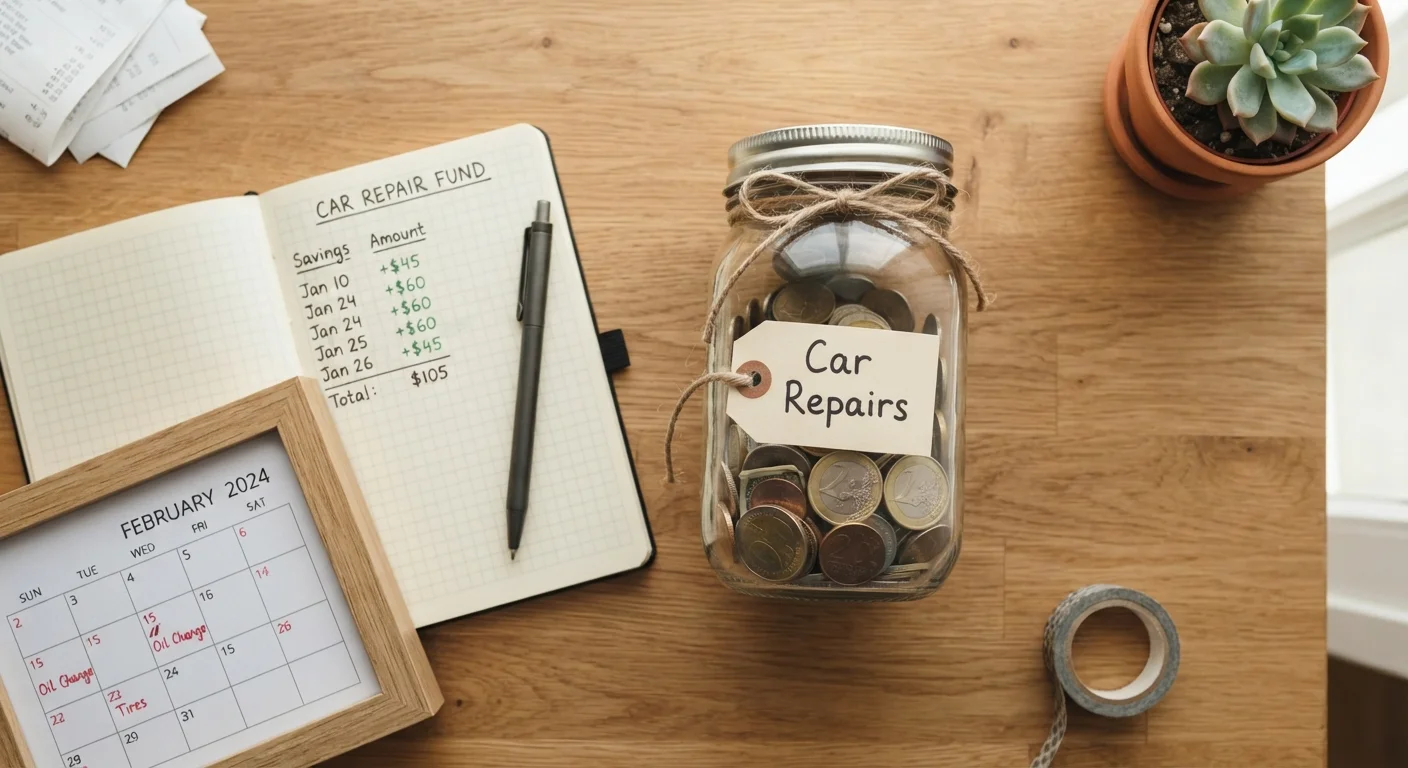
Start with one category - the single irregular expense that has most reliably disrupted your budget in the past year. Common first choices include car repairs, holiday gifts, and medical copays. Anchor it to something specific and name the fund after that expense rather than giving it a vague label like "savings."
Name Your Fund After the Expense
Labeling a savings account 'Car Repairs' or 'Holiday 2025' makes it significantly harder to raid for unrelated spending than a generic 'savings' label. The specificity creates accountability. Many online banks allow multiple free sub-accounts for exactly this purpose.
Once you've calculated your monthly contribution, automate the transfer on payday. Treating the sinking fund deposit like a fixed bill - money that leaves your checking account before you have a chance to spend it - is the habit that makes the system work over time. Even if you can only start with $10 or $20 per month, a small consistent contribution beats an inconsistent large one.
If your income varies month to month, a fixed dollar amount may not be realistic. In that case, contribute a fixed percentage of each paycheck instead. For more on adapting budget systems to variable income, see budgeting strategies for irregular income.
Sinking Funds vs. Emergency Funds: Not the Same Thing
A common point of confusion is conflating sinking funds with emergency funds. They are complementary tools, not substitutes. An emergency fund exists for genuinely unpredictable events - a sudden layoff, an unexpected medical crisis - and it should remain untouched unless a true emergency occurs.
A sinking fund targets the opposite scenario: costs you can anticipate and schedule. Blurring the line between the two gradually erodes your emergency cushion and leaves you more financially exposed than you realize. If you haven't established an emergency fund yet, building that foundation first is generally the recommended sequence before layering in multiple sinking funds.
For a deeper look at how the two tools fit into a complete household plan, see how emergency funds and budgets work together.