

Key Takeaways
Why Package Feeding Guides Miss the Mark
The feeding guidelines printed on pet food packaging are calculated for an average, intact adult animal of a given weight range. They do not account for whether your pet is spayed or neutered, how active they actually are, their age bracket within adulthood, or their current body condition. As a result, following package guidelines to the letter often leads to gradual weight gain - particularly in less active or altered pets.
This does not mean the label is useless. It gives you a reasonable starting range and the calorie density information you need to do your own math. Think of it as an upper boundary to work down from, not a prescription to follow exactly.
What you will need
If you cook for your pet rather than using commercial food, portion accuracy becomes even more variable - see our guide on homemade pet food for considerations specific to home-prepared diets.
What You Need Before You Start
Accurate portion sizing requires a few inexpensive tools and some baseline information about your pet. Before working through the steps below, gather the items listed here.
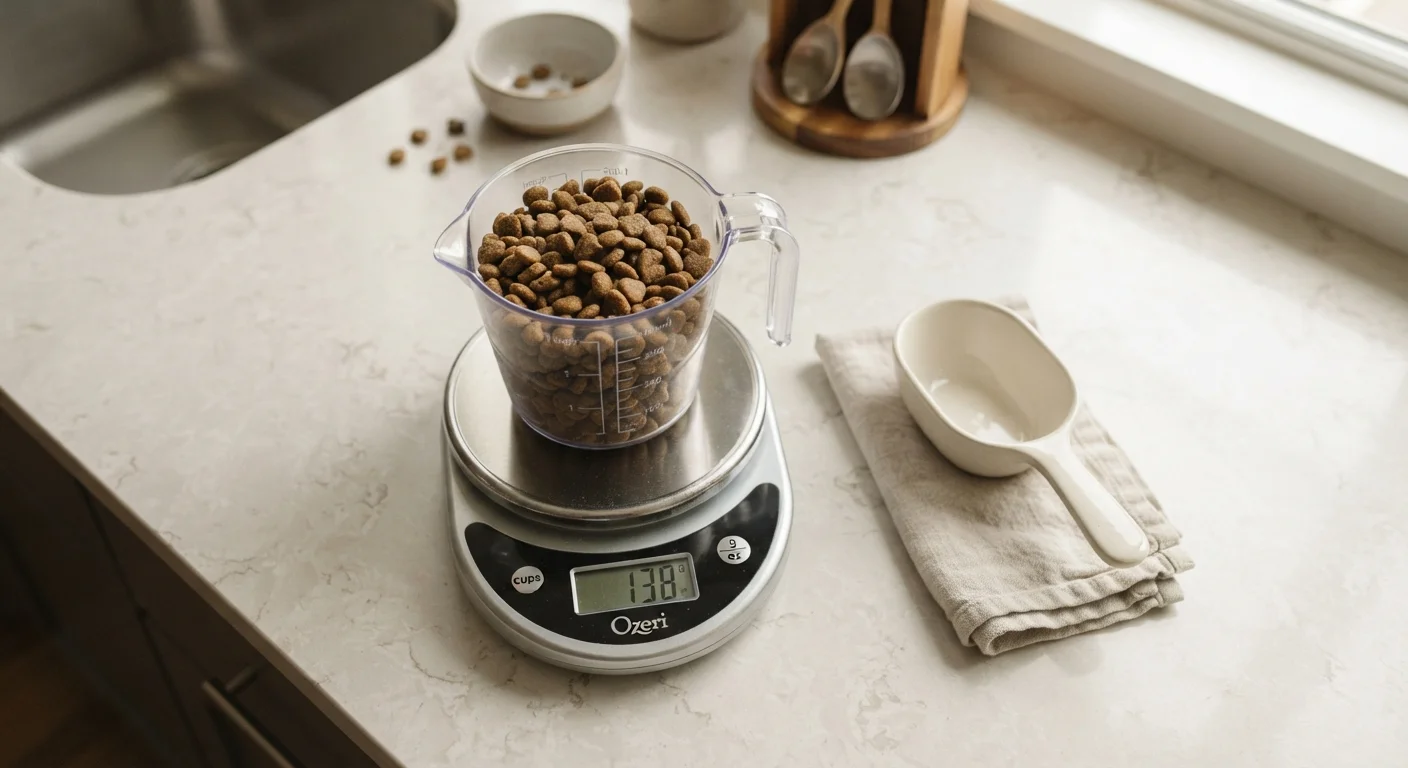
Digital kitchen scale
Weighs portions in grams or ounces for accuracy - far more reliable than volume cups alone.
Dry measuring cup (standard)
Provides a quick volume estimate for dry kibble when used alongside weight verification.
Body condition score (BCS) chart
A visual/tactile reference tool (available free from most veterinary associations) used to assess whether your pet is under, over, or at a healthy weight.
Pet food calorie calculator
Online tools from veterinary schools can estimate a starting daily calorie target based on weight and life stage.
Track Cost-Per-Serving, Not Just Price
Once you know your pet's accurate daily portion in grams, you can calculate exactly how many servings are in a bag and compare foods on a true cost-per-day basis. This is one of the most effective ways to stretch a pet food budget without sacrificing quality. Our guide on stretching your pet food budget walks through the math in detail.
Step-by-Step: Dialing In the Right Portion
Follow these steps in order. Each builds on the previous one, and skipping ahead - particularly step 3 - tends to undermine the accuracy of everything that follows.
Find the Calorie Density of Your Pet's Food
Locate the kilocalorie (kcal) content on your pet food's label - it is usually expressed as kcal per cup (for dry food) or kcal per can (for wet food). If it is not printed on the packaging, check the manufacturer's website or contact them directly; AAFCO guidelines require this information to be available.
This number is the foundation for every calculation that follows. Two foods that look similar in price and serving size can differ by 30% or more in calorie density, which directly affects how much you should be feeding.
Establish a Starting Daily Calorie Target
A common veterinary formula for estimating a maintenance calorie need (called Resting Energy Requirement, or RER) starts with your pet's weight in kilograms: RER = 70 × (body weight in kg)0.75. From there, a multiplier is applied based on life stage and reproductive status - for example, neutered adult dogs typically use a multiplier of around 1.6, while intact adults may use 1.8, and puppies under four months can require 3.0 or higher.
These multipliers are general estimates used in veterinary practice; your vet can refine them for your specific animal. Free calculators from accredited veterinary schools can also help you run this math without doing it by hand.
Assess Body Condition Score (BCS)
Body condition scoring is a hands-on method used by vets to gauge whether a pet is under, over, or at an appropriate weight - independent of breed weight charts, which can be misleading. Most BCS systems use a 1-9 scale, where 4-5 is considered ideal. At an ideal score, you should be able to feel your pet's ribs without pressing hard, but not see them prominently.
Download a BCS chart from a reputable veterinary source (such as a veterinary school or professional association) and assess your pet before finalizing any portion changes. If your pet scores 6 or above, starting with portions at the lower end of any recommended range is generally advisable. If they score 3 or below, the opposite applies.
For a deeper look at what weight assessment tells you - and where it falls short - see our article on pet weight management.
Calculate and Measure Your Daily Portion
Divide your target daily calorie amount by the food's kcal-per-gram figure to get the daily portion in grams. Then weigh that amount on your kitchen scale. If you feed twice daily, split the total in half per meal.
Example: A food with 350 kcal per 100g, fed to a pet needing 490 kcal/day, requires approximately 140g of food daily - about 70g per meal.
[warning_callout]Account for Treats and Toppers
Treats, chews, food toppers, and table scraps all contribute calories. A general guideline in veterinary nutrition is that extras should make up no more than 10% of total daily calories. Calculate what that 10% ceiling looks like in real numbers, then subtract it from your main meal portions accordingly.
If you use a food topper regularly - broths, shredded proteins, canned food mixed with dry - factor in those calories the same way you would a treat. Our article on treats, toppers, and supplements covers which additions serve a genuine dietary purpose.
Monitor and Adjust Over 4-6 Weeks
No formula gets portion sizing exactly right on the first attempt. Weigh your pet and re-check BCS at the four-to-six-week mark. If BCS is creeping up, reduce the daily portion by roughly 10% and reassess. If BCS is dropping and your pet seems lethargic or food-obsessed, a modest increase may be warranted.
Small, incremental adjustments over several weeks are more effective - and safer - than large abrupt changes. If your pet's weight is not responding as expected despite careful portioning, bring your records to a veterinarian rather than continuing to experiment independently.
Pets With Health Conditions Need Vet Guidance
If your pet has been diagnosed with diabetes, kidney disease, obesity, or food allergies, general portion guidelines do not apply. These conditions often require prescription diets and calorie targets set by a veterinarian. Do not rely on this article as a substitute for professional veterinary nutrition advice. See our companion article on feeding pets with health conditions for more context.
Special Situations That Change the Math
Several life events and conditions shift calorie needs enough to warrant a fresh calculation rather than just adjusting the existing one:
- Pregnancy and nursing: Energy requirements can double or more during late gestation and peak lactation. This is a situation where veterinary guidance is essential, not optional.
- Growth (puppies and kittens): Caloric needs per pound of body weight are significantly higher than for adults, and change rapidly as the animal grows. Life-stage-appropriate food with more frequent check-ins is the standard approach.
- Senior pets: Metabolic rate tends to decline with age, but some seniors also become less efficient at absorbing nutrients. The net effect varies by individual and often warrants a vet conversation rather than a straightforward reduction.
- High-activity working or sporting animals: Dogs used for fieldwork, agility, or sled sports may require 2-4 times the calories of a comparably sized sedentary pet.
This article provides general educational information about pet feeding and is not a substitute for personalized veterinary advice. Always consult a licensed veterinarian for guidance specific to your pet's health status and nutritional needs.