

Key Takeaways
Rolling Resistance
Rolling resistance is the energy a tire must expend to keep moving forward as it contacts the road surface. When a tire is under-inflated, more of its sidewall flexes with each rotation, creating extra friction and forcing the engine to work harder. That extra engine effort means burning more fuel to travel the same distance.
Rolling resistance is quantified as a coefficient (Crr) - the ratio of resistive force to the normal load on the tire. Even small increases in Crr from low pressure translate to measurable fuel consumption penalties over thousands of miles.
Why Tire Pressure Is a Fuel Economy Variable, Not Just a Safety Check
Most drivers think of tire pressure as a safety issue - and it is - but it's also one of the most direct, controllable factors affecting how many miles you squeeze out of every gallon of fuel. The connection runs through a concept called rolling resistance: the force your engine must overcome just to keep the tires rotating against the road surface.
A properly inflated tire maintains a firm, consistent contact patch with the pavement. An under-inflated tire flattens out and spreads, causing the sidewall to flex excessively with every rotation. That flex generates heat and consumes energy - energy that has to come from somewhere. It comes from your fuel tank. The engine compensates for the extra resistance by burning more gas to maintain speed, and your MPG quietly drops.
This isn't a marginal effect. According to the U.S. Department of Energy, fuel economy can fall by approximately 0.2% for every single PSI that your tires drop below the recommended inflation level. With four tires potentially drifting 5 PSI low - which happens gradually and often goes unnoticed - you could be looking at around 1% reduced efficiency on a sustained basis. For a driver covering 15,000 miles a year, that adds up to a meaningful fuel cost increase over time.
~0.2%
Fuel economy loss per 1 PSI under-inflated
Estimated by the U.S. Department of Energy based on tire rolling resistance data.
1 PSI
Pressure drop per 10°F temperature decrease
A widely cited rule of thumb from tire industry and automotive safety organizations.
25%
Under-inflation threshold that triggers TPMS warning
Required TPMS threshold under U.S. federal safety regulations (FMVSS 138).
How to Read and Use the Right Pressure Number
One of the most common tire pressure mistakes is inflating to the number printed on the tire sidewall. That number is the maximum pressure the tire structure can handle - not what your vehicle is engineered to run on. Using it can cause over-inflation, uneven wear, and reduced traction.
The number you actually need is on a sticker typically located on the inside edge of the driver's door or door jamb. This is your vehicle manufacturer's recommended PSI, calibrated for the car's weight, suspension, and handling characteristics. Some vehicles specify different pressures for front and rear tires - always check both.
Check Pressure Monthly, Not Just When It Looks Low
Tires can lose 1-3 PSI per month through normal permeation alone - no puncture needed. A tire that looks visually fine can still be 5-6 PSI below spec. Building a quick monthly check into your routine (try pairing it with a regular errand or the first of each month) catches this drift before it affects your fuel bill or your tires' wear pattern.
It's also worth understanding that your Tire Pressure Monitoring System (TPMS) warning light - required on all passenger vehicles sold in the U.S. since 2008 - is a late-stage alert. It typically triggers only when pressure is 25% or more below the recommended level. At that point, fuel economy and handling are already noticeably compromised. Don't rely on the light as your maintenance signal; use it as an emergency backup.
Checking Pressure Correctly: A Two-Minute Routine
Getting an accurate reading requires a small amount of discipline around timing and technique. Here's the process that gives you reliable numbers:
- Check cold. Tires should be driven less than a mile before checking. Driving heats the air inside, temporarily raising pressure and skewing the reading. The best time is first thing in the morning.
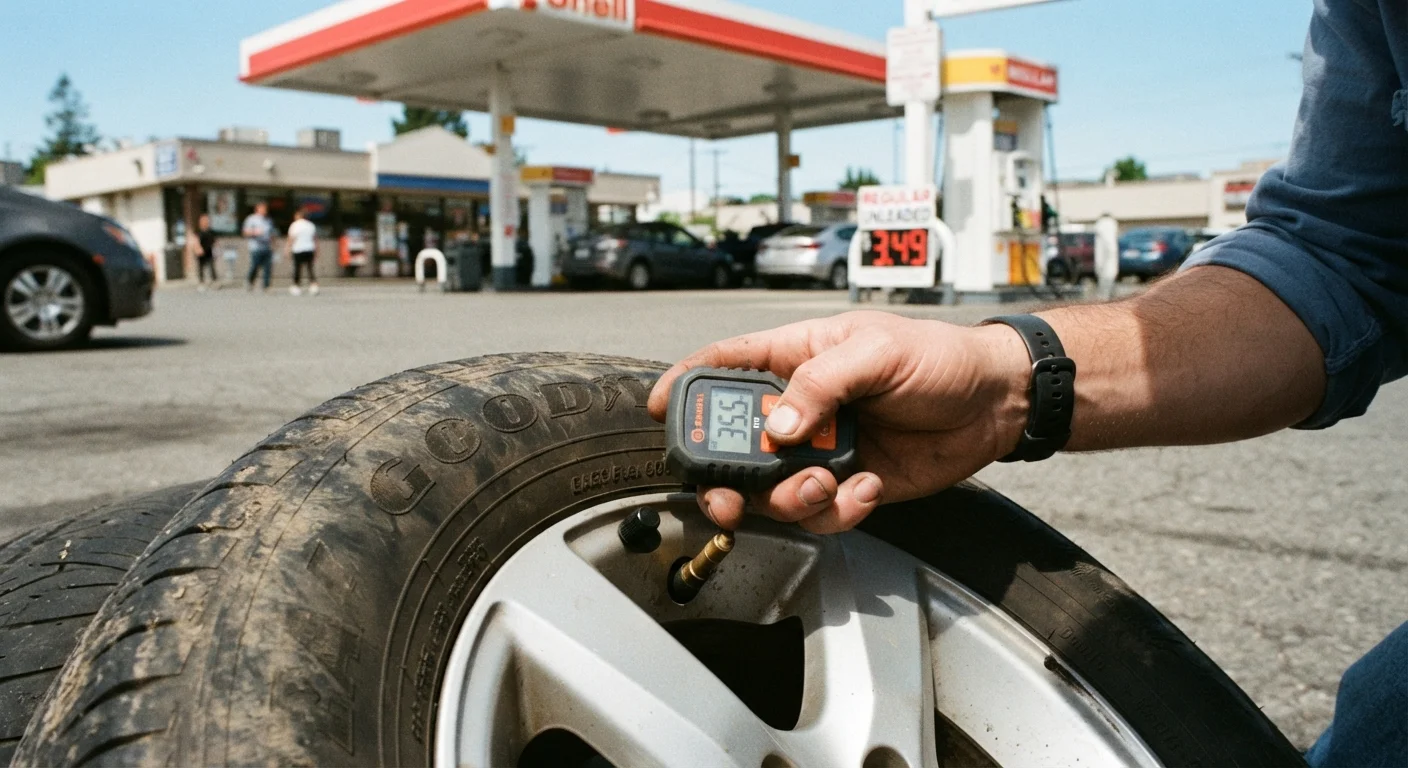
- Use a quality gauge. Stick gauges are inexpensive and widely available. Digital gauges offer clearer readings. The gauges on gas station air hoses vary in accuracy - having your own is more reliable.
- Remove the valve cap and press the gauge firmly and straight onto the valve stem. A hissing sound means the seal isn't tight - reposition and try again.
- Compare to the sticker spec. Add air if you're below the recommended PSI; release air using the small pin inside the valve stem if you're over.
- Recheck after adjusting. Pressure changes slightly when you connect and disconnect the gauge or air hose, so always verify the final number.
For a broader look at quick maintenance habits that protect your fuel budget, see our weekly car check guide - it covers tire pressure alongside other high-impact items like fluid levels and air filters.
Temperature Changes and the Seasonal Pressure Drop
Tire pressure isn't static even when you haven't touched the valve. Air contracts in cold temperatures, and the general rule of thumb is that pressure drops approximately 1 PSI for every 10°F decrease in ambient temperature. When temperatures swing 30-40°F between seasons - as they do in much of the U.S. - that translates to 3-4 PSI of natural loss without a single slow leak involved.
This makes the fall-to-winter transition a particularly important time to check all four tires. Many drivers find themselves unknowingly running on noticeably under-inflated tires through the coldest months, exactly when road traction matters most and when fuel economy is already challenged by cold engine behavior.
The reverse is also true: pressure rises slightly in summer heat, but over-inflation from heat alone is rarely a problem for vehicles maintained at normal recommended levels.
Tire pressure is just one of several physical factors affecting your real-world fuel consumption. If you want to see how your driving inputs compound with vehicle condition, our article on driving habits that drain your gas tank breaks down which behaviors carry the heaviest fuel penalty.