

Key Takeaways
Bodyweight Training
Bodyweight training is a form of exercise that uses your own body's mass as resistance to build strength, endurance, and flexibility. Movements like push-ups, squats, lunges, and planks challenge muscles without any gym equipment or weights. It can be done virtually anywhere - at home, outdoors, or while traveling.
From a biomechanics standpoint, bodyweight exercises engage multiple muscle groups simultaneously through compound movement patterns, stimulating neuromuscular adaptations similar to those produced by resistance training with external loads.
The Core Idea: Your Body Is the Equipment
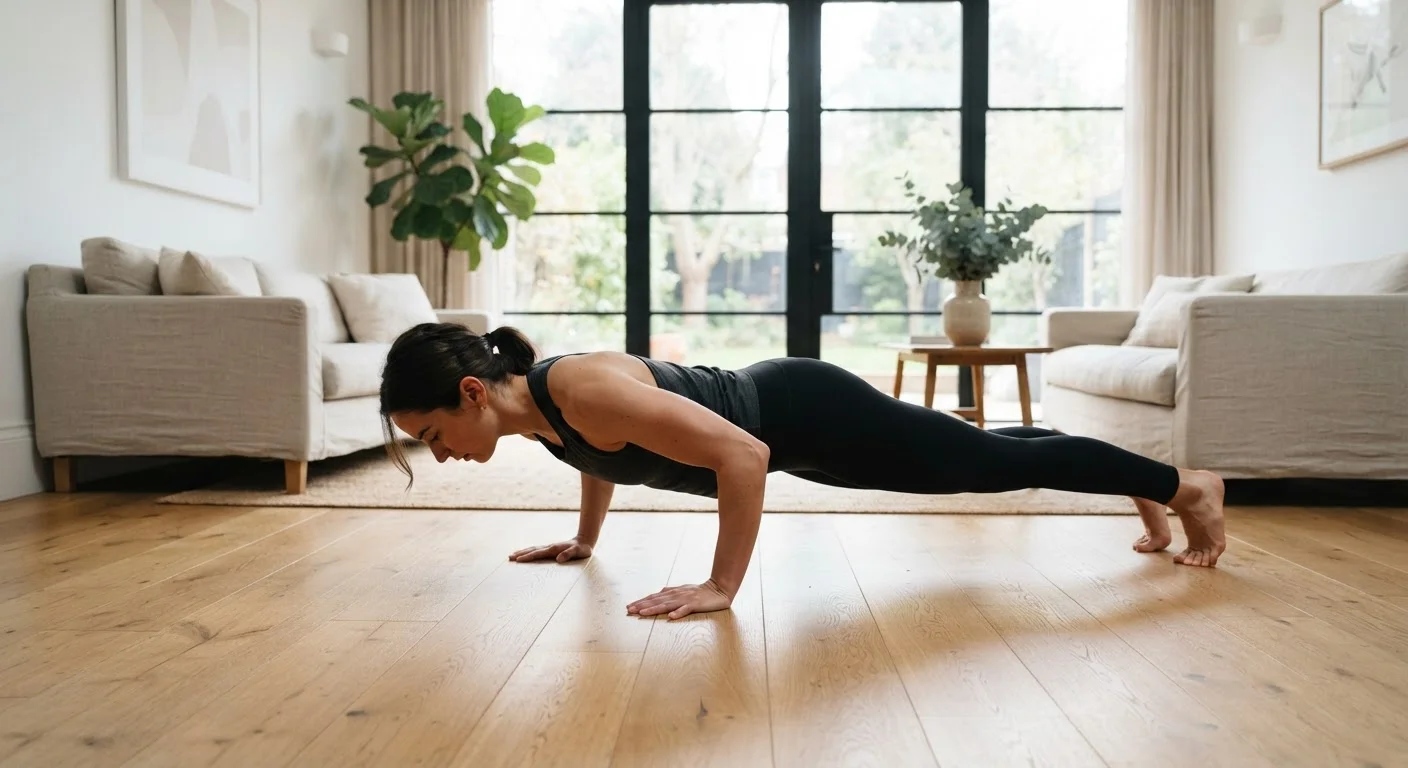
Bodyweight training strips fitness down to its simplest form - movement against gravity using the mass you already carry. Unlike gym-based programs that rely on machines or free weights, bodyweight exercise is entirely self-contained. A push-up uses your chest, shoulders, and triceps to press your bodyweight up from the floor. A squat loads your legs and hips with every repetition. The stimulus to your muscles is real, even without a weight rack in sight.
This accessibility is precisely why bodyweight training has been practiced by athletes, military personnel, and everyday people for generations. It requires no membership, no commute, and no significant financial investment. For budget-conscious individuals looking to maintain or improve their fitness, it represents one of the most practical options available.
Start With Movement Patterns, Not Muscles
Rather than thinking about individual muscles to train, focus on covering fundamental movement patterns each week: a push, a pull, a squat, a hinge, and a core stabilization exercise. This approach naturally ensures balanced development and reduces the risk of overworking one area while neglecting another.
The Science Behind Why It Works
Muscles grow stronger in response to mechanical tension, metabolic stress, and muscle damage - three mechanisms identified by exercise science researchers as central to strength adaptation. Bodyweight exercises can produce all three when programmed thoughtfully. A slow, controlled push-up creates significant tension across the working muscles. A high-repetition set of squats generates meaningful metabolic stress. Neither requires external load to be effective.
The principle of progressive overload - gradually increasing the challenge placed on the body over time - applies equally to bodyweight training. Instead of adding plates to a barbell, a bodyweight trainee might change the angle of a movement (elevating feet during a push-up), slow the tempo, or shift to a more demanding variation. This keeps training stimulating and prevents the plateau that occurs when the body fully adapts to a routine.
72%
Adults who cite cost as a gym barrier
Survey data from the International Health, Racquet & Sportsclub Association has consistently found that cost is among the top reasons US adults avoid gym membership.
2-4 weeks
Time to notice initial strength gains
Exercise physiology research generally indicates that neuromuscular adaptations - early strength improvements - begin within two to four weeks of consistent resistance training, including bodyweight exercise.
How Difficulty Scales Without Weights
One common misconception is that bodyweight training hits a ceiling - that once push-ups feel easy, there is nowhere to go without equipment. In practice, the progression ladder is steep. A beginner might work toward a standard push-up; an intermediate trainee might progress to close-grip or archer push-ups; an advanced practitioner might work toward a one-arm push-up. Each variation shifts leverage and increases the proportion of bodyweight the working muscles must handle.
Similar progressions exist for lower-body and pulling movements. Squats advance to Bulgarian split squats and eventually pistol squats. Glute bridges become single-leg variations. Horizontal rows - performed under a sturdy table or using gymnastic rings - can progress toward full pull-ups. For a deeper look at how to structure these progressions into a coherent plan, see how workout programming works.
Bodyweight vs. Equipment-Based Training
Bodyweight training and equipment-based training are not opposites - many fitness professionals incorporate both. However, they do differ in meaningful ways. External weights make it easier to isolate specific muscles and to increment resistance in small, measurable steps, which can be valuable for targeted strength goals. Bodyweight training, by contrast, tends to demand greater involvement of stabilizing muscles and often builds body control and coordination alongside raw strength.
For most general fitness goals - improving strength, body composition, endurance, and mobility - bodyweight training is a fully capable tool. Those interested in how equipment options compare can explore how resistance bands and dumbbells differ as a complement to bodyweight work, not a replacement.
“The best exercise program is the one you'll actually do. Consistency with a simple bodyweight routine outperforms an elaborate gym plan that rarely gets executed.”
— American College of Sports Medicine, Leading professional organization for exercise science and sports medicine
Making It a Sustainable Practice
The most effective training program is one a person will actually follow consistently. Bodyweight training removes several common barriers to consistency: there is no gym to drive to, no equipment to set up, and no cost-per-session to justify. A 20-minute session in a living room counts. So does a set of lunges during a work break.
Building a lasting habit around any exercise format requires behavioral structure, not just motivation. Strategies for making home exercise a lasting routine can help bridge the gap between knowing what to do and actually doing it regularly. And when progress seems to stall - as it eventually does for most people - understanding why home workout plateaus happen makes it easier to course-correct without giving up.
This article is for general informational purposes only and does not constitute medical or fitness advice. Consult a qualified healthcare professional before beginning any new exercise program, particularly if you have existing health conditions or injuries.