

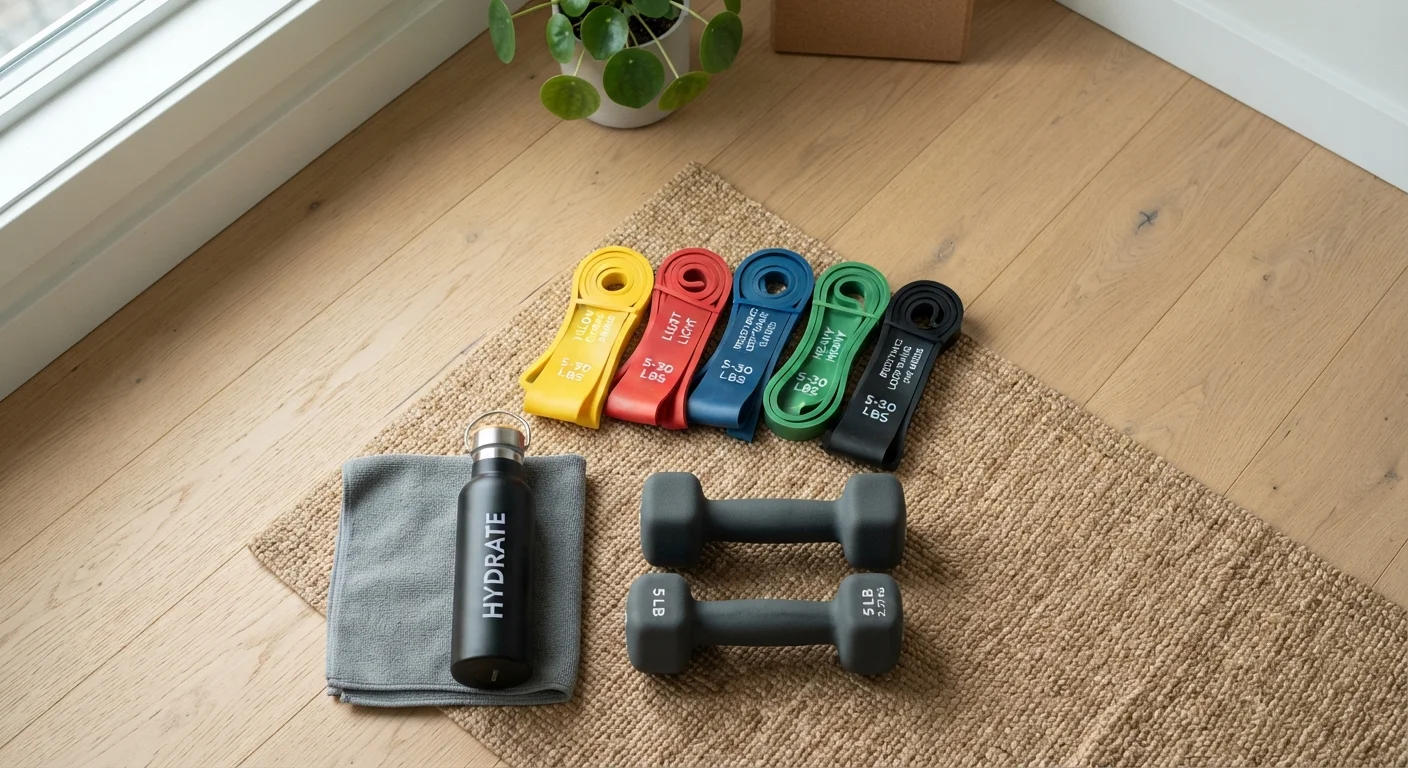
Key Takeaways
Option A
Resistance Bands
The compact, travel-ready alternative that grows with your movement.
Best for: Anyone prioritizing portability, joint-friendly loading, and budget-conscious entry into strength training.
Option B
Dumbbells
The reliable, progressive staple of serious home strength work.
Best for: Anyone seeking precise, measurable load progression and a broad library of established exercises.
If you're starting on a tight budget and limited space
Resistance Bands
A full set of bands typically costs far less than an equivalent range of dumbbells and takes up minimal room, making them the most accessible entry point.
If you want consistent, measurable load progression
Dumbbells
Fixed weight increments make it straightforward to track and gradually increase resistance - a fundamental principle of building strength over time.
If you train while traveling or have no dedicated workout space
Resistance Bands
Bands fold into a bag and weigh almost nothing, making them the only practical option when space and portability are non-negotiable.
If you're rehabilitating a joint or managing discomfort during exercise
Resistance Bands
Bands apply lighter resistance at the start of a movement and peak at end range, which many people find gentler on joints - though anyone managing an injury should consult a healthcare professional before starting.
If you want a long-term home gym investment that covers most goals
Dumbbells
A modest set of adjustable dumbbells covers the widest range of exercises and load levels, providing lasting utility as your fitness progresses.
How Each Tool Creates Resistance
Understanding how bands and dumbbells generate resistance helps you choose the right tool - or combination - for your training goals.
Resistance bands work through elastic tension. As you stretch a band further, resistance increases - meaning the hardest point in any movement is typically at full extension. This ascending resistance curve differs fundamentally from gravity-based tools. It can be advantageous for certain movements where muscles are strongest at the end range, but it also means the beginning of a rep feels comparatively easy.
Dumbbells rely on gravity, which creates a consistent load throughout most movements. The resistance you feel is predictable and stable, which is one reason they remain a cornerstone of evidence-based strength programming. A 15-pound dumbbell delivers 15 pounds of challenge at every point in the movement - no guessing required.
For readers curious about training without any equipment at all, our article on bodyweight training and how it builds strength provides useful context on resistance principles more broadly.
| Criterion | Resistance Bands | Dumbbells |
|---|---|---|
| Resistance type | Elastic, increases with stretch | Gravity-based, consistent throughout |
| Typical entry cost | Lower upfront investment | Higher, scales with weight range |
| Storage space needed | Minimal - fits in a bag | Moderate to significant floor space |
| Portability | Travel-friendly, lightweight | Fixed location, heavy |
| Load precision | Approximate - varies by stretch | Exact fixed increments |
| Progressive overload ease | Less precise, bigger jumps | Straightforward, incremental |
| Joint impact | Generally gentle, lighter start | Depends on exercise and form |
| Exercise variety | Wide, including mobility work | Wide, well-documented techniques |
Practical Differences: Cost, Space, and Versatility
For budget-conscious home trainers, the logistical differences between bands and dumbbells often matter as much as the physical ones.
Cost: A set of loop or tube resistance bands covering light to heavy resistance can be acquired for a modest amount. A comparable range of dumbbell weights - say, three to four pairs spanning light to moderately heavy - costs considerably more, and the price scales with weight. Adjustable dumbbell systems reduce the footprint but carry a higher upfront cost.
Space: Bands roll into a drawer or travel bag. Even a small dumbbell collection requires dedicated floor space and a storage solution. If you live in an apartment or share space with others, this difference is significant.
Versatility: Dumbbells support an enormous library of well-documented exercises - rows, presses, curls, lunges, deadlifts - with clean technique cues. Bands can replicate many of these, and add unique options like pull-aparts and banded mobility work, but anchoring them safely requires a door anchor or fixed attachment point.
~$10-30
Typical cost of a basic resistance band set
General market pricing for a multi-resistance loop or tube band set; prices vary by retailer and band quality.
~$1-2/lb
Common dumbbell cost per pound of weight
A widely cited general range for standard fixed dumbbells; adjustable sets vary significantly in price.
2-3x
Estimated strength gain potential from consistent resistance training
Research published in sports science literature consistently shows significant strength improvements from regular progressive resistance exercise over several months.
If you're building out a home training routine from scratch, our first-month home workout guide covers how to structure early sessions regardless of which tool you choose.
Progression, Plateaus, and Long-Term Results
One of the most important variables in strength training is progressive overload - the gradual increase in challenge over time that drives continued adaptation. How well each tool supports this principle matters enormously for long-term results.
With dumbbells, progression is explicit: you move from 10 pounds to 12.5 to 15, tracking improvements with precision. This clarity makes programming straightforward and helps you identify plateaus early.
With bands, progression is less precise. Manufacturers label bands by color or general resistance range, but actual tension varies by stretch distance, band age, and brand. Moving to the next resistance level can be a larger jump than anticipated. That said, combining bands - doubling up or adding a lighter band to a heavier one - offers some middle-ground options.
Plateaus are a normal part of any home training routine. Our article on why home workouts stop working explores the underlying reasons and practical strategies for restoring progress, whichever tool you use.
The most effective long-term approach for many home trainers is using both: bands for warm-up, mobility, and accessory work; dumbbells as the primary load for compound movements. Even a small investment in each covers the weaknesses of the other.
Consistency over time matters more than which tool you use. Our guide to building a home workout habit that actually sticks outlines the behavioral strategies that help everyday Americans make fitness a durable part of their routine.
This article is for general informational and educational purposes only and is not a substitute for professional medical or fitness advice. Consult a qualified healthcare provider before beginning any new exercise program, particularly if you have an existing health condition or injury.