

Key Takeaways
Cardio Without a Gym Is More Than Possible
The idea that effective cardiovascular exercise requires a treadmill, a gym membership, or specialized equipment is a widespread misconception - and an expensive one. The human body generates its own resistance, and sustained rhythmic movement is all that cardiovascular fitness fundamentally requires.
Whether you're working with a studio apartment, a tight budget, or a body that needs gentler movement, there are no-equipment cardio options that fit. The six movements below span the full spectrum from low-impact and beginner-friendly to high-intensity and advanced, so you can find a starting point that honestly matches where you are right now.
This Is General Information, Not Medical Advice
The movements described in this article are intended for general educational purposes only. They are not a substitute for personalized guidance from a qualified healthcare or fitness professional. If you have a health condition, injury, or concern - including cardiovascular issues, joint pain, or pregnancy - consult a licensed professional before beginning or changing any exercise routine.
Six No-Equipment Cardio Movements, Ranked From Gentlest to Most Demanding
Marching in Place
Marching in place is one of the most accessible cardio movements available. It raises your heart rate gently while being nearly zero-impact on the joints, making it a strong starting point for beginners, older adults, or anyone returning to exercise after a break.
To increase intensity, lift your knees higher or pump your arms more vigorously. Even a few minutes woven into commercial breaks or a lunch hour adds meaningful movement to a sedentary day. If you're exploring low-impact options more broadly, see home fitness guidance for joint pain or mobility limits.
Marching in place is nearly zero-impact and can be done in any room with no prep.
Jumping Jacks
A familiar staple, jumping jacks engage the whole body - legs, shoulders, and core - while steadily elevating heart rate. They require only enough ceiling height to raise your arms overhead and a small footprint of floor space.
For those who find the jump jarring, a stepping variation works well: step one foot out at a time while raising the arms, achieving a similar range of motion without the impact. This modification makes jumping jacks adaptable across fitness levels.
A stepping variation removes impact entirely while preserving the full range of motion.
Stair Climbing
If your home has even a single step - a stair landing, front stoop, or sturdy low platform - you have a reliable cardio tool. Repeatedly stepping up and down recruits the glutes, quads, and calves while keeping heart rate elevated over time.
Pace controls intensity naturally: slow and controlled for lower effort; brisk and continuous for a more demanding session. Those managing balance concerns should always keep a hand on a railing. Stair climbing also layers well into a broader home routine - this beginner-friendly home workout guide explains how to structure movements like this safely from day one.
A single step is enough equipment to sustain a meaningful cardio session.
Dancing
Dancing is genuinely effective cardio that most people don't think to count as exercise. A 20-minute freestyle session to upbeat music can elevate heart rate comparably to a brisk walk, while also supporting mood through movement and music combined.
No choreography or skill is required. The goal is sustained movement, not performance. Dancing suits tight spaces well - for more ideas on maximizing small rooms, small-space fitness strategies offer practical solutions.
Dancing can elevate heart rate comparably to a brisk walk while actively supporting mood.
Bodyweight Circuits
Combining movements - such as squats, push-ups, and mountain climbers - into a continuous circuit delivers both cardiovascular and muscular stimulus without rest intervals long enough to let heart rate drop significantly. This approach is often called metabolic conditioning.
The key is minimal rest between exercises rather than maximum effort on any single move. Circuits are highly scalable: slower transitions and simpler movements for beginners, faster pacing and more demanding exercises for those with a stronger fitness base. Pairing circuits with a consistent daily structure helps build lasting habits - behavioral strategies for sticking with home exercise cover exactly this.
Minimal rest between exercises - not maximum effort - is what keeps heart rate elevated in a circuit.
High-Intensity Interval Training (HIIT)
HIIT alternates short bursts of maximal or near-maximal effort with brief recovery periods. Research consistently supports its efficiency: shorter sessions can produce cardiovascular benefit comparable to longer moderate-intensity workouts, though individual responses vary and it is not appropriate for everyone.
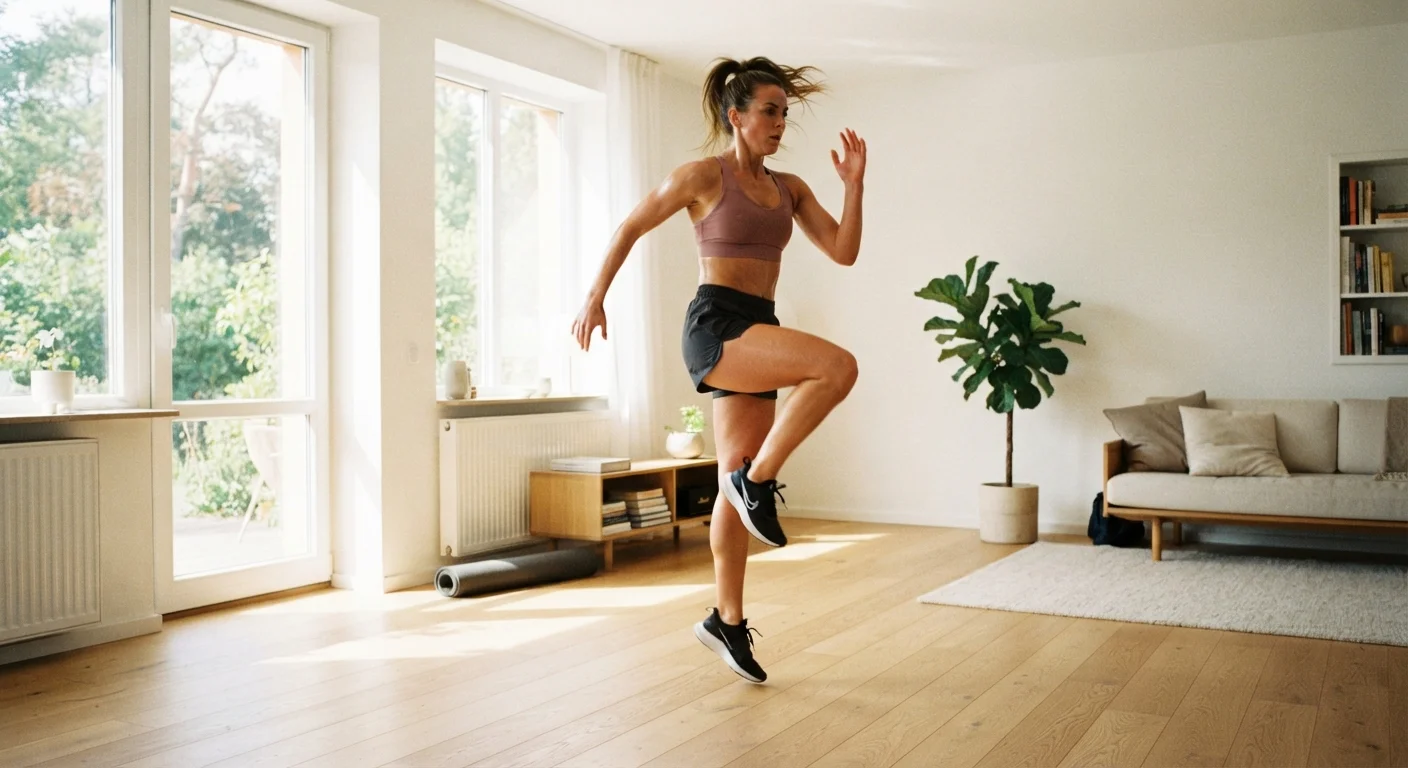
Common no-equipment HIIT moves include burpees, high knees, squat jumps, and speed skaters. Because of its intensity, HIIT is generally better suited to those who already have a baseline fitness level and should be approached with caution by anyone with cardiovascular conditions. Always consult a healthcare professional if you have any underlying health concerns before attempting high-intensity exercise.
HIIT's efficiency is well-supported by research, but it's not appropriate for every fitness level or health status.
Start Shorter Than You Think You Need To
Many people abandon home cardio routines by starting too ambitiously. Beginning with 10-15 minute sessions builds the habit without overtaxing recovery. As consistency improves, duration and intensity can be gradually increased - a principle sometimes called progressive overload.
Building on What You Start With
The most effective cardio routine is the one you'll actually do consistently. Starting with the movement that feels most accessible - even if it seems too easy - is a sound strategy. Progression comes from adding time, frequency, or intensity incrementally, not from jumping straight to the hardest option.
If you're ready to think beyond individual movements and structure these into a repeatable plan, building a home workout habit that actually sticks offers evidence-grounded behavioral strategies to help make consistency the default. For those adding strength work alongside cardio, floor-based core training without crunches is a natural complement with no equipment required.
This article provides general health and fitness information for educational purposes only. It is not medical advice. Consult a qualified healthcare professional before starting any new exercise program, particularly if you have existing health conditions or physical limitations.