

Key Takeaways
Why Your Core Is More Than Abs
The term "core" is often used as shorthand for the rectus abdominis - the muscle responsible for the visible six-pack. In practice, the core is a far larger system. It includes the deep spinal stabilizers (multifidus), the pelvic floor, the diaphragm, the obliques, the hip flexors, and the glutes, all working together to control movement and protect the spine.
Research in rehabilitation and sports science has long distinguished between global mobilizer muscles, which produce large movements, and local stabilizer muscles, which maintain joint position under load. Crunches primarily train the global mobilizers - they do little to develop the deep stability system that most people actually need for pain-free, functional movement.
Floor-based exercises like the ones covered here train both layers without equipment and without cost. They fit comfortably within the framework of bodyweight training, which research supports as an effective means of building strength and endurance for a wide range of fitness levels.
Back Pain or Injury? Read This First
If you have a diagnosed spinal condition, recent surgery, or ongoing back pain, some floor exercises may not be appropriate for you. This article provides general fitness education - it is not a substitute for personalized medical or physical therapy guidance. Please consult a qualified healthcare professional before beginning any new exercise routine.
What You Need Before You Begin
One of the genuine advantages of floor-based core training is the minimal setup required. You do not need a gym membership, specialized equipment, or a dedicated room. Even a small living space can work - for more guidance on training in tight quarters, see our resource on small-space fitness.
What you will need
Exercise mat or folded blanket
Provides cushioning for the spine, hips, and knees during floor work.
Firm, flat floor space (roughly 6×4 feet)
All exercises require enough room to extend arms and legs fully while lying down.
Timer or phone
Helps track hold durations for isometric exercises like the plank and hollow hold.
The Exercises: Step-by-Step
The sequence below moves from foundational awareness to progressively more demanding patterns. Work through all six steps in order, resting 30-60 seconds between exercises. The full routine takes 15 to 30 minutes depending on your pace and rest intervals.
Set up your space and find a neutral spine
Lie on your back on the floor with your knees bent and feet flat. Place one hand lightly under your lower back. A neutral spine means there is a small, natural arch - you should feel slight contact with your hand, not your full lower back pressing into the floor and not an exaggerated arch. This position is your reference point for most of the exercises that follow.
Practice diaphragmatic breathing
Before any movement, take three to five slow breaths into your belly rather than your chest. Place a hand on your abdomen - it should rise on the inhale and fall on the exhale. This activates the deep core system, including the transverse abdominis (your body's natural stabilizing belt), before your limbs begin moving.
Dead Bug - slow and controlled
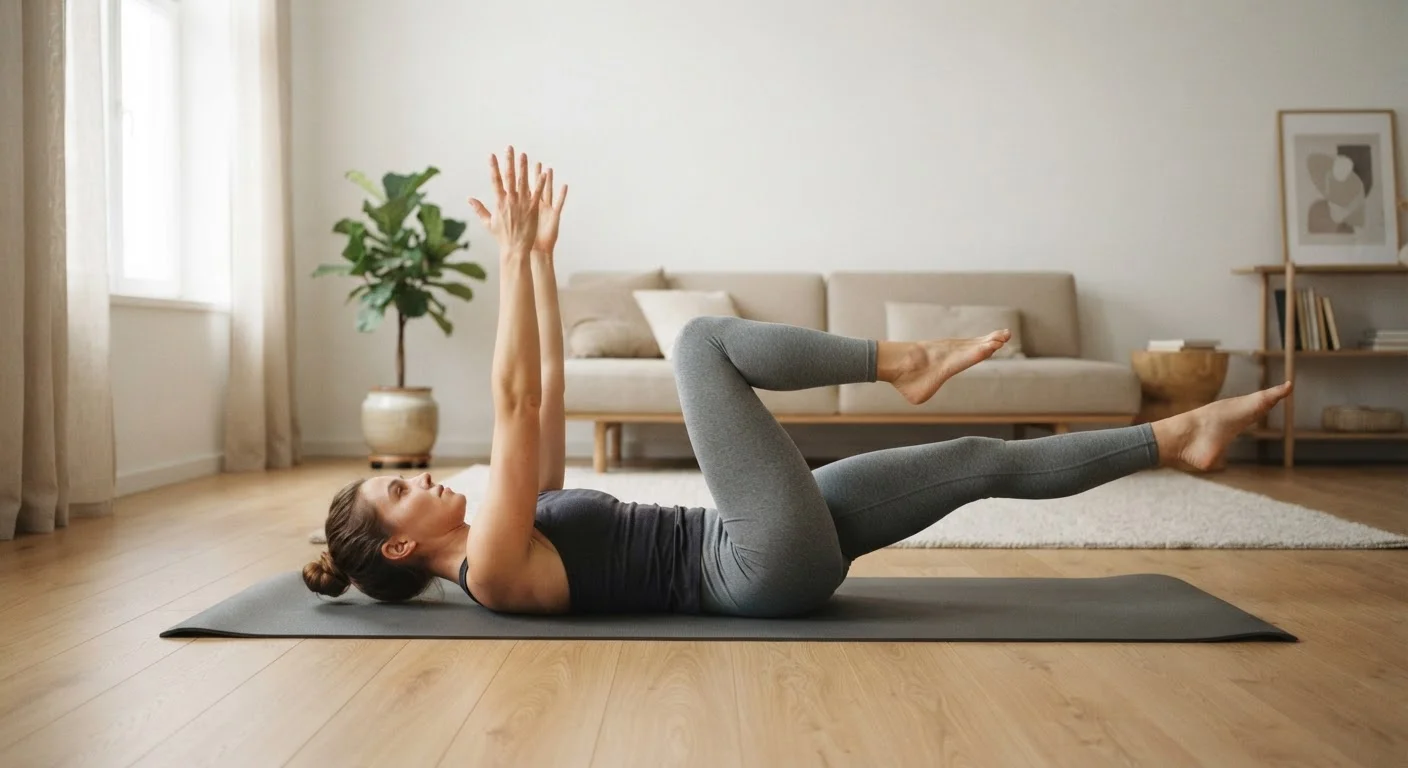
Lie on your back, arms extended toward the ceiling, knees bent at 90 degrees with shins parallel to the floor (tabletop position). Slowly extend your right arm overhead and your left leg toward the floor simultaneously - stopping before either touches down. Return to start and alternate sides. The goal is to resist any rotation or arching in your lower back throughout. Begin with 5 repetitions per side.
Bird Dog - from hands and knees
Start on all fours with wrists under shoulders and knees under hips. Engage your core gently before moving. Extend your right arm forward and your left leg back until both are roughly parallel to the floor, hold for 2-3 seconds, then return with control. Alternate sides for 5-8 repetitions each. Keep your hips level - avoid rotating the pelvis to lift the leg higher.
Modified Plank or Forearm Plank
Place forearms on the floor with elbows under shoulders. Either hold a full plank position (toes and forearms) or drop to your knees for a modified version. Your body should form a straight line from head to tailbone (or knees). Brace gently as if anticipating a light tap to the stomach, and hold for 10-20 seconds to start. Rest and repeat 2-3 times. Gradually increase duration as control improves over days and weeks.
Glute Bridge - integrating the posterior chain
Lie on your back, knees bent, feet flat and hip-width apart. Press through your heels and lift your hips toward the ceiling until your body forms a straight line from knees to shoulders. Squeeze your glutes at the top, hold for 2 seconds, and lower with control. Perform 8-10 repetitions. The glutes, hamstrings, and lower back are integral parts of the core system - training them together builds the functional stability that daily movement demands.
Quality Beats Quantity Every Time
Five slow, controlled repetitions of a dead bug outperform twenty rushed ones. Prioritize maintaining a neutral spine and deliberate muscle engagement over hitting a specific rep count. Progress is measured by how well you move, not how many times you move.
Avoid Holding Your Breath
Many people unconsciously hold their breath during core exercises, which increases intra-abdominal pressure and can strain the spine. Focus on steady, rhythmic breathing throughout each movement. If you cannot breathe normally during an exercise, reduce the difficulty or range of motion.
Making This a Lasting Habit
A single session of floor core work won't transform your stability, but a consistent practice over weeks can yield meaningful improvements in posture, movement quality, and comfort during daily tasks. Aim to perform this routine two to three times per week, allowing at least one rest day between sessions for muscular recovery.
Pairing core work with other home-based movement - such as the approaches outlined in our guide on no-equipment cardio - creates a more complete fitness picture without adding complexity or expense. For practical strategies to make any home exercise routine stick long term, the principles in building a home workout habit are worth reviewing.
Progress in core training tends to be gradual and not always visible. A useful benchmark is whether everyday activities - carrying groceries, sitting for extended periods, or getting up from the floor - feel more stable and less effortful over time.
This article is for general informational and educational purposes only and does not constitute medical advice. Always consult a qualified healthcare professional before beginning a new exercise program, particularly if you have any existing health conditions or injury history.