

Key Takeaways
Why Small Spaces Are More Than Workable
The belief that meaningful fitness requires a dedicated gym, a garage, or at minimum a spare room is one of the most common barriers stopping people from exercising consistently. Research on physical activity consistently shows that accumulated movement - even in short bouts - contributes to cardiovascular health, muscular strength, and mental wellbeing. Space is far less of a limiting factor than habit and method.
Studio apartments, shared bedrooms, and basement rooms all share a defining constraint: limited floor area. But the human body is its own resistance system. Bodyweight training, long studied and applied in contexts ranging from military conditioning to physical therapy, requires no footprint beyond the person performing it. The challenge is primarily logistical - knowing which movements fit the space and how to organize a session that stays sustainable.
If you're also navigating a smaller home more broadly, downsizing without the stress addresses the spatial trade-offs that affect every room, including how you might reconfigure your living area for multi-purpose use.
What you will need
Step-by-Step: Setting Up and Getting Moving
Audit and clear your available floor space
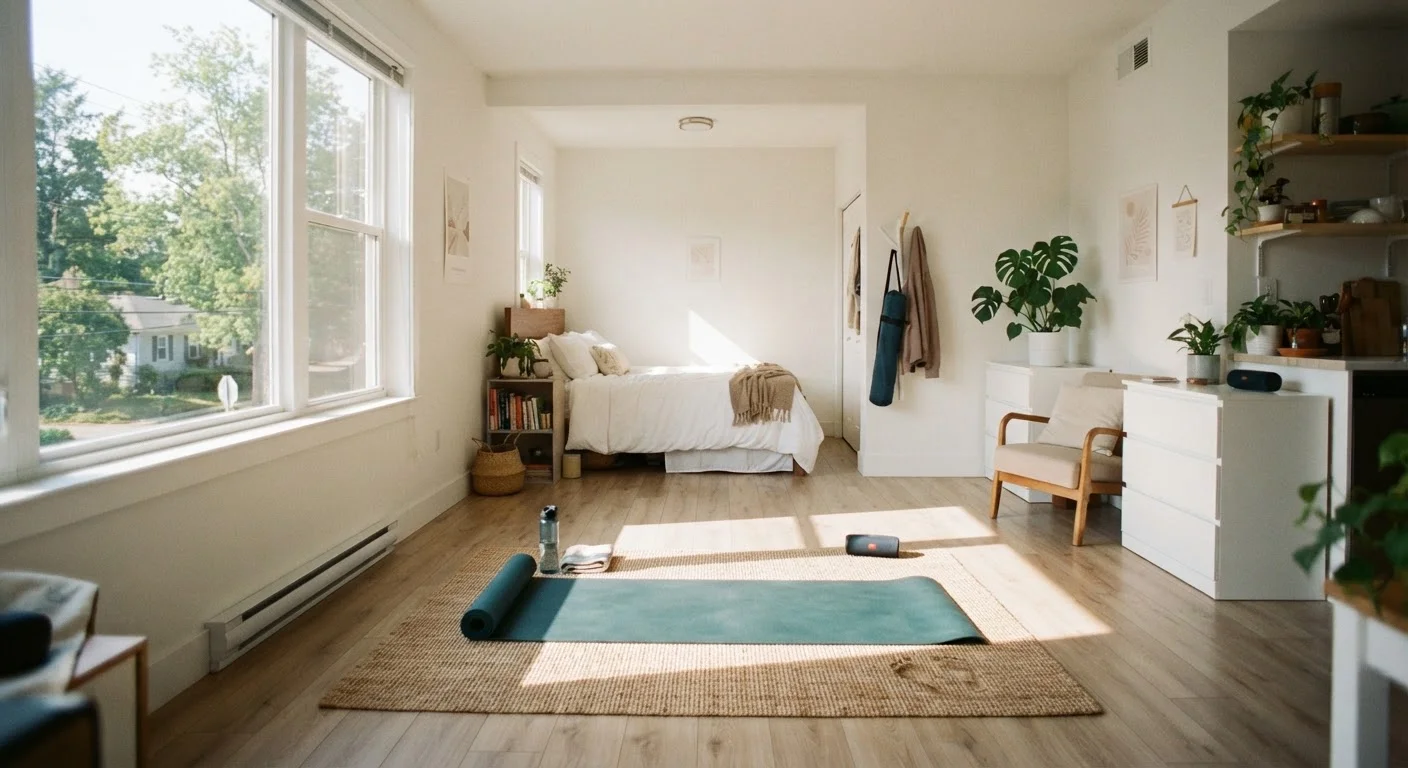
Walk through your space and identify the largest unobstructed area - often near a bed, sofa, or kitchen table. Measure it loosely: you need room to lie flat, stand with arms extended, and step sideways without hitting furniture. Even 5 ft × 4 ft is workable for most bodyweight movements.
Temporarily slide light furniture (chairs, small tables, ottomans) toward walls during workout sessions. Returning items after each session takes under two minutes and keeps your home livable the rest of the day.
Choose low-impact movement patterns suited to a small footprint
High-impact exercises like jumping jacks or box jumps can disturb neighbors and stress joints on hard floors. Instead, prioritize movements that stay in one place: squats, lunges (stationary or reverse), push-up variations, plank holds, glute bridges, and standing core work. These deliver significant muscular and cardiovascular benefit without lateral travel or heavy landing forces.
For cardio, marching in place, slow mountain climbers, and step-touch patterns raise heart rate effectively within a single floor tile's worth of space. See no-equipment cardio options for a fuller range of low-gear movements.
Structure a short, repeatable session format
A practical small-space session doesn't need to be long to be effective. A simple framework: 3-5 minutes of dynamic warm-up (arm circles, leg swings, hip rotations), 15-20 minutes of circuit work (3-4 exercises rotated with brief rest), and 3-5 minutes of static stretching to close. That's under 30 minutes total.
Rotate between lower-body emphasis days (squats, lunges, bridges), upper-body emphasis (push-ups, dips off a chair, plank variations), and full-body or core-focused sessions. This prevents monotony and ensures balanced muscle development. For stretching guidance, static vs. dynamic stretching explains when and how to apply each method.
Use walls, a sturdy chair, and your own bodyweight as equipment
Walls are underrated fitness tools. Wall sits build lower-body endurance; a wall provides balance support for single-leg exercises; incline push-ups against a wall reduce intensity for those building strength. A stable chair (no wheels) opens up seated core work, tricep dips, incline or decline push-up variations, and step-up movements if ceiling height and chair stability allow.
Resistance bands are optional but compact - they store flat in a drawer and can substantially expand exercise variety if you choose to add them later.
Build consistency with a realistic schedule
Three to four sessions per week of 20-25 minutes each is a realistic, evidence-supported starting point for general fitness maintenance, according to public health guidelines. Shorter, more frequent movement - even 10-minute breaks - also contributes to overall activity levels when longer sessions aren't possible.
Anchor workouts to an existing daily habit (morning coffee, lunch break, before showering) to reduce decision fatigue. Your first month of working out at home offers a beginner-friendly progression framework if you're building from scratch.
For those managing joint discomfort or reduced mobility, many of the movements described here have seated or supported modifications. Home fitness for people with joint pain or mobility limits covers low-impact adaptations in more detail - and always check with a qualified healthcare professional before beginning any new exercise program.
Think Vertically for Storage, Not Just Exercise
Keeping your living space clear for workouts is partly an organization challenge. Wall hooks, over-door storage, and vertical shelving can move everyday items off the floor permanently - freeing up workout space without the nightly furniture shuffle. For more on maximizing small rooms, vertical vs. floor storage breaks down which approach works best by room type.
Staying on Track: Progress and Troubleshooting
Plateaus in small-space training often come from doing the same movements at the same intensity repeatedly. Progress can be created without extra equipment: add repetitions, slow the tempo, reduce rest periods, or increase the difficulty of a variation (standard squat → single-leg squat progression, for example). Fitness metrics worth tracking at home can help you identify which signals actually reflect progress rather than noise.
Core training is a particularly space-efficient focus. Floor-based exercises like dead bugs, bird dogs, and side-lying hip work require minimal space and build the foundational stability that supports every other movement. For a structured approach, see core strength without crunches.
Noise and neighbor concerns are real in shared buildings. Avoiding hard landings, using a mat to dampen floor contact, and scheduling sessions during reasonable daytime hours are practical courtesies that keep your routine sustainable long-term.
This article is for general informational and educational purposes only and does not constitute medical or fitness advice. Consult a qualified healthcare professional before beginning any new exercise program, particularly if you have existing health conditions, injuries, or concerns.