

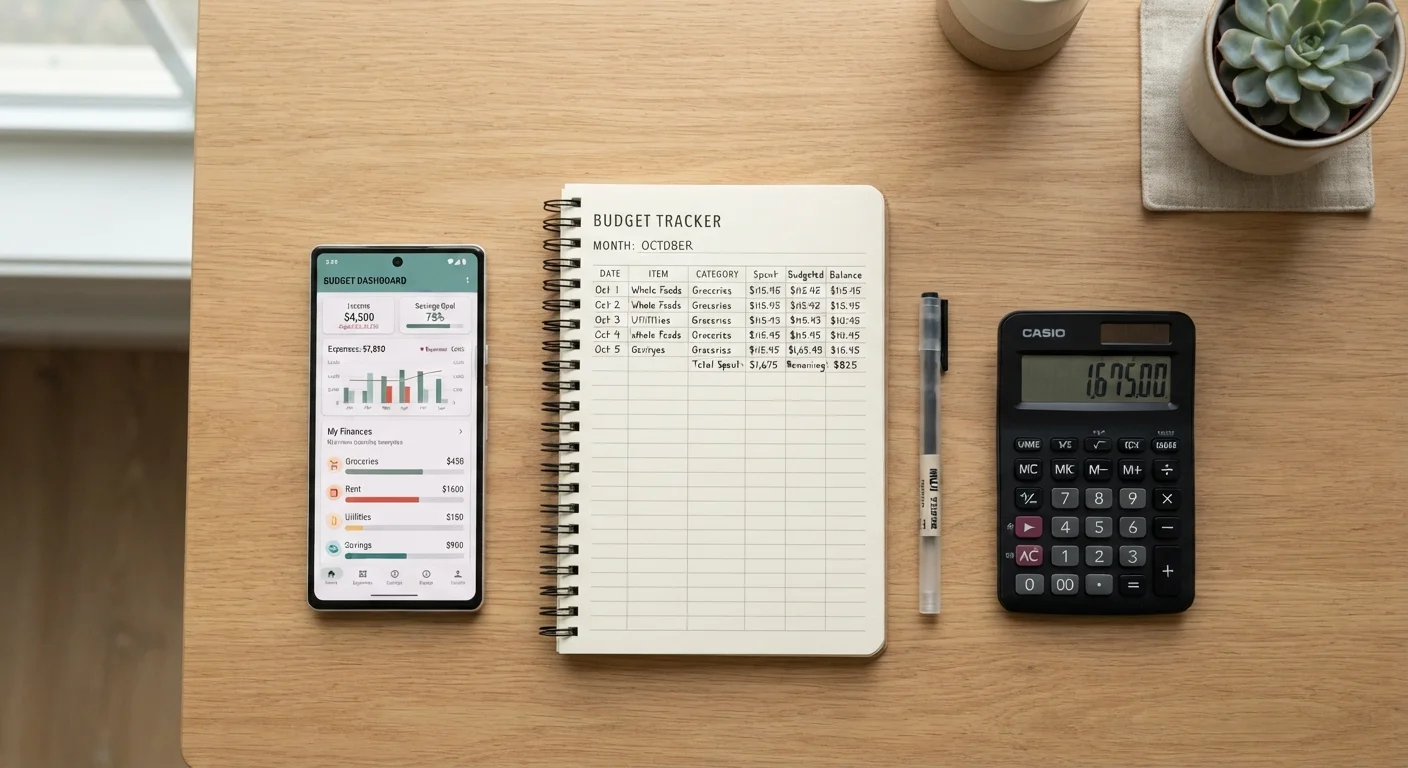
Key Takeaways
Automatic transaction import reduces manual data entry
Most apps sync with bank and card accounts, pulling in transactions in real time. This removes the most common reason people stop tracking - the tedium of entering every purchase manually.
Aggregate view across all accounts in one place
Seeing checking, savings, and credit balances together helps identify patterns that are invisible when reviewing one account at a time. It can make total debt or total cash flow immediately legible.
Alerts and reports surface problems early
Category overspending alerts can prompt course correction before the end of the month. Automated monthly summaries also make year-over-year comparisons easier without manual spreadsheet work.
Accessible anywhere via smartphone
Being able to check your budget at the point of purchase - before making a decision - is a real behavioral advantage that pen-and-paper methods can't replicate as quickly.
Requires sharing financial account credentials
Most apps access your accounts through data aggregation services. This involves granting a third party access to sensitive financial login information, raising legitimate security and privacy questions.
Automatic categorization reduces active engagement
When spending is categorized and summarized without user input, it's easy to passively review numbers without genuinely processing them. Passive awareness rarely changes spending habits.
Subscription fees add up over time
Many capable budgeting apps carry monthly or annual fees. For a household already stretching a tight budget, paying for a budgeting tool is a cost worth weighing against the actual benefit delivered.
App discontinuation can disrupt your system
Budgeting apps are commercial products that can be acquired, pivoted, or shut down. Building a long-term financial habit on a platform you don't control carries continuity risk.
Our Verdict
Budgeting apps suit people who want automation, real-time visibility, and don't mind sharing financial account access with a third-party platform. Manual methods work best for those who find that writing things down creates genuine accountability and prefer to keep their financial data offline. Neither approach is superior - the one you'll actually stick with is the right one.
Anyone who is ready to commit to tracking spending consistently, regardless of which format feels more natural to them.
Why the Tool You Choose Actually Matters
Most budgeting advice skips straight to spreadsheet templates or app recommendations without acknowledging a fundamental truth: the tool that works is the one you use. If a polished app sits unopened on your phone or a notebook goes blank after week two, neither has done its job.
The choice between digital and manual budgeting isn't just about convenience. It touches on data privacy, the psychology of spending, time investment, and how you process financial information. Understanding the real trade-offs helps you choose intentionally rather than by default.
For a broader framework on building a budget from scratch, see our complete guide to household budgeting.
Budgeting Apps: The Case For and Against
Digital budgeting tools have grown significantly in capability. Many connect directly to bank and credit card accounts, categorize transactions automatically, and send alerts when spending in a category runs high.
Automatic transaction import reduces manual data entry
Most apps sync with bank and card accounts, pulling in transactions in real time. This removes the most common reason people stop tracking - the tedium of entering every purchase manually.
Aggregate view across all accounts in one place
Seeing checking, savings, and credit balances together helps identify patterns that are invisible when reviewing one account at a time. It can make total debt or total cash flow immediately legible.
Alerts and reports surface problems early
Category overspending alerts can prompt course correction before the end of the month. Automated monthly summaries also make year-over-year comparisons easier without manual spreadsheet work.
Accessible anywhere via smartphone
Being able to check your budget at the point of purchase - before making a decision - is a real behavioral advantage that pen-and-paper methods can't replicate as quickly.
The automation is the biggest draw. Manual data entry is one of the most common reasons people abandon budgets, and apps largely eliminate it. Aggregate views - seeing all accounts in one dashboard - can also surface patterns that are hard to spot when reviewing statements one at a time.
That said, the cons are real and often underappreciated.
Requires sharing financial account credentials
Most apps access your accounts through data aggregation services. This involves granting a third party access to sensitive financial login information, raising legitimate security and privacy questions.
Automatic categorization reduces active engagement
When spending is categorized and summarized without user input, it's easy to passively review numbers without genuinely processing them. Passive awareness rarely changes spending habits.
Subscription fees add up over time
Many capable budgeting apps carry monthly or annual fees. For a household already stretching a tight budget, paying for a budgeting tool is a cost worth weighing against the actual benefit delivered.
App discontinuation can disrupt your system
Budgeting apps are commercial products that can be acquired, pivoted, or shut down. Building a long-term financial habit on a platform you don't control carries continuity risk.
The most significant concern for many users is data access. Connecting a budgeting app to financial accounts typically requires sharing login credentials or granting access via a data aggregation service. Understanding how that data is stored, shared, and protected takes time most people don't spend upfront.
There's also a cognitive trade-off. When categorization is automatic, many users lose active engagement with their numbers. Passive reviewing is not the same as active awareness - and awareness is the mechanism through which budgets actually change behavior.
Pen-and-Paper Budgeting: What You Gain and What It Costs You
Manual budgeting - whether in a notebook, on a printed template, or with index cards - has been the default approach for most of recorded personal finance history. Its staying power isn't nostalgia; it's rooted in how humans learn and retain information.
Research in cognitive science consistently suggests that writing by hand engages memory and processing differently than typing or reading a screen. Applied to budgeting, this means that physically recording a transaction may make the amount feel more real than watching it appear in a feed.
When Privacy Is a Priority
If you're uncomfortable granting a third-party app access to your bank accounts, you don't have to. A manual spreadsheet or notebook captures the same information without any external data sharing. Some people use app features that allow manual-only entry as a middle ground - no account linking, but still digital organization. Verify how any tool you consider handles and stores your data before connecting sensitive accounts.
Manual tracking also pairs naturally with cash-based methods. If you're exploring the envelope system, a written budget log is a natural companion - you're already handling physical money, so written records feel consistent rather than burdensome.
The obvious downside is time. Logging every transaction manually takes discipline, and it scales poorly for households with high transaction volume or multiple income sources. Errors are also harder to catch without automatic reconciliation against bank statements.
Making a Practical Decision
Rather than treating this as an either/or choice, consider what each format does well and where your own habits tend to break down.
If you've tried apps before and found yourself passively scrolling a dashboard without changing any behavior, a notebook may force the engagement you're missing. If you've started manual budgets but abandoned them after missing a few days of entries, an app's automatic import might be the continuity mechanism you need.
~1 in 3
Americans who follow a formal budget
Gallup polling has consistently found that a minority of U.S. adults report budgeting in a structured way, suggesting tool friction is a real barrier regardless of format.
68%
People who feel more in control writing things down
A widely cited survey by the American Psychological Association found that people who write goals and plans by hand report higher feelings of personal control, a finding with plausible application to financial tracking.
A hybrid approach is worth considering: use an app to capture and categorize transactions automatically, then review and transcribe key weekly totals into a notebook. You get the automation without losing the reflective step. This is more work but has the benefit of both accuracy and engagement.
Whatever you choose, the structure of your budget matters as much as the medium. Our overview of popular budgeting frameworks walks through how different allocation methods - 50/30/20, zero-based, and pay-yourself-first - fit different income patterns and lifestyles.
This article is for general informational purposes only and does not constitute personalized financial advice. For guidance specific to your situation, consider consulting a qualified financial professional.