

Key Takeaways
Option A
Zero-Based Budgeting (ZBB)
The meticulous, income-first planning system.
Best for: People with predictable income who want granular control over every spending category.
Option B
Envelope Budgeting
The tactile, cash-driven spending guardrail.
Best for: People who overspend on impulse categories and want a physical, hard-stop mechanism.
If you have a steady paycheck and want complete visibility into every spending decision
Zero-Based Budgeting (ZBB)
ZBB's category-by-category planning gives salaried earners a precise map of where money flows, making it easier to find and close spending gaps.
If you consistently overspend on groceries, dining, or entertainment
Envelope Budgeting
The physical cash limit creates a hard stop that digital notifications rarely replicate - when the envelope is empty, spending in that category stops.
If your income varies month to month from freelance or gig work
Envelope Budgeting
Envelopes can be funded proportionally from each paycheck, making the system more flexible when income amounts aren't predictable in advance.
If you prefer managing finances digitally without handling physical cash
Zero-Based Budgeting (ZBB)
ZBB translates naturally into spreadsheets and budgeting software, while envelope budgeting's cash-handling requirement can feel impractical in a digital-payment world.
If you're new to budgeting and want a simple concept to start with
Envelope Budgeting
Labeled envelopes make spending limits concrete and tangible - an intuitive entry point that doesn't require mastering financial software.
How Each Method Actually Works
Despite sharing the same end goal - spending less than you earn - zero-based budgeting and envelope budgeting operate through entirely different mechanics.
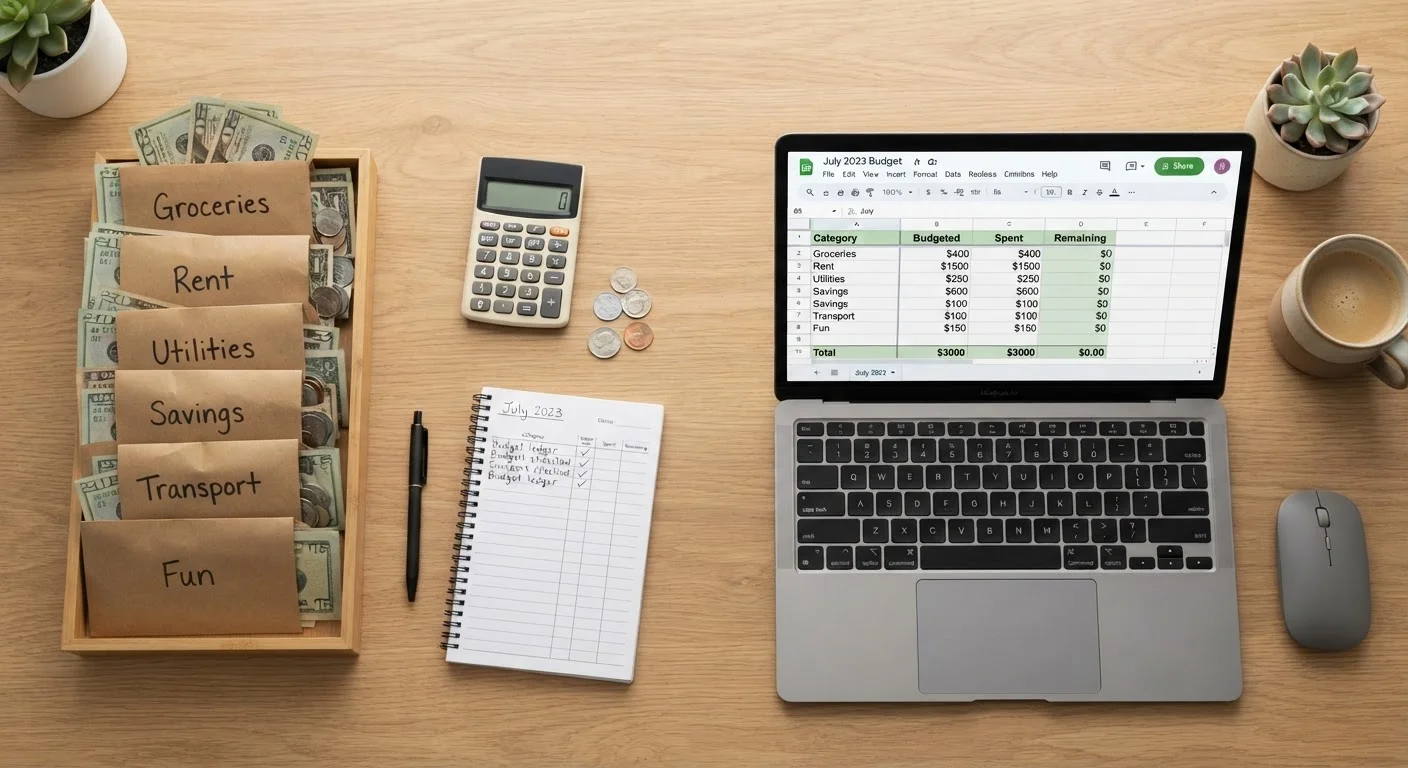
Zero-based budgeting starts with your total monthly income and systematically assigns every dollar to a named category: rent, groceries, car insurance, savings, and so on. The process continues until income minus all category allocations equals zero. That zero doesn't mean you've spent everything - it means every dollar has a designated job, including dollars earmarked for savings or debt paydown. If you earn $3,800 a month, your category totals must add up to exactly $3,800.
Envelope budgeting takes a more physical approach. At the start of the month, you withdraw cash and distribute it into labeled envelopes - one for groceries, one for gas, one for entertainment, and so on. When a given envelope runs out, spending in that category stops for the month. There's no borrowing across envelopes without a conscious, deliberate decision.
The structural difference matters: ZBB is a planning system that tracks allocations on paper or screen, while envelope budgeting is an enforcement system that uses physical scarcity as its control mechanism. For a broader look at how different frameworks approach these tradeoffs, see comparing popular budgeting frameworks.
| Criterion | Zero-Based Budgeting | Envelope Budgeting |
|---|---|---|
| Core mechanism | Assign every income dollar to a category | Physically separate cash into labeled envelopes |
| Tracking method | Spreadsheet or budgeting app | Physical cash or digital sub-accounts |
| Spending enforcement | Self-reported; relies on discipline | Hard stop when envelope is empty |
| Works well with digital payments | Yes - easily integrated | Requires workarounds for non-cash spending |
| Best income type | Steady, predictable income | Variable or irregular income |
| Setup time | Moderate to high each month | Low once categories are established |
| Learning curve | Moderate - requires category planning | Low - concept is immediately intuitive |
| Visibility into total finances | High - whole budget mapped at once | Moderate - category-level only |
Where Each Method Runs Into Trouble
Both approaches have real-world friction points that can derail even motivated budgeters.
Zero-based budgeting's biggest challenge is the upfront time investment. Building a complete category list, estimating realistic spending limits, and reconciling actual spending against allocations each month requires consistent effort. If you skip a month of tracking, the system loses its integrity quickly. It also assumes you can forecast irregular expenses - car repairs, medical bills, seasonal costs - accurately enough to pre-assign them. Underestimating these categories is one of the most common ZBB failure points.
Envelope budgeting's friction is mostly logistical. Carrying and managing physical cash has become increasingly awkward in a world dominated by debit cards, online subscriptions, and digital payments. Paying a utility bill or streaming service from a paper envelope simply doesn't work. Many people adapt by using separate checking accounts or digital sub-account tools to replicate the envelope concept - which adds administrative layers. For an honest evaluation of digital versus manual tracking trade-offs, explore how budgeting apps compare to pen-and-paper methods.
~33%
Americans who follow a formal monthly budget
Gallup polling has consistently found that fewer than one in three U.S. adults maintain a detailed household budget, suggesting most people rely on informal spending judgment.
$1,000+
Typical monthly discretionary spending gap
Consumer finance research broadly suggests households often underestimate discretionary spending by several hundred to over a thousand dollars monthly before implementing structured tracking.
Variable-income households face additional stress with ZBB specifically, because you can't assign dollars you haven't yet earned. Envelope budgeting's fund-as-you-earn structure often works better for gig workers or freelancers navigating fluctuating paychecks.
This article is for general informational and educational purposes only and does not constitute personalized financial advice. Consider consulting a qualified financial professional for guidance tailored to your specific circumstances.
Choosing Based on Your Habits, Not Just Your Goals
The most sophisticated budgeting method in the world fails if you don't use it consistently. That makes behavioral fit just as important as structural logic.
Ask yourself two questions. First: Where does my money leak? If you genuinely don't know where hundreds of dollars disappear each month, ZBB's category-by-category accounting will surface those leaks quickly. If you know exactly where the problem is - say, grocery runs that balloon past $600 - envelope budgeting's hard cap on that specific category may be all you need.
Second: How do I respond to abstract limits versus physical ones? Some people can look at a spreadsheet showing $47 left in their dining budget and genuinely modify behavior. Others need the physical reality of an empty envelope to stop spending. Neither response is wrong - they reflect how your brain processes financial feedback.
It's also worth remembering that budgeting systems aren't permanent commitments. Many households start with envelope budgeting to build the habit of category awareness, then graduate to ZBB once they're comfortable assigning and tracking allocations digitally. Comparing pay-yourself-first and traditional budgeting can also clarify whether a savings-first or expense-first structure fits your household better. And regardless of which method you choose, a paired emergency fund keeps unexpected costs from blowing up your monthly plan - see how emergency funds and budgets work together for a practical breakdown of that relationship.