

Key Takeaways
Automatic Transfer
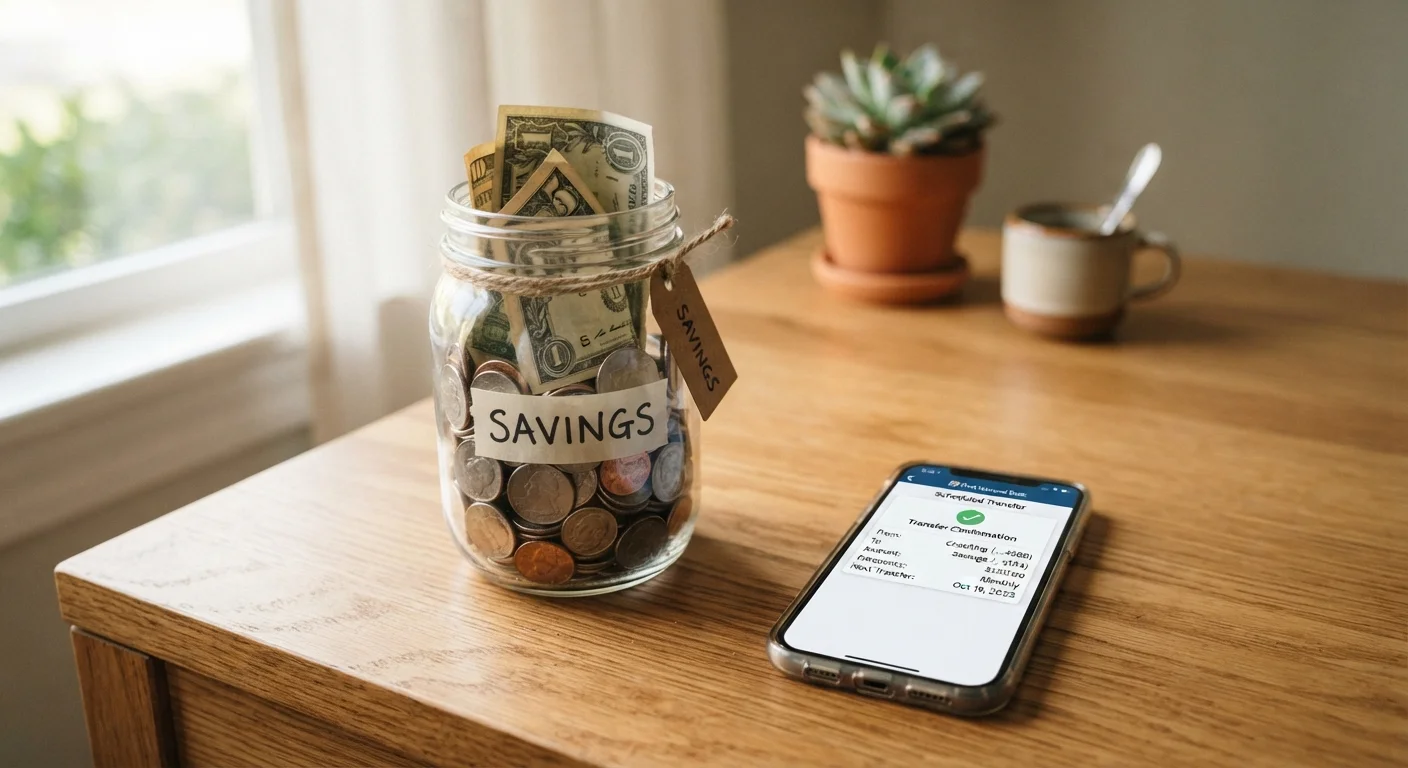
An automatic transfer is a scheduled, recurring movement of money between two accounts - typically from a checking account to a savings account - that happens without any manual action from you. You set the amount and frequency once, and your bank or credit union executes it on a fixed schedule. The core idea is that money you never see in your spending account is money you're far less likely to spend.
Automatic transfers are distinct from direct deposit splits, though both achieve a similar result. Some employers allow payroll to be split across multiple accounts at the source, bypassing the checking account entirely - this is sometimes called 'pay yourself first' at the payroll level.
Why Most People Struggle to Save Manually
Saving money by deciding each month how much to set aside sounds reasonable in theory. In practice, it rarely works. Competing expenses always feel more urgent - a car repair, a higher utility bill, an unexpected grocery run. By the time those are covered, the savings intention has evaporated.
Behavioral economics research consistently shows that people default to spending available balances. Willpower is a finite resource, and relying on it for routine financial decisions creates a losing setup. The solution isn't more discipline - it's removing the decision entirely.
Automatic transfers do exactly that. They shift the default from spending to saving. Instead of consciously choosing to move money into savings each pay period, the system does it for you. This is the structural reason consistent savers tend to automate: it's not that they have stronger willpower, it's that they've designed around the need for it.
See why small deprivations often don't move the needle - the real gains come from structural habits, not individual sacrifices.
How Automatic Transfers Actually Work
Setting up an automatic transfer typically takes less than five minutes through your bank's online portal or mobile app. You choose a source account, a destination account, a dollar amount, and a recurring schedule. Most banks support weekly, biweekly, or monthly intervals.
The most effective scheduling strategy is to align the transfer date with your pay deposit date - ideally the same day or the following business day. This captures the money before it integrates into your spending mental model. Money that arrives in a savings account before you've budgeted around it is psychologically easier to leave untouched.
Align Your Transfer Date With Payday
Schedule your automatic transfer for the same day your paycheck deposits - or the next business day at the latest. This captures the money before your brain has absorbed it into your spending budget. Transfers set for mid-month or end-of-month are far more likely to get mentally redirected to covering bills or discretionary spending.
Destination matters too. A savings account at the same institution as your checking account is convenient but may carry a lower interest rate than alternatives. Once you've established the automatic transfer habit, consider whether a high-yield savings account would put that saved money to better work.
For those building a broader savings routine, pairing automatic transfers with a month-by-month savings calendar can help you anticipate large annual expenses and adjust transfer amounts accordingly.
The Compounding Effect of Consistency Over Size
A common misconception is that automatic transfers are only meaningful at large dollar amounts. In reality, the behavioral and financial value comes from consistency, not size.
57%
Americans without $1,000 in emergency savings
According to Bankrate's annual emergency savings survey, a majority of U.S. adults would struggle to cover a $1,000 unexpected expense from savings alone.
$1,300
Annual savings from $50 biweekly transfers
A $50 automatic transfer every two weeks, sustained for 12 months, results in $1,300 saved - without any additional decision-making after initial setup.
3x
Higher savings rate among those who automate
Research in behavioral economics, including work associated with Richard Thaler's 'Save More Tomorrow' program, has found that defaulting workers into savings plans dramatically increases participation and contribution rates compared to opt-in approaches.
Consider two people. One transfers $200 to savings in a month when they remember and feel motivated - but skips the next three months. Another transfers $50 every two weeks without exception. Over a year, the second person has moved $1,300 into savings, built a reinforced habit, and avoided the pattern of starting over. The first person may have moved less total, with more internal friction.
Small transfers also carry a lower psychological cost to initiate. The hardest part of saving is often starting. A $25 automatic transfer is easy to greenlight mentally. A $200 manual transfer feels heavier. Start with whatever amount you can commit to without hesitation, and revisit the amount every few months as your income or fixed expenses shift.
This principle connects to foundational budgeting habits: small, repeatable actions are more sustainable than sporadic large ones, and sustainability is what builds actual financial security over time.
Practical Setup Considerations
Before scheduling a transfer, review your typical monthly cash flow to identify a safe amount - one that won't cause your checking account to dip below any minimum balance requirements or trigger overdraft fees. It's better to start conservatively and increase than to overdraw and lose trust in the system.
If your income is irregular, a percentage-based approach tends to work better than a fixed dollar amount. Some financial apps support rules like "transfer 10% of any deposit over $500." If your bank doesn't offer this natively, manually initiating a transfer immediately after each income deposit can serve the same function.
Shoppers who already use coupons and cashback strategies can treat those earned amounts as bonus transfer candidates. If your grocery run saved you $18 in cashback, transferring that $18 the same day locks in the actual saving rather than letting it diffuse back into general spending. See how to build a savings system around coupons and cashback for a repeatable structure that pairs well with automatic transfers.
For households managing a fixed income, the discipline of automatic transfers becomes even more critical. Smart shopping on a fixed income starts with making sure every dollar has a pre-assigned role - automatic transfers formalize that assignment for the savings portion.
This article is for general informational purposes only and does not constitute personalized financial advice. Consult a qualified financial professional for guidance tailored to your specific situation.