

Key Takeaways
Start here
Why a Fixed Income Demands a Different Shopping Mindset
Next
Know What You're Working With Before You Shop
Then
The Spend-or-Wait Decision Framework
Build habits
Low-Effort Habits That Compound Over Time
Keep going
Where to Go From Here
Why a Fixed Income Demands a Different Shopping Mindset
When income is variable, a spending mistake can sometimes be absorbed by next month's extra hours or a bonus. On a fixed income, that recovery mechanism does not exist. Every dollar committed to one category is unavailable for every other. That constraint is not a problem to solve emotionally - it is a math reality to work with practically.
The shopping habits that work for variable-income households - browsing, impulse buying, stocking up speculatively - create real risk when the monthly ceiling is firm. What replaces them is a simple system: know your ceiling, categorize what you need, and decide when and how to spend before you are standing in a store or scrolling a product page.
This guide walks through that system from the ground up. No complex spreadsheets required at the start - just a clear framework and a few habits that work regardless of income level.
Fixed income
A predictable, capped income that arrives in the same amount each period - such as Social Security, a pension, or disability payments - with no variable upside.
Discretionary ceiling
The amount of money left after all fixed obligations are paid. This is the only pool available for day-to-day spending decisions.
Impulse purchase
An unplanned buy made in the moment without checking whether it fits the budget or serves a genuine need.
Price cycle
The predictable seasonal pattern in which certain product categories go on sale - such as appliances in late fall or linens in January - based on retail calendars.
Pantry-first shopping
The habit of checking existing supplies before making a shopping list, so you buy only what you actually need rather than duplicating items you already own.
Mental accounting
Tracking spending in your head rather than on paper or in an app. Research consistently shows this method underestimates what is actually being spent.
Know What You're Working With Before You Shop
Before any shopping strategy makes sense, you need one number: your actual monthly take-home income. Not gross, not approximate - the dollar amount that lands in your account or arrives by check each month. From that number, subtract fixed obligations: rent or mortgage, utilities, insurance premiums, any required loan payments. What remains is your discretionary ceiling - the only pool of money available for food, household goods, personal care, and everything else.
If you have not mapped this yet, start with tracking your spending for one month before changing anything else. The data almost always reveals at least one spending category that has quietly grown larger than expected.
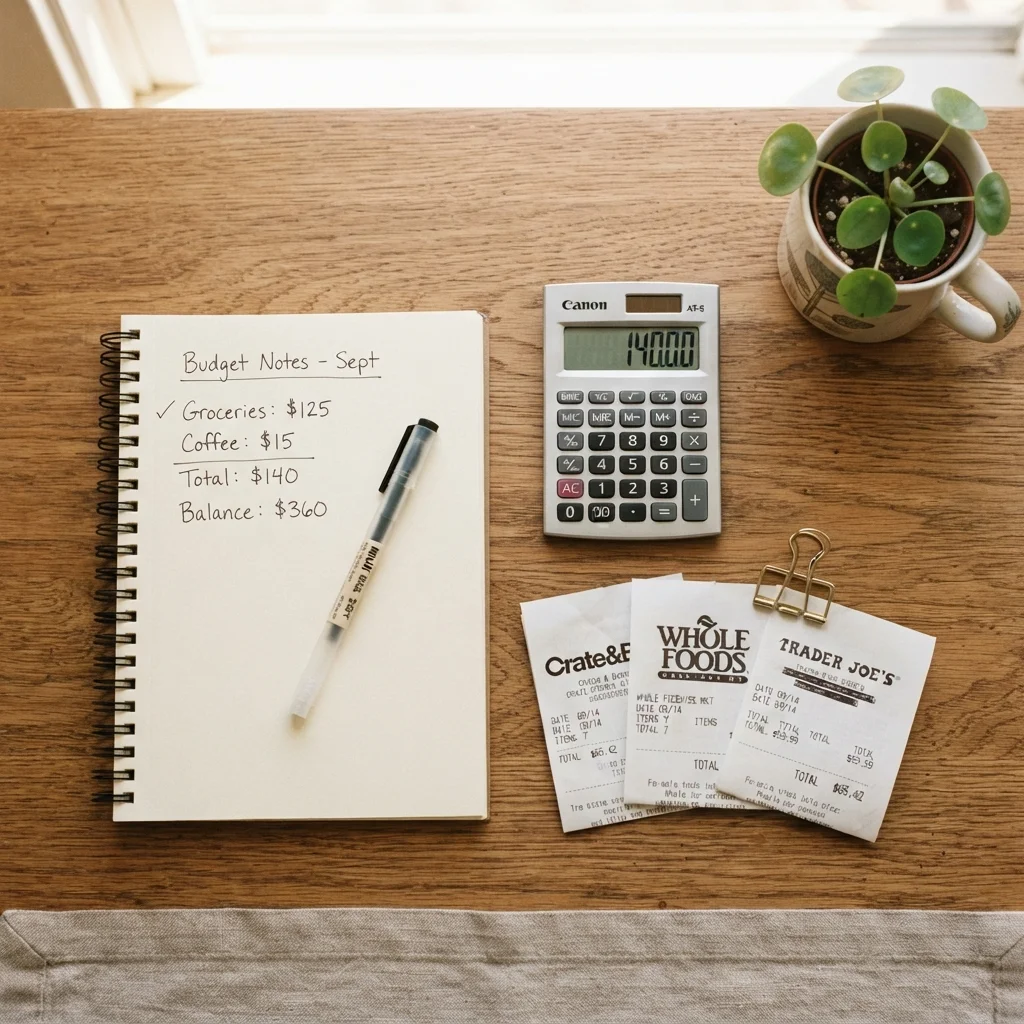
Once you know your discretionary ceiling, divide it loosely into categories - groceries, household supplies, personal care, transportation, and a small buffer for the unexpected. Written categories, even rough ones, are more reliable than mental accounting. The envelope method is one time-tested way to make these divisions concrete without needing any software.
The Spend-or-Wait Decision Framework
Most overspending on a fixed income is not reckless - it is reactive. Something breaks, a sale appears, or a need feels urgent. A simple decision framework slows that reaction down enough to make a deliberate choice.
Step one: categorize the purchase. The need vs. want vs. nice-to-have framework is a useful starting structure. A need is something that affects health, safety, or the ability to function day to day. A want improves comfort or quality of life. A nice-to-have is everything else.
Step two: for wants and nice-to-haves, ask whether the purchase can be timed. Many product categories - appliances, linens, clothing, automotive supplies - follow predictable seasonal discount cycles. Learning those cycles means you can plan non-urgent purchases around them rather than paying full price reactively. The guide on building a personal shopping calendar around predictable price drops lays out those windows in practical detail.
Step three: check whether you already own something that serves the same purpose. This is especially effective for grocery and household goods spending - a practice sometimes called a pantry-first approach.
Use the 48-Hour Pause Before Non-Essentials
When something that is not a genuine need lands in your cart - physical or digital - close the tab or set the item aside and revisit the decision after 48 hours. Most of the time, the urgency fades. This single habit removes a large share of impulse spending without requiring any budget math in the moment.
Low-Effort Habits That Compound Over Time
Large savings goals feel overwhelming. Small, consistent habits do not - and they produce real results over a year or more. Here are four that require almost no setup:
- List before you shop, always. A written list - grocery or otherwise - reduces unplanned purchases. It also prevents duplicate buying, which is a common source of waste on tight budgets.
- Audit before you restock. Before a grocery run, check what is already in the pantry and fridge. Pantry-first shopping consistently reduces weekly food costs for households that adopt it.
- Apply a 48-hour pause to non-essential purchases. Waiting two days before completing a non-urgent purchase eliminates a large share of impulse spending without requiring any willpower in the moment - the pause does the work.
- Review your spending weekly, not monthly. A short weekly check of what was spent against what was budgeted catches drift early, when it is easy to correct, rather than at month-end when the damage is done.
If you are starting from zero savings, building even a small emergency buffer changes the risk calculus considerably - an unexpected expense no longer has to derail the entire month's budget.
Where to Go From Here
This guide is a starting point, not a complete system. Once the basics above are in place - income mapped, categories set, a decision habit established - the next layer is category-specific strategy.
For a comprehensive look at spending less across groceries, auto supplies, home goods, and more, see budget shopping strategies that hold up across every category. If nutrition on a tight budget is a priority, eating well on a tight budget offers evidence-informed guidance grounded in practical meal planning.
The overarching principle across all of it is the same: a system beats willpower every time. You do not need to earn more to spend better - you need a process that makes the better choice the default one.
This article is for general informational and educational purposes only and does not constitute financial, legal, or professional advice. Readers facing financial hardship should consult a qualified financial counselor or appropriate social services professional for guidance specific to their situation.