

Key Takeaways
Revolving Debt
Revolving debt is a type of borrowing - most commonly credit card debt - where you can carry a balance from month to month rather than paying it off in full. You're only required to pay a small minimum each billing cycle, but interest accrues on whatever balance remains. This structure lets debt persist - and grow - for years even when you stop adding new charges.
Minimum payments are typically calculated as a percentage of the outstanding balance (often 1-3%) or a fixed dollar floor, whichever is greater. Because the required payment shrinks as the balance falls, the payoff timeline can extend dramatically.
Why the Minimum Payment Feels Safe (But Isn't)
Credit card companies are required to set a minimum payment low enough that you can almost always afford it. That's intentional - a manageable minimum keeps you current, avoids penalties, and protects your credit record. But "current" and "making progress" are very different things.
When you carry a balance at a high interest rate, a significant portion of every payment is consumed by interest before a single dollar reduces your actual debt. The lower your payment, the more of it disappears into interest charges rather than shrinking your balance. Over time, this ratio barely changes - and the debt lingers.
This structure isn't accidental. Revolving credit is designed so that small required payments can coexist with a large, durable balance. For cardholders on tight budgets, that can feel like flexibility. In practice, it often functions as a financial anchor.
How Minimum Payments Are Calculated
Most card issuers set the minimum as a percentage of your outstanding balance - typically 1-3% - or a fixed floor (often $25-$35), whichever is greater. As your balance decreases, so does your minimum payment, which can make it feel like you're making progress. In reality, the shrinking payment often extends the payoff timeline rather than shortening it.
The Math That Works Against You
To see the real cost, consider a straightforward example. Suppose you carry a $3,000 balance on a card with a 20% annual percentage rate (APR). If your minimum payment is 2% of the balance - or a $25 floor, whichever is higher - your first payment might be around $60. That sounds manageable.
But here's what's happening underneath: at 20% APR, your monthly interest charge on $3,000 is roughly $50. So that $60 payment leaves only $10 to actually reduce your principal. The next month, your balance is $2,990 - and the cycle repeats, with your minimum payment shrinking slightly because the balance is slightly lower.
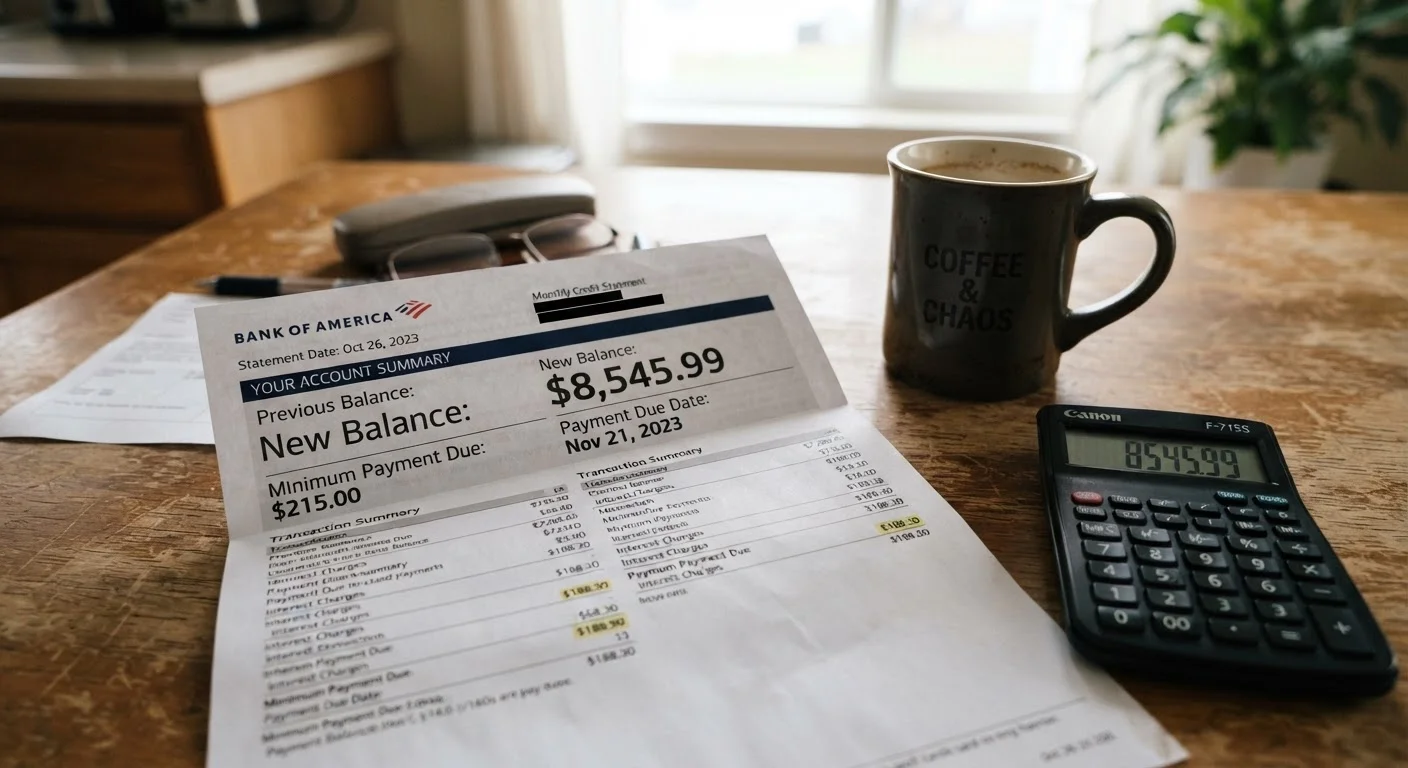
At this pace, paying off that $3,000 can take well over a decade, and the total interest paid can approach - or exceed - the original balance itself. Your monthly statement is legally required to show you this timeline. If you haven't looked at that disclosure recently, it's worth finding.
20%+
Average credit card APR in recent years
Federal Reserve data has shown average credit card interest rates consistently above 20% in recent periods, making revolving balances especially costly.
$6,000+
Average US household credit card balance
Industry surveys from sources including the Federal Reserve and major credit bureaus have estimated median revolving balances in this range for American cardholders.
10+ years
Potential payoff timeline on minimum payments only
At typical APRs and minimum payment structures, a modest four-figure balance paid at minimums only can take well over a decade to fully clear.
How Revolving Debt Competes With Saving
Every dollar directed toward interest is a dollar that cannot go toward a savings goal - an emergency fund, a car repair buffer, or a longer-term objective. For deal-seeking households already stretching a tight budget, this tradeoff is especially costly.
Consider what that monthly interest cost represents in practical terms. If you're paying $50 a month in interest on a card balance, that's $600 a year effectively gone - not building equity, not earning interest in your favor, not funding anything you chose. It's the cost of carrying the balance, and it resets every single month.
This is why minimum payments can quietly become a trap even for disciplined spenders. You don't have to add new charges for the debt to persist. The interest does the work on its own.
For a broader look at how consumer debt accumulates and what options exist at each stage, see The Full Picture of Living With Debt in America.
Small Changes That Shift the Outcome
The good news is that you don't need to pay off your entire balance at once to change the trajectory meaningfully. Paying even a fixed amount above the minimum - rather than letting the required payment shrink each month - can dramatically reduce both the total interest paid and the time to payoff.
The key shift is moving from a percentage-of-balance payment to a fixed dollar amount. If your minimum is currently $60, committing to pay $100 every month - regardless of what the statement says - redirects more money to principal each cycle and accelerates your progress.
Strategies like the debt avalanche (targeting highest-rate balances first) or the debt snowball (clearing smallest balances first for momentum) offer structured frameworks for households managing multiple accounts. See The Debt Snowball and Debt Avalanche, Explained for a breakdown of how each method works.
For households building a broader spending plan, Budgeting Basics provides practical tools for finding room to increase debt payments without sacrificing essentials. And if you're concerned about habits that may be quietly deepening your debt, Financial Moves That Make Debt Harder to Escape covers the patterns worth watching.
Check Your Statement's Payoff Disclosure
Federal regulations require credit card issuers to print a minimum-payment warning on every monthly statement, showing how long it will take to pay off your current balance paying only the minimum - and the total interest cost. Reviewing this number once is often enough to motivate a payment strategy change.
This article is for general informational and educational purposes only and does not constitute personalized financial advice. Please consult a licensed financial professional for guidance specific to your situation.