

Key Takeaways
Why the 'Untrainable Cat' Myth Persists
The idea that cats simply cannot be trained is one of the most stubborn beliefs in pet ownership. Unlike dogs, cats were not selectively bred over millennia for cooperative tasks with humans, which may explain some of the temperamental differences owners notice. But temperament is not the same as learning capacity. Cats have the same core neurological machinery for associative learning that dogs, rats, and pigeons do - and research confirms they use it.
Part of the myth's staying power is that cats train on their own terms. A cat that ignores a command isn't demonstrating an inability to learn; it's demonstrating that the reward on offer isn't compelling enough, or that the timing was off. Understanding that distinction changes everything about how owners approach the process. For a grounding in how learning actually works across species, see how pets actually learn.
Myth
Cats are too independent to be trained - they simply don't respond to instruction the way dogs do.
Fact
Cats learn through the same operant conditioning mechanisms as dogs; their training simply requires different motivators and shorter sessions.
Independence is a behavioral tendency, not a ceiling on learning. Studies in comparative animal cognition have shown that cats form clear associations between cues and outcomes when rewards are meaningful and timing is precise. A 2021 review published in Applied Animal Behaviour Science confirmed that domestic cats are capable of object-choice tasks, name recognition, and following human social cues - none of which would be possible without robust learning capacity. The difference from dogs is largely motivational, not cognitive.
Myth
Cats only do what they want - you can't use rewards to change their behavior.
Fact
Positive reinforcement reliably shapes cat behavior when the reward is something the individual cat genuinely values.
The error here is assuming all cats want the same things. Some are highly food-motivated; others prioritize play or social contact. Research on feline preference shows wide individual variation, which means a treat that works for one cat may be ignored by another. When owners identify what their specific cat finds rewarding - and deliver it consistently within one to two seconds of the desired behavior - behavioral change follows predictably. This isn't opinion; it's a direct application of reinforcement theory, which applies across virtually all vertebrate species.
Myth
Punishing a cat when it misbehaves is the most direct way to stop unwanted behavior.
Fact
Punishment is largely ineffective with cats and frequently makes behavioral problems worse.
Unlike some species, cats do not generalize well from punishment to intent. Spraying a cat with water or making a loud noise may startle it in the moment, but the cat is more likely to associate the unpleasant experience with the owner's presence than with the behavior being targeted. This can damage trust and increase stress without reducing the unwanted behavior. Veterinary behaviorists consistently recommend redirecting cats toward appropriate alternatives rather than attempting to suppress behavior through aversive means.
Myth
Training a cat takes months of effort and specialized knowledge before you see any results.
Fact
Many cats show measurable responses to basic cue training within a few consistent sessions.
Owners frequently report that a cat learns to associate a clicker or verbal marker with food within one to three short sessions. Simple behaviors - like sitting on cue or touching a target - often follow within a week of five-minute daily practice. The timeline varies by individual cat and owner consistency, but the threshold for early success is far lower than most people expect. Starting simple and keeping sessions brief dramatically improves the odds of quick progress.
Myth
If a cat already has a behavioral problem, training won't fix it - you just have to accept it.
Fact
Many common feline behavioral problems, including litter box avoidance and inter-cat aggression, respond to behavioral intervention strategies.
Behavioral modification - which uses the same learning principles as training - has an established track record with cats when applied correctly and consistently. Environmental management paired with positive reinforcement can address issues like scratching furniture, nighttime vocalization, and fear-based reactions. Complex cases benefit from guidance by a certified applied animal behaviorist or a veterinary behaviorist, particularly when anxiety or health factors are involved. Behavior problems rarely resolve on their own, but that doesn't mean they're permanent.
What Cat Training Actually Looks Like in Practice
Effective cat training doesn't require special equipment or expensive classes. It requires short sessions - typically two to five minutes - timed to when a cat is alert and mildly hungry. Most owners find success immediately before a meal, when food motivation is naturally higher.
79%
Cat owners who report skipping vet visits due to transport stress
According to American Veterinary Medical Association surveys, carrier and travel anxiety is among the most cited barriers to routine feline veterinary care.
2-5 min
Recommended training session length for cats
Animal behaviorists generally recommend keeping feline training sessions brief to maintain attention and prevent frustration on both sides.
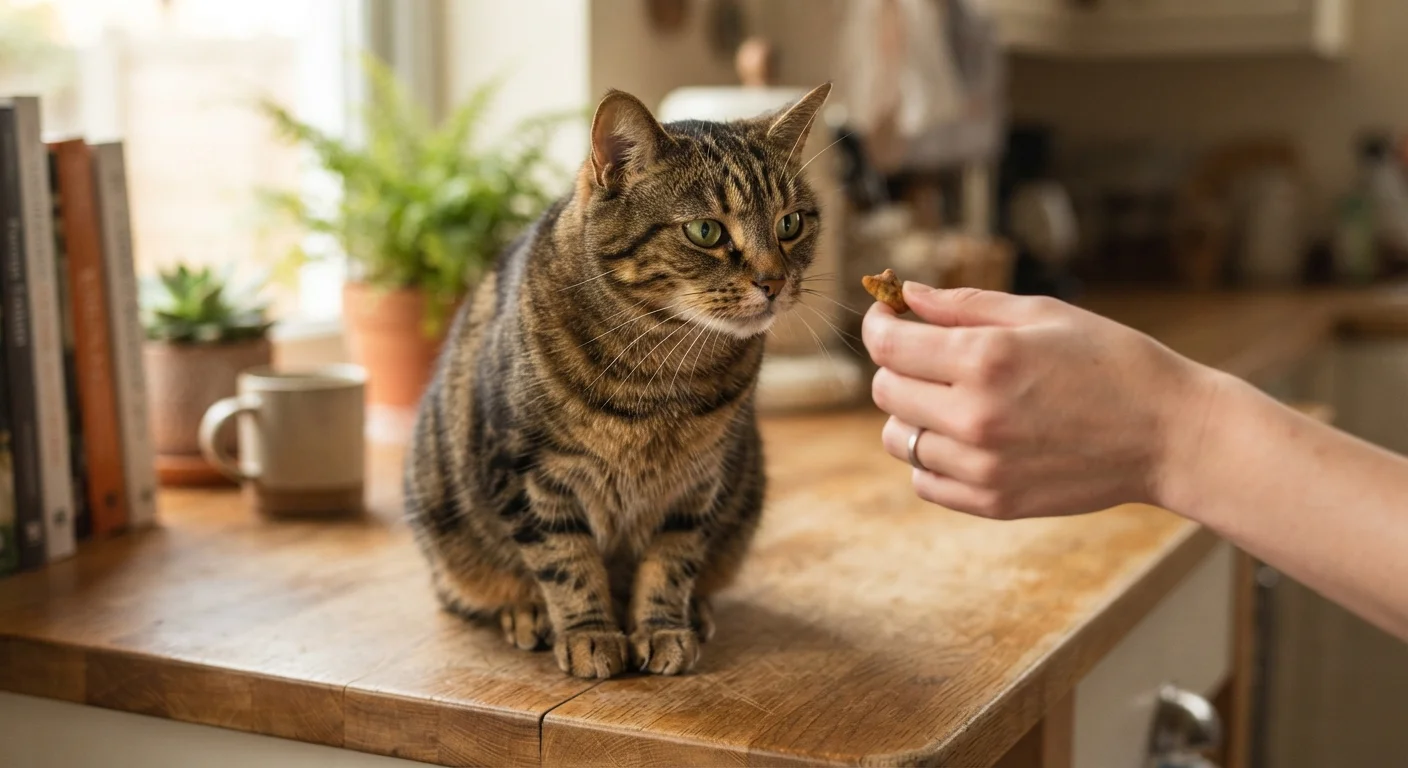
The mechanics are straightforward: pair a cue (a word, a hand gesture, or a clicker sound) with a behavior the cat already performs naturally, then deliver a reward the instant the behavior occurs. Sitting, coming when called, and touching a target with their nose are common starting points because cats do these things anyway. The training process simply attaches a predictable signal to them.
Cats that seem disinterested in food treats often respond to play rewards - a brief chase with a wand toy, for example. Some respond to verbal praise, though this tends to be individual. The key insight from behavioral research is that the reward must matter to the animal being trained, not just to the trainer. For a practical walkthrough of where to start, this beginner's training guide covers realistic first steps for new owners.
Training as a Health and Welfare Tool
Beyond sit-and-stay novelty, training serves real welfare functions for cats. Carrier training - gradually teaching a cat to enter and rest in a carrier without stress - can meaningfully reduce veterinary visit anxiety, which is one of the most commonly cited reasons owners skip routine checkups. Cats that associate handling with positive outcomes are also easier to examine and medicate at home.
Sudden Behavior Changes Need a Vet Check First
If a cat that was previously well-behaved begins eliminating outside the litter box, becoming aggressive, or withdrawing suddenly, a veterinary exam should come before any training intervention. Behavioral changes are frequently the first sign of an underlying medical condition in cats. Attempting to train around an undiagnosed health problem can delay necessary care and worsen the animal's situation.
Cognitive engagement through training also matters. Indoor cats in particular benefit from structured mental stimulation, and brief daily training sessions provide that without additional cost. This connects to broader patterns in feline health - cats and dogs have fundamentally different needs, and enrichment gaps affect them differently. The piece on cat and dog health differences covers why those distinctions matter for long-term care.
For a comprehensive look at how training fits into the full picture of pet behavior at home, this end-to-end behavior resource brings it all together.
This article is for general informational and educational purposes only. Consult a qualified veterinarian or certified animal behaviorist for guidance specific to your cat's health or behavioral needs.