

Key Takeaways
Start here
Why Training Matters From Day One
Understand the mechanics
How Pets Actually Learn
Take action
The First Commands to Teach
Build habits
Building a Consistent Routine
Avoid pitfalls
Common Mistakes First-Time Trainers Make
Keep going
Where to Go From Here
Why Training Matters From Day One
Training isn't about making your pet perform tricks. It's the foundation of a safe, low-stress relationship. A dog that understands a handful of basic cues is easier to manage at the vet, less likely to bolt out an open door, and less likely to develop the frustration-driven behaviors - destructive chewing, excessive barking - that lead owners to rehome pets.
Starting early also matters because every interaction teaches something, whether you intend it to or not. If you ignore an unwanted behavior, it may extinguish naturally. If you laugh at it or give the pet attention in response, you've likely reinforced it. That's not a moral failing - it's just how learning works, and understanding it puts you in control. See our complete overview of pet behavior and training for context on the full picture.
How Pets Actually Learn
The short version: behavior that produces a good outcome gets repeated. Behavior that produces nothing, or a mildly unpleasant outcome, fades. This principle - called operant conditioning - is the engine behind virtually all practical pet training.
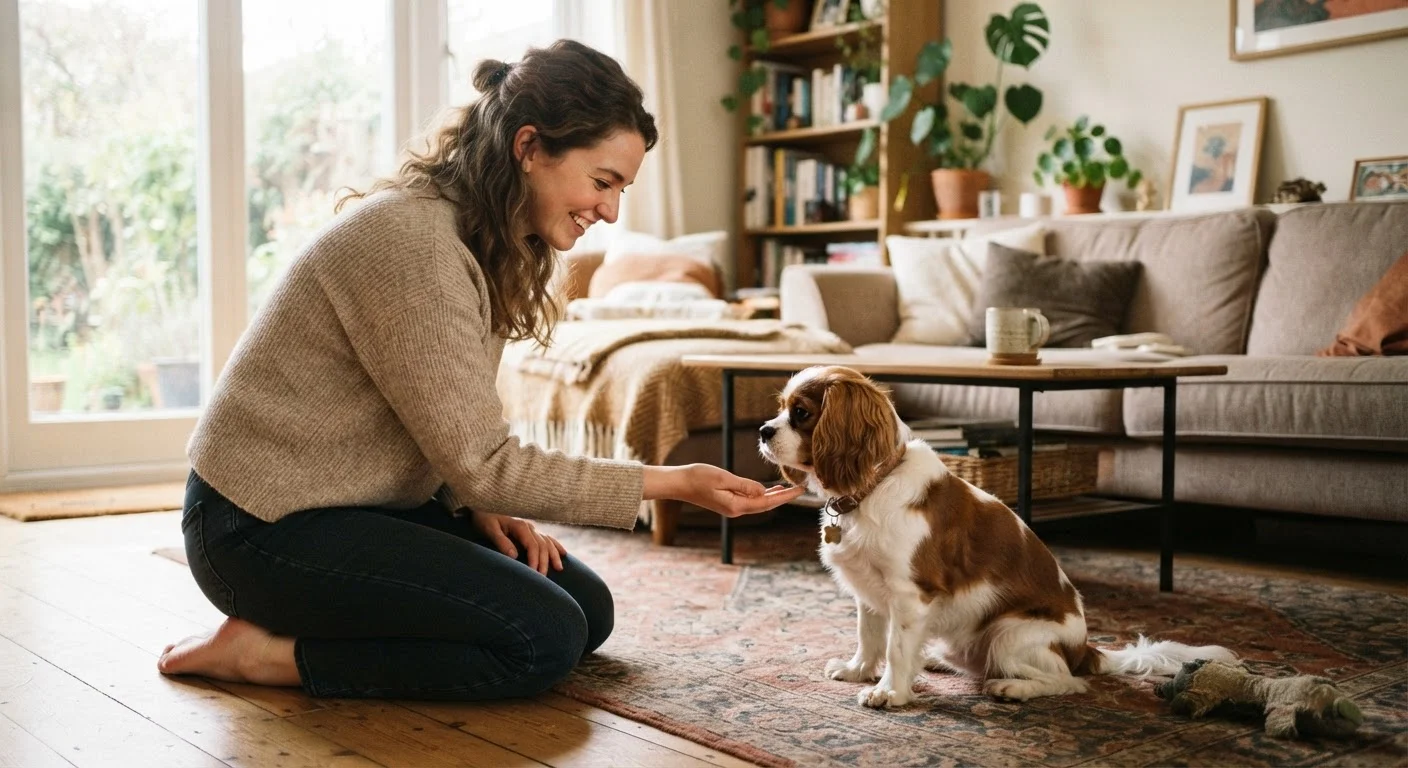
Positive reinforcement means adding something the pet wants (usually a treat or praise) immediately after a desired behavior. Timing is critical. A reward delivered even a few seconds late may reinforce whatever the pet was doing at that moment - standing, sniffing the floor - rather than the sit you asked for.
Positive reinforcement
Adding something the pet wants - typically a treat or praise - immediately after a desired behavior, making that behavior more likely to happen again.
Operant conditioning
A learning process in which behavior is shaped by its consequences. Behaviors followed by rewards increase; behaviors followed by nothing or mild discomfort decrease.
Marker signal
A precise sound - a click or a short word like 'yes' - used to pinpoint the exact moment a pet does something correctly, before the treat is delivered.
Generalization
The process of practicing a learned behavior in multiple settings and situations so the pet responds reliably, not just in the original training environment.
Luring
Using a treat held in your hand to guide a pet's body into the desired position, such as moving a treat over the head to encourage a sit.
For a deeper look at the science, including classical conditioning and how everyday home moments shape behavior, see how pets actually learn.
The First Commands to Teach
Start with behaviors that have immediate practical safety value: sit, stay, come (recall), and leave it. These four cover the majority of everyday situations where a trained response prevents harm or chaos.
- Sit: Lure the pet's nose upward with a treat; the hips naturally lower. The moment the pet sits, mark it ('yes' or a click) and reward.
- Stay: Ask for a sit, wait one second, reward. Gradually extend the duration before rewarding - never in a single jump.
- Come: Practice in a low-distraction space. Say the cue once, crouch down, and reward generously when the pet arrives. Never call your pet to you for anything unpleasant.
- Leave it: Place a low-value treat on the floor and cover it with your hand. When the pet stops trying to get it and looks at you, reward with a different, higher-value treat.
Keep Treat Sizes Small
Training treats should be no bigger than a pea for a medium-sized dog. Small treats mean you can reward many repetitions in a short session without the pet losing interest from fullness. Soft treats tend to be consumed faster than crunchy ones, keeping the session moving.
You don't need to master these before moving on - overlap is fine. The point is to keep sessions short enough that the pet stays engaged and ends wanting more.
Building a Consistent Routine
Consistency is the variable most within a first-time owner's control - and the one most often underestimated. Using the same word for the same cue every time, having every household member use that same word, and delivering rewards promptly all matter far more than session length or training environment.
Aim for two to three short sessions daily rather than one long one. Five minutes of focused practice beats a distracted thirty-minute session. Folding brief training moments into everyday life - asking for a sit before the food bowl goes down, a stay before opening the door - accelerates progress without requiring dedicated time blocks.
For owners weighing whether to add a structured class, training at home versus group classes lays out the practical trade-offs clearly.
Common Mistakes First-Time Trainers Make
Most early training failures trace back to a few predictable patterns:
- Repeating cues: Saying 'sit, sit, sit' teaches the pet that one 'sit' means nothing. Say the cue once, wait, then help the pet into position if needed.
- Sessions that run too long: Mental effort is tiring for pets. A bored or frustrated pet stops learning. End sessions on a success.
- Inconsistent signals: Mixed hand gestures, varying words, or rewarding the same behavior only sometimes creates confusion. Our article on signals that confuse pets covers these handler habits in detail.
- Punishing errors: If the pet gets it wrong, simply withhold the reward and try again. Punishment adds stress and erodes trust without clarifying what the correct behavior is.
Don't Use Punishment as a Teaching Tool
Physical corrections, harsh verbal reprimands, and aversive devices can increase anxiety and fear responses in pets, sometimes making behavior problems worse rather than better. If a session is going poorly, end it calmly and try again later rather than escalating pressure. Most veterinary behaviorists recommend against punishment-based methods as a primary training strategy.
Where to Go From Here
Once your pet reliably responds to basic cues in a quiet room, the next step is generalization - practicing the same behaviors in new locations, with new distractions, and around other people or animals. A behavior practiced only at home is not yet a reliable behavior.
If you've recently adopted a rescue dog, there are specific considerations before diving into formal training. Before you start training a rescue dog walks through what to observe and establish first. And if you want to refine your marker technique, clicker training vs. verbal markers is a practical next read.
Training is cumulative. The owner who spends five consistent minutes a day will, over weeks, far outpace the owner who does occasional hour-long sessions. Start small, stay consistent, and adjust based on what you observe - your pet's behavior will tell you what's working.
This article is for general informational purposes only and does not constitute professional veterinary or behavioral advice. For concerns about your pet's specific behavioral or health needs, consult a qualified veterinarian or certified animal behaviorist.