

Key Takeaways
Option A
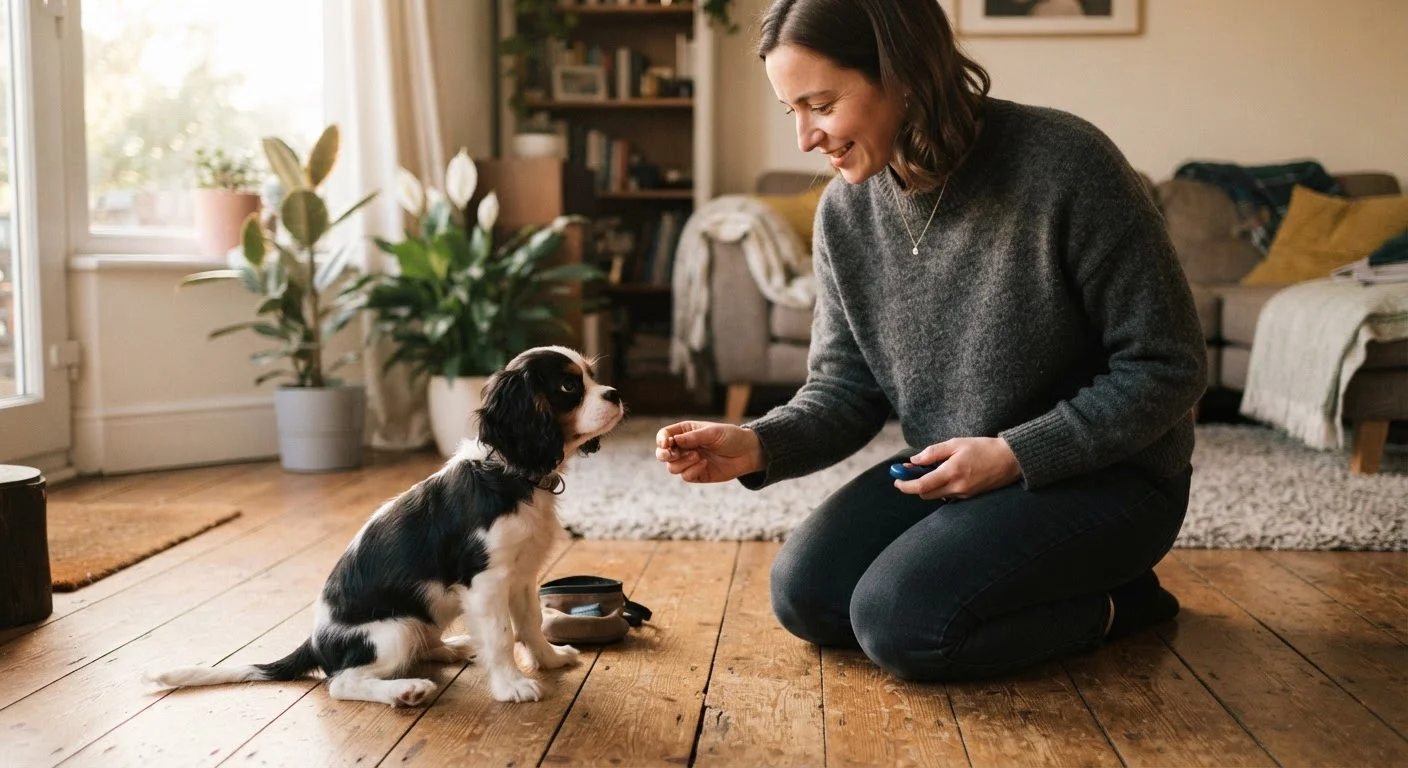
Clicker Training
The precise, dedicated-tool approach to marking behavior.
Best for: Owners who want a consistently distinct, non-emotional sound and can keep a clicker on hand during sessions.
Option B
Verbal Markers
The always-available, hands-free alternative to mechanical markers.
Best for: Owners who want zero equipment and are willing to practice delivering a crisp, consistent word or sound.
If you want the fastest initial conditioning for a new puppy or kitten
Clicker Training
The clicker's distinct, non-variable sound is easy for animals to isolate from background noise, which can shorten the early association phase between marker and reward.
If you want a method you can use anywhere without carrying extra gear
Verbal Markers
A well-practiced verbal cue like 'yes' is always with you - no fumbling in your pocket - making spontaneous reinforcement during daily life much easier.
If your pet is sound-sensitive or easily startled by sudden noises
Verbal Markers
A calm, soft verbal marker avoids the sharp click sound that can briefly startle noise-reactive animals, keeping sessions stress-free from the start.
If multiple people in your household will be training the same pet
Clicker Training
Different family members have different vocal tones and speech patterns; a clicker produces the same sound regardless of who is holding it, reducing inconsistency.
How Both Methods Actually Work
Both clicker training and verbal markers are forms of event marking - a technique rooted in operant conditioning. The marker (click or word) acts as a precise bridge between the moment a pet performs the correct behavior and the moment the reward arrives. Without that bridge, the reward can easily become associated with whatever the animal happens to be doing when it arrives, not the behavior you intended to reinforce.
The process for establishing either marker is the same: you pair the sound with a high-value reward repeatedly until the animal responds to the marker itself with anticipation. This is sometimes called charging the marker. Once charged, the marker communicates clearly: that exact thing you just did earns a reward.
If you're new to this approach, our beginner's guide to pet training covers the foundational principles in plain language before you pick up any tool.
| Criterion | Clicker Training | Verbal Markers |
|---|---|---|
| Equipment needed | Mechanical clicker (~$2-5) | None |
| Sound consistency | Identical every time | Varies with tone/mood |
| Always available | Only when carried | Yes, at all times |
| Hands-free use | Requires one hand | Fully hands-free |
| Suited for noise-sensitive pets | May startle some animals | Easily softened |
| Multi-handler consistency | High - same sound for everyone | Lower - voice varies by person |
| Learning curve | Requires hand-eye coordination | Requires voice discipline |
Where Each Method Has a Real Advantage
Clicker advantages: The mechanical click is acoustically distinct - it doesn't vary with your mood, fatigue, or excitement the way a spoken word does. Research in animal learning consistently highlights timing precision as one of the most critical variables in marker training. Because a click is a reflexive single motion, many handlers find it easier to deliver within the optimal window (generally within one to two seconds of the behavior). It's also emotionally neutral, which matters when you're frustrated mid-session.
Verbal marker advantages: Your voice is always present. This makes verbal markers genuinely more practical for the unscripted training moments that happen throughout a normal day - catching a dog sitting calmly, reinforcing a cat for using the scratch post, rewarding a pet for coming when called without a treat pouch in sight. The tradeoff is that your delivery needs to be deliberate: use a short, upbeat word like yes or good and say it the same way every time. Avoid words you use casually in conversation, which can dilute the marker's meaning.
Inconsistent or delayed cues from either method can slow progress more than the choice of marker itself. See common handler habits that confuse pets for a practical breakdown of what to watch for.
< 1-2 sec
Optimal marker delivery window after behavior
Animal learning researchers generally cite a one-to-two second window as critical for the marker to be meaningfully associated with the intended behavior.
~40 pairings
Typical repetitions to charge a new marker
Conditioning a new marker typically requires repeated treat pairings across multiple short sessions before the sound reliably predicts a reward.
Choosing What Fits Your Household
Neither method is universally superior - the better one is whichever you'll use with the most consistency. Ask yourself a few practical questions: Do you typically have both hands free during training? Are there multiple people in your home who will work with the pet? Does your pet startle easily? Is the clicker likely to sit forgotten in a drawer?
Many trainers suggest starting with whichever method removes the most friction from your routine. If a clicker genuinely excites you and you'll carry it reliably, use it. If the thought of managing another object feels like a barrier, a verbal marker will serve you just as well - provided you commit to using a consistent, deliberate word.
It's also worth noting that these methods aren't mutually exclusive long-term. Some owners use a clicker during structured sit-down sessions for precision work, and a verbal marker throughout the day for spontaneous reinforcement. This kind of layered approach fits naturally within a broader training plan - something covered in detail in our complete home training resource.
Both approaches fall squarely within reward-based training principles. If you're curious how that compares to other philosophies, our comparison of positive reinforcement and dominance-based training provides useful context on what current animal behavior research supports.