

Key Takeaways
Anchoring & Decoy Pricing
Anchoring is a cognitive bias where the first price you see shapes how you judge every price that follows. Decoy pricing is a related retail tactic that introduces a third option specifically designed to make one of the other two look like the obvious choice - even when it isn't necessarily the best value for your needs.
Both techniques exploit relative judgment: the human brain evaluates value comparatively rather than in absolute terms, a finding well documented in behavioral economics research by scholars such as Dan Ariely.
How Anchoring Works Against Your Wallet
Walk into almost any store and you'll see it immediately: a price tag showing $199 crossed out, replaced with $129. That crossed-out number is an anchor - a reference point your brain locks onto before it processes the actual price. From that moment, your evaluation of $129 is relative to $199, not relative to what the item is genuinely worth or what competitors charge.
Anchoring is one of the most replicated findings in behavioral economics. Once a number enters the frame, it biases subsequent judgment even when people know it's arbitrary. Retailers exploit this by setting anchor prices high - sometimes at Manufacturer's Suggested Retail Price (MSRP) figures that few retailers ever actually charge - then presenting the selling price as a dramatic discount.
The counter-move is to establish your own anchor before you shop. Check a price-history tracker or scan a few competing sources to learn the realistic market range for what you want. When you already know a product typically sells for $130-$145, a "was $199" tag stops feeling like a windfall and starts looking like marketing math.
When 'Sale' Prices Deserve Extra Scrutiny
Regulatory standards in the US generally require that a 'former price' displayed alongside a sale price must have been a genuine price offered for a meaningful period. However, enforcement varies, and MSRP-based anchors - which few retailers actually charge - are commonly used. Independent price verification remains the most reliable defense. Common shopping myths, including the assumption that sales always mean savings, are worth understanding before any major purchase.
For a deeper look at why low sticker price and genuine value often diverge, see the difference between a good deal and a cheap purchase.
The Mechanics of Decoy Pricing
Decoy pricing works by adding a third option to a two-option lineup, structured so that one of the original options now looks like the rational choice by comparison. The decoy itself is rarely meant to sell - it exists to reshape how you perceive the others.
A classic structure looks like this:
- Option A (Small): $8
- Option B (Decoy/Large): $14
- Option C (Extra-Large): $15
Option B is priced close to Option C but offers noticeably less. Its presence makes Option C look like an obvious upgrade for just one more dollar, driving buyers toward the higher-priced item. Without Option B in the lineup, far fewer people would upgrade from $8 to $15. The decoy manufactures a comparison that didn't previously exist.
This shows up across categories: subscription tiers, streaming plans, insurance packages, and even automotive trim levels. Recognizing the three-option structure is half the battle. When you see it, ask yourself what you actually need - not which option wins the comparison game the retailer set up.
Set Your Ceiling Before You See Prices
Decide the maximum you're willing to spend on a category before you open any retailer's site or walk into any store. Writing it down adds a small commitment that makes it easier to hold. Once you're inside a pricing environment, anchors and decoys have already started working - your pre-set ceiling is one of the few defenses that operates before the effect kicks in.
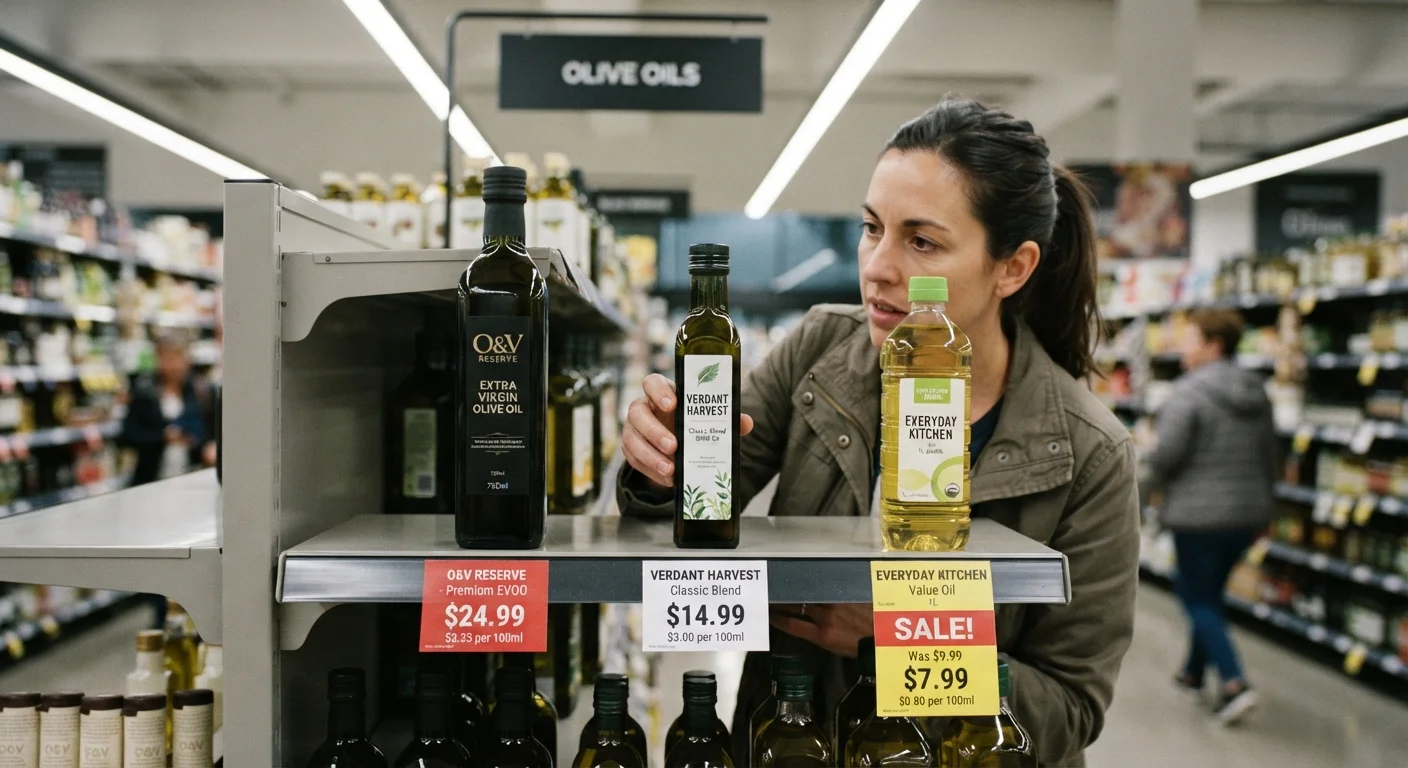
Comparing unit prices rather than package prices cuts through decoy lineup math by giving you a single, comparable number across all options.
Practical Defenses You Can Use Today
Both anchoring and decoy pricing exploit the same vulnerability: your brain's tendency to judge value relatively rather than absolutely. The practical fix is to introduce your own objective reference points.
- Research before you browse. Know the going market price before a retailer's pricing can anchor you. Price-history browser extensions can show whether a current price is genuinely lower than historical norms or just lower than an inflated anchor.
- Isolate each option. When facing a tiered lineup, evaluate each tier as if the others don't exist. Does Option C deliver enough value to justify $15 on its own merits? If you wouldn't pay $15 without seeing the $14 option, that's the decoy working on you.
- Apply a fixed budget ceiling first. Decide the maximum you're willing to spend before you see pricing. Options above that ceiling get dismissed regardless of how good the comparison looks.
- Check total cost, not just sticker price. An anchored sale price on a product with high ongoing costs may still be the expensive choice. Total cost of ownership thinking closes that gap.
These tactics also interact with other retail psychology techniques - urgency messaging, loyalty point framing, and strategic product placement all compound the effect. For a broader map of those triggers, see the psychological triggers retailers use to encourage impulse spending.
~40%
Lift in premium option sales from decoy effect
Research published in behavioral economics literature has found decoy pricing can shift preference toward a target option by roughly 40% compared to two-option lineups.
4x
Anchoring effect magnitude in consumer studies
Studies in negotiation and pricing psychology consistently show initial numbers can influence final judgments by a factor of several times, even when participants are aware of the anchor.
~60%
Shoppers who don't verify 'original' prices
Consumer behavior surveys suggest a majority of shoppers accept displayed 'was' prices at face value without independently checking historical or competitor pricing.