

Key Takeaways
Option A
Unit Price
The apples-to-apples comparison tool.
Best for: Shoppers who want to compare true cost across different sizes and brands without doing mental gymnastics at the shelf.
Option B
Package Price
The number retailers lead with.
Best for: Situations where budget is fixed, storage is limited, or you need a quick snapshot of what you'll spend at checkout.
If you're comparing two different package sizes of the same product
Unit Price
Unit price strips away the packaging variable so you're comparing actual cost per measurable unit, not retailer-chosen container sizes.
If you have a strict checkout budget and limited storage space
Package Price
When cash flow or pantry space is the binding constraint, the package price tells you exactly what leaves your wallet today.
If you're shopping in bulk or warehouse stores
Unit Price
Warehouse prices look large but often - not always - beat grocery store unit prices. You need to calculate to confirm, not assume.
If you're buying perishables that may go to waste
Package Price
A lower unit price on a large package isn't a saving if half the product spoils. Wasted food erases any per-unit advantage.
Why the Number on the Front of the Package Can Mislead You
Retailers design packaging to anchor your attention on the total package price - the big, bold number on the front label or the shelf tag. That figure tells you one thing only: what you'll hand over at the register for that specific container. It says nothing about whether you're getting more or less product per dollar than the item next to it.
Unit price, by contrast, is the cost per standardized measure - per ounce, per fluid ounce, per count, per square foot. It's the only metric that makes an honest comparison possible when package sizes differ. A 16 oz jar priced at $3.84 has a unit price of $0.24/oz. A 24 oz jar at $6.24 works out to $0.26/oz. The bigger jar costs more per ounce despite looking like a bulk deal. This kind of inversion happens regularly across grocery, household, and personal-care categories.
Understanding this gap is foundational to smarter shopping - it connects directly to the broader idea of distinguishing real value from a low sticker price.
| Criterion | Unit Price | Package Price |
|---|---|---|
| What it measures | Cost per standardized unit (oz, count, etc.) | Total out-of-pocket for one package |
| Useful for cross-size comparison | Yes - directly comparable | No - sizes differ, numbers mislead |
| Reflects budget impact today | No - ignores total spend | Yes - shows exact checkout cost |
| Accounts for waste risk | No - assumes full use | Partly - smaller package limits waste |
| Where to find it | Shelf tag (small print) or calculate manually | Front label or large shelf tag number |
| Retailer manipulation risk | Low - math is objective | Higher - anchoring and decoy pricing apply |
How to Find and Use Unit Price Data at the Shelf
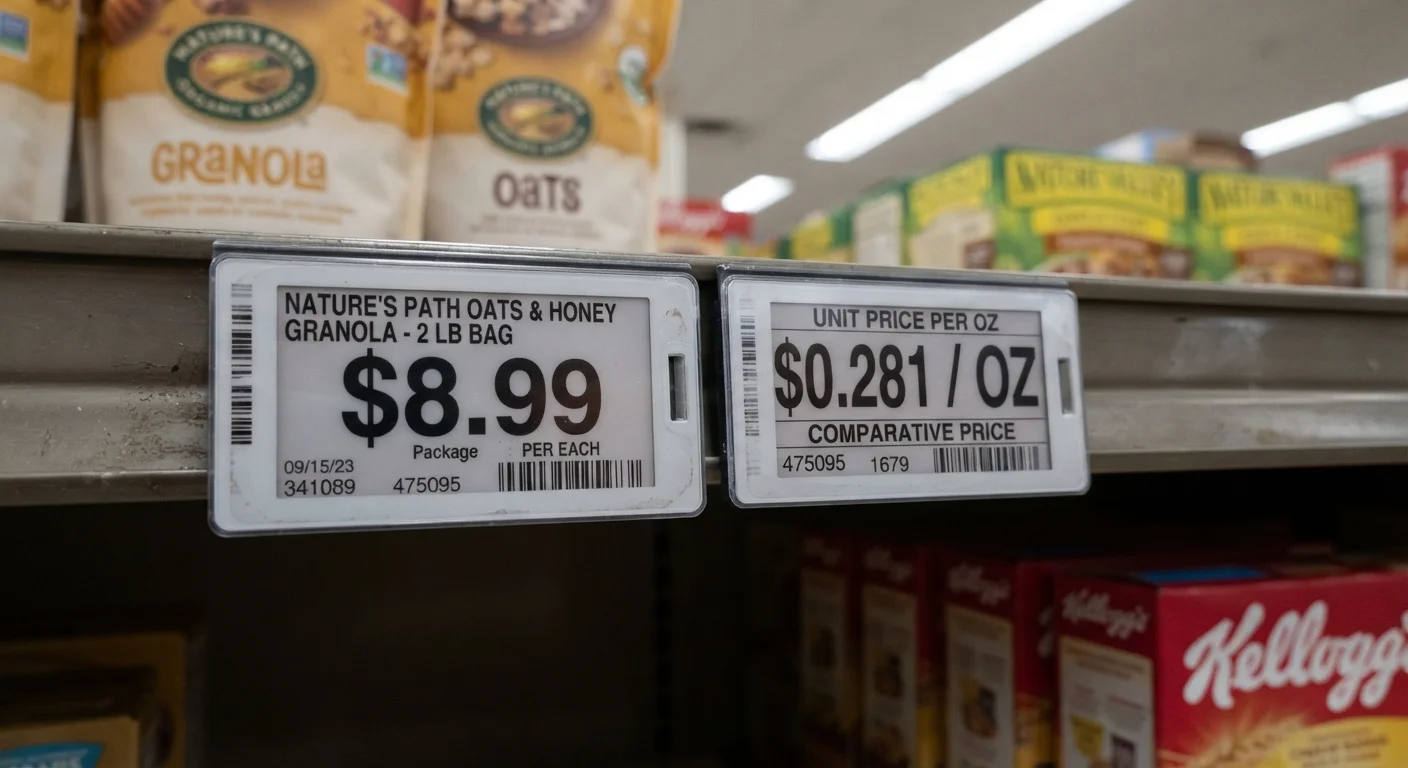
In most US states, retailers selling packaged goods are required to display unit prices on shelf tags. The catch: the formatting is inconsistent. Some stores display it prominently; others print it in small grey type at the bottom left of a busy tag. The unit-of-measure also shifts - one tag may show cost per ounce, the next per pound, another per 100 count. Always confirm you're comparing the same base unit before drawing a conclusion.
When shelf tags are missing or confusing, a basic calculation takes under 10 seconds: divide the package price by the total quantity. Your phone's calculator works fine. Apps like Flipp or store-specific apps sometimes display unit prices in their digital circulars, which speeds up pre-trip comparisons.
Shelf Tag Unit Price: What the Law Requires
Unit pricing laws vary by state. Some states mandate unit price display for all packaged goods; others apply rules only to food or specific store sizes. The Federal Trade Commission has published guidance on unit pricing, but there is no single federal mandate covering all retail categories. If a shelf tag is missing or illegible, ask a store associate - many retailers have internal policies requiring unit price display even when state law doesn't.
One practical complication: promotional pricing can temporarily make a smaller package the better unit-price choice. A sale-priced 12 oz item may undercut the everyday unit price of the 32 oz version. This is why combining unit price literacy with an understanding of deal timing cycles compounds your savings.
Also worth noting: the "bigger package = better deal" assumption is one of the most persistent shopping myths that quietly cost budget-conscious buyers. Retailers know shoppers hold this belief and don't always price accordingly.
When Package Price Is the Right Number to Focus On
Unit price isn't always the deciding variable. If your grocery budget for the week is $75 and a warehouse-club unit of laundry detergent costs $22, the fact that it has a superior unit price is irrelevant if buying it blows your budget for the rest of the week. Package price reflects your immediate cash outlay - a real constraint that unit price ignores.
Storage is a second practical limit. A lower unit price on a 50-count product you can't store properly, or a perishable item you won't finish, erodes quickly. Bulk buying can backfire when waste enters the equation - the unit price advantage disappears pound for pound when product goes in the trash.
A third scenario: when two competing products have nearly identical unit prices, other factors - quality, convenience, personal preference - become the tiebreaker. Unit price comparison is a filter, not a final verdict. It narrows the field; it doesn't always end the conversation. For a fuller picture of costs beyond the shelf tag, consider total cost of ownership, particularly for durable goods.
~30%
Price difference found in same-brand size comparisons
Consumer Reports research has found unit price differences of roughly 30% or more between sizes of the same product within a single store, with the larger size sometimes costing more per unit.
48
US states with some form of unit pricing regulation
According to FTC historical reporting, the majority of US states have enacted unit pricing rules, though scope and enforcement vary significantly by jurisdiction.