

Key Takeaways
Why Car Troubleshooting Myths Persist
Automotive advice travels fast - through online forums, well-meaning family members, and decades-old shop talk. Some of it holds up. Much of it doesn't. The problem isn't that drivers are careless; it's that cars produce ambiguous signals, and pattern-matching those signals to familiar stories feels intuitive even when it leads nowhere useful.
Acting on inaccurate troubleshooting assumptions costs money - either by chasing the wrong fix or by delaying attention to something genuinely serious. The myths below are among the most common ones that send drivers in the wrong direction. Understanding what's actually happening mechanically puts you in a better position to describe symptoms accurately to a mechanic or decide whether a DIY inspection makes sense. Our practical troubleshooting primer covers the foundational observation skills worth building alongside these myth corrections.
Myth
A check engine light means something catastrophic and expensive is wrong.
Fact
The check engine light covers hundreds of fault codes, ranging from a loose gas cap to a failing oxygen sensor.
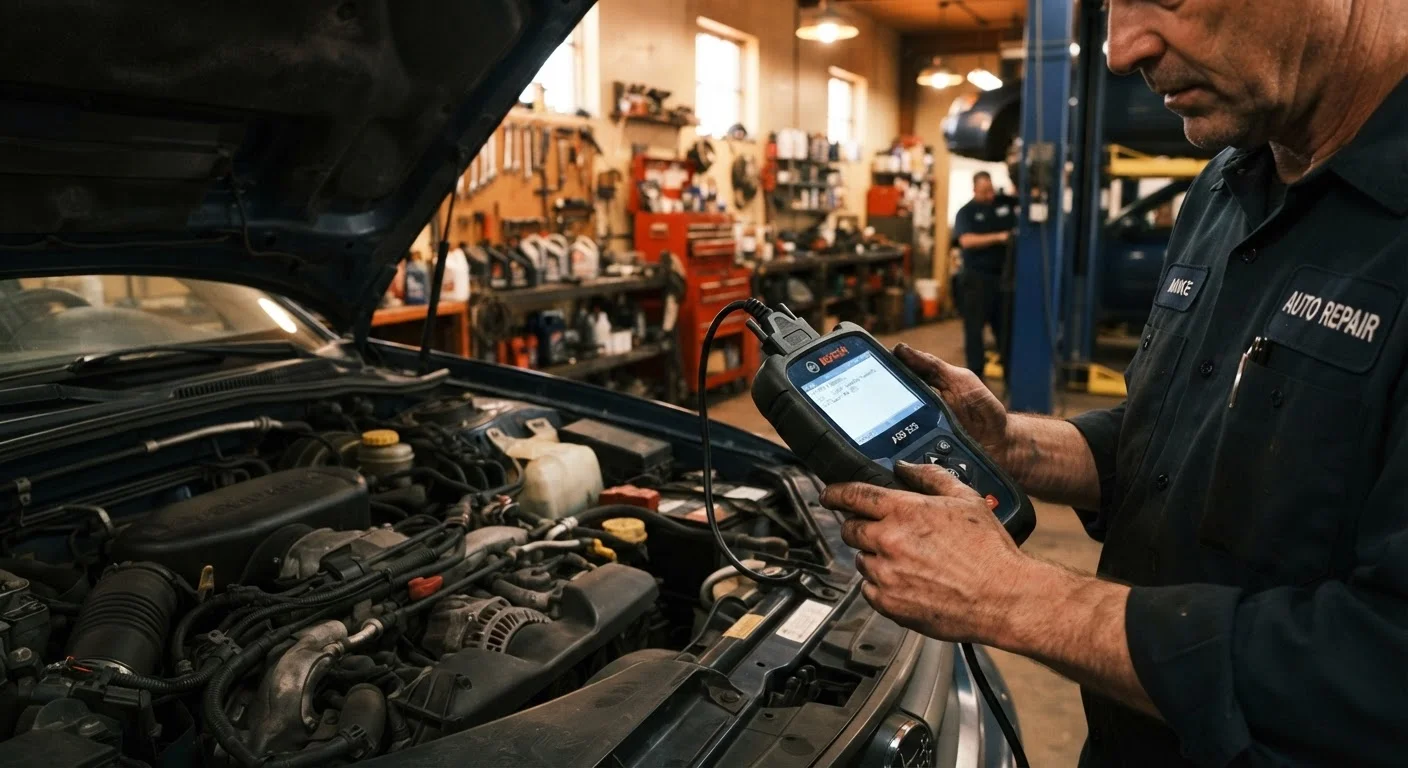
The check engine light (officially the malfunction indicator lamp) is connected to your vehicle's OBD-II system, which monitors dozens of sensors. A loose or missing gas cap is one of the most common triggers. While some codes do point to costly repairs, many are minor. Reading the actual fault code with an inexpensive OBD-II scanner - available at most auto parts stores for self-service use - tells you specifically what triggered the light before you spend a dollar on repairs.
Myth
If the noise disappears on its own, the problem has resolved itself.
Fact
Intermittent symptoms often indicate an early-stage mechanical issue that worsens before it becomes constant.
A brake squeal that stops after a few minutes, a knock that only appears when cold, or a rattle that vanishes at highway speed are all examples of symptoms that drivers frequently dismiss. In reality, these patterns can signal worn components cycling through early failure. Tracking when, where, and under what conditions a noise occurs is far more useful than waiting for it to become permanent. See our guide to intermittent car problems for a structured approach to logging these events.
Myth
You can pinpoint an engine problem by listening to where the noise is loudest inside the cabin.
Fact
Sound travels through a vehicle's structure and can appear to originate far from its actual source.
Cabin acoustics are notoriously misleading. A worn front wheel bearing can sound like it's coming from the rear. An exhaust rattle can mimic a loose heat shield near the firewall. Mechanics use stethoscopes, chassis ears (contact microphones placed on components), and road test observations to localize sounds - not just their ears. If you suspect a noise, note conditions precisely: speed, road surface, turning direction, engine temperature, and whether it changes with acceleration or braking.
Myth
White smoke from the exhaust always means a blown head gasket.
Fact
White exhaust smoke on cold mornings is usually just water vapor condensing, which is completely normal.
On a cold start, especially in cool weather, water vapor in the exhaust system condenses into visible white mist that dissipates within a few minutes. This is normal combustion byproduct behavior. Persistent thick white smoke - especially accompanied by a sweet smell, coolant loss, or milky residue on the oil cap - does warrant head gasket investigation. But occasional wisps on startup are not cause for alarm. Similarly, blue smoke typically indicates oil burning, while dark gray or black smoke often points to a rich fuel mixture.
Myth
If your car starts fine, the battery is in good health.
Fact
A battery can start an engine reliably yet still be close to failure under load.
Cold-cranking performance and overall battery health are different things. A battery may retain enough charge to start the car while having significantly reduced capacity - meaning it can fail unexpectedly during extreme temperatures or when accessories draw extra power. Battery load testing (not just a voltage check) reveals the battery's true condition. Many auto parts stores offer this service at no charge. For a fuller picture of electrical system diagnosis, our article on diagnosing a battery vs. alternator problem walks through key distinctions.
Myth
A car that pulls to one side just needs a tire pressure correction.
Fact
Steering drift can result from alignment issues, brake caliper drag, suspension wear, or uneven tire wear - not just pressure differences.
While mismatched tire pressures can contribute to pull, they're rarely the sole cause of persistent drift. A vehicle that consistently pulls left or right typically has a wheel alignment problem, a sticking brake caliper, or uneven suspension component wear. Correcting tire pressure is always a good first step, but if the pull persists afterward, a professional alignment check is warranted. Ignoring sustained pull accelerates tire wear and can affect handling safety.
Applying Accurate Diagnosis in Practice
Separating myth from fact isn't just an intellectual exercise - it changes how you respond when something feels off with your vehicle. A few habits make a real difference:
- Document symptoms precisely. Note when the issue occurs (cold start, highway speed, turning), what it sounds or feels like, and whether it's getting more frequent. Vague descriptions lead to vague diagnoses.
- Read the code before you act. An OBD-II scanner gives you the actual fault code behind a warning light. That single step can save hours of guesswork.
- Verify the simple explanations first. Check tire pressure, fluid levels, and gas cap seating before assuming the worst. Sometimes the straightforward answer is the right one.
- Know when to involve a qualified mechanic. Some symptoms - a flashing check engine light, brake fade, or transmission hesitation - carry real safety implications. There's no savings in delaying those.
Don't Ignore a Flashing Check Engine Light
A steady check engine light warrants attention soon, but a flashing or blinking check engine light signals an active misfire that can rapidly damage the catalytic converter - an expensive component. Pull over safely and have the vehicle inspected without delay. Driving normally on a flashing light is one of the costliest mistakes a driver can make.
For specific symptom categories, the guide to strange car noises and why your car won't start articles offer structured walkthroughs that build on the principles above. Accurate information is the cheapest tool in any driver's kit.
Clearing Codes Is Not a Fix
Using an OBD-II scanner (on-board diagnostics reader) to erase a fault code will turn off the warning light temporarily, but the underlying fault remains. The light will return - and in the meantime, you're driving without the early-warning system doing its job. Always identify and address the cause before clearing any stored code.