

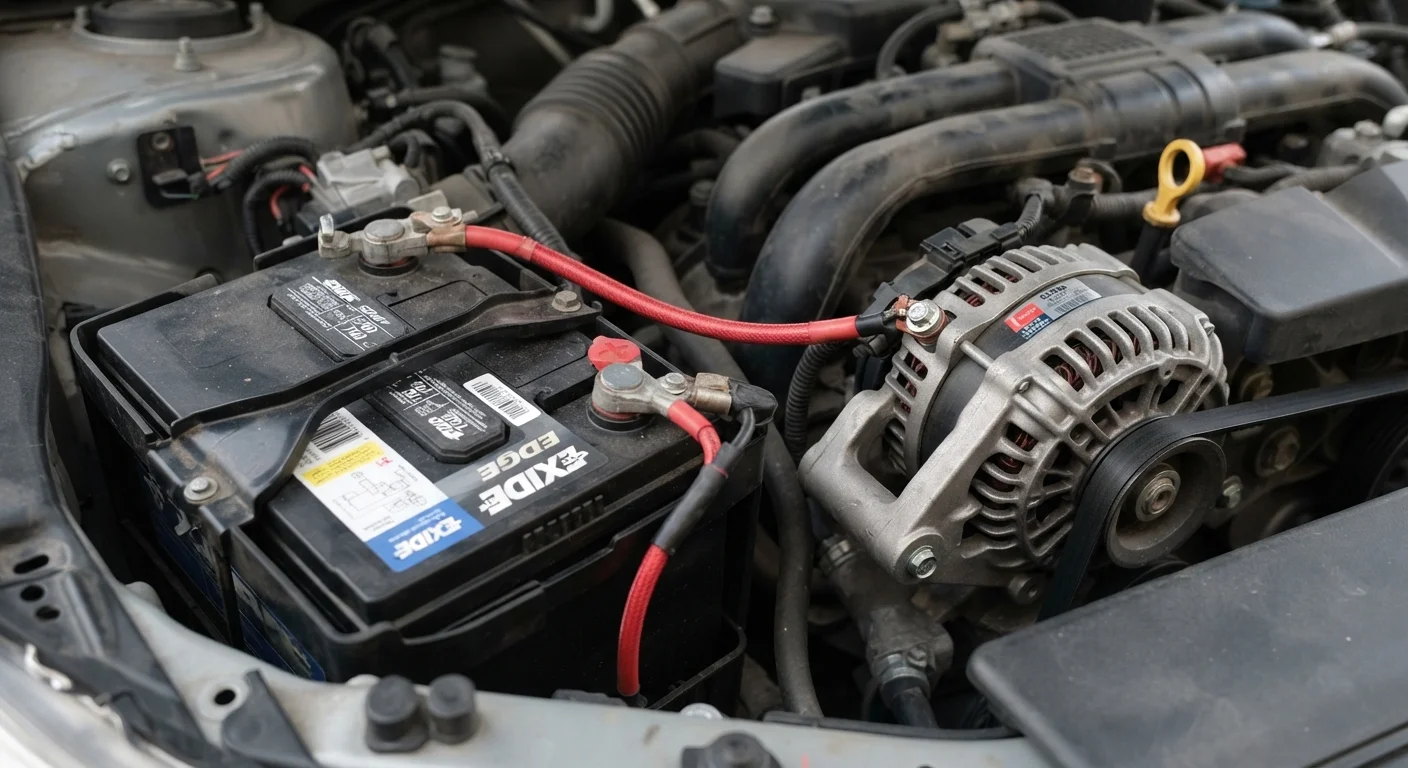
Key Takeaways
Option A
Car Battery
The stored-energy source that starts your engine.
Best for: Supplying the initial burst of power needed to crank the engine and supporting the electrical system when the engine is off.
Option B
Alternator
The on-board generator that keeps everything running.
Best for: Recharging the battery while the engine runs and powering all electrical systems during normal driving.
If your car cranks slowly or clicks but won't start, especially in cold weather
Car Battery
Slow cranking and click sounds on ignition are classic signs of a battery that can no longer deliver enough current to start the engine.
If your car starts fine but lights dim and electrical accessories lose power while driving
Alternator
Electrical degradation during normal driving means the alternator isn't generating enough voltage to sustain the system, regardless of battery condition.
If your car starts after a jump but dies again within minutes or a few miles
Alternator
A healthy alternator recharges the battery while the engine runs; if the car dies shortly after a jump, the alternator is almost certainly not doing its job.
If your battery warning light appears and you also notice a burning or rubber smell from the engine bay
Alternator
An overworked or failing alternator can generate heat and cause belt slippage, producing smells alongside the dashboard warning.
If your car is three or more years old and struggles to start only after sitting overnight
Car Battery
Batteries typically last three to five years; difficulty starting after extended rest - when no alternator is running - points to a battery that can no longer hold a charge.
Why These Two Get Confused
The battery and alternator are partners in your car's electrical system, so when one fails, it stresses the other - making it genuinely difficult to tell them apart from symptoms alone. Before replacing anything, it helps to understand what each component actually does.
The battery is a chemical energy reservoir. It delivers the high-amperage burst needed to crank the starter motor and keeps basic electronics alive when the engine is off. The alternator is a generator driven by a belt off the engine. Once the engine starts, the alternator takes over, powering the car's electrical systems and simultaneously recharging the battery.
When the alternator fails slowly, it stops recharging the battery, which eventually goes flat - and the driver replaces the battery, not the alternator. The new battery then dies for the same reason. This is one of the most common and avoidable diagnostic errors budget-conscious drivers make. Our car troubleshooting myths guide covers several similar misdiagnoses worth knowing.
| Criterion | Car Battery | Alternator |
|---|---|---|
| Primary function | Stores and delivers starting power | Generates power while engine runs |
| Typical failure symptom | Won't start; slow crank or clicking | Dims lights and stalls after jump |
| When symptoms appear | At startup, after sitting idle | During driving, not at startup |
| Dashboard indicator | May trigger battery light if very low | Battery light on while driving |
| Multimeter reading (engine off) | Below 12.0 V signals trouble | Not testable with engine off |
| Multimeter reading (engine running) | Should rise to 13.7-14.7 V if alternator is healthy | Below 13.7 V signals charging failure |
| Average lifespan | 3-5 years | 7-10 years |
| Jump-start response | Car starts and stays running | Car starts but stalls within minutes |
Reading the Symptoms Side by Side
Symptoms overlap, but their timing and context reveal a lot. Battery problems almost always show up at the moment you try to start the car - particularly after the vehicle has sat for several hours. Alternator problems tend to emerge while the engine is already running.
Battery Warning Signs
- Slow, labored cranking when you turn the key or push the start button
- A rapid clicking sound with no engine turnover (the starter solenoid is firing but getting insufficient current)
- Corrosion visible on the battery terminals - a greenish-white crust that increases resistance
- Headlights that are notably dim before the engine starts, then brighten once it runs
- Battery age over four years with no replacement history
Alternator Warning Signs
- Dashboard battery light illuminating while driving (this light monitors charging voltage, not just battery charge)
- Headlights or interior lights that dim progressively as you drive
- Electrical accessories - radio, power windows, climate controls - behaving erratically
- A whining, grinding, or squealing noise from the engine bay that changes with engine speed
- The engine stalls or dies a short time after a successful jump-start
If you notice symptoms that come and go rather than appearing consistently, the guide on intermittent car problems explains why those patterns can be misleading and how to track them more accurately.
The Jump-Start Test: A Quick Field Diagnostic
One of the most practical field tests requires nothing but jumper cables or a portable jump starter. Here's how to interpret the outcome:
- Jump-start the vehicle. If it starts readily, the battery had enough remaining capacity to respond - this is consistent with a discharged (not necessarily dead) battery or an alternator that has been failing to recharge it.
- Remove the jumper cables and observe. If the car continues running normally for a sustained drive, the alternator is likely generating charge and the battery may simply have been drained by a short trip cycle, an old cell, or a parasitic draw.
- If the engine stalls within a few minutes after removing jump cables, the alternator is almost certainly not producing enough voltage to sustain the system. The car was running entirely on the battery's stored charge, which depleted quickly.
Important safety note: Do not disconnect a running battery to test the alternator. This outdated method can damage modern vehicle electronics and is not a recommended diagnostic procedure. Instead, use a multimeter or have a free charging-system test done at an auto parts store.
About the Battery Warning Light
Despite its battery icon, the dashboard battery warning light actually monitors the charging system's voltage output - not the battery's state of charge directly. It typically illuminates when the alternator voltage drops below a threshold the vehicle's computer considers normal. Seeing this light while driving is therefore more likely an alternator signal than a battery signal, though a severely depleted battery can also trigger it in some vehicles.
For a broader look at how to approach no-start situations, see our guide to why your car won't start, which walks through the full range of possible causes beyond the battery and alternator.
Using a Multimeter to Confirm the Diagnosis
A basic digital multimeter - set to DC voltage - removes most of the guesswork. You don't need to be a mechanic to use one for this purpose.
Testing the Battery (Engine Off)
Place the red probe on the positive terminal and the black probe on the negative terminal. A fully charged 12-volt battery should read between 12.6 V and 12.8 V. A reading below 12.0 V indicates significant discharge; below 11.8 V suggests the battery may no longer hold a charge reliably.
Testing the Alternator (Engine Running)
With the engine running, repeat the same measurement at the battery terminals. A healthy alternator typically produces between 13.7 V and 14.7 V. A reading at or below 12.6 V while the engine is running means the alternator is contributing little to no charge - the battery is essentially powering everything alone. A reading above 15 V indicates overcharging, which is also an alternator fault and can damage the battery over time.
Many auto parts retailers offer free charging-system tests using more sophisticated equipment than a handheld multimeter. Taking advantage of that service before purchasing any part is a straightforward way to validate your diagnosis. If you're newer to interpreting these kinds of vehicle signals, our practical troubleshooting primer provides a useful foundation.