

Key Takeaways
Why Maintenance and Fuel Economy Are Inseparable
Most drivers think about fuel economy in terms of driving habits - how fast they accelerate, how often they idle, whether they use cruise control on highways. Those things do matter. But the mechanical condition of your vehicle quietly sets a ceiling on how efficient your driving can ever be.
When components like air filters, spark plugs, and oxygen sensors degrade, your engine compensates by consuming more fuel to deliver the same performance. The losses are gradual enough that most drivers don't notice them trip to trip - but they compound steadily over months and miles.
The good news: the maintenance items that protect fuel economy most are among the least expensive to address. Understanding which intervals matter most lets you prioritize spending when budgets are tight. See our guide to decoding your owner's manual service intervals for context on what each milestone actually covers.
The Service Intervals With the Biggest MPG Impact
Not every maintenance item affects fuel economy equally. These are the ones worth prioritizing if efficiency is your goal.
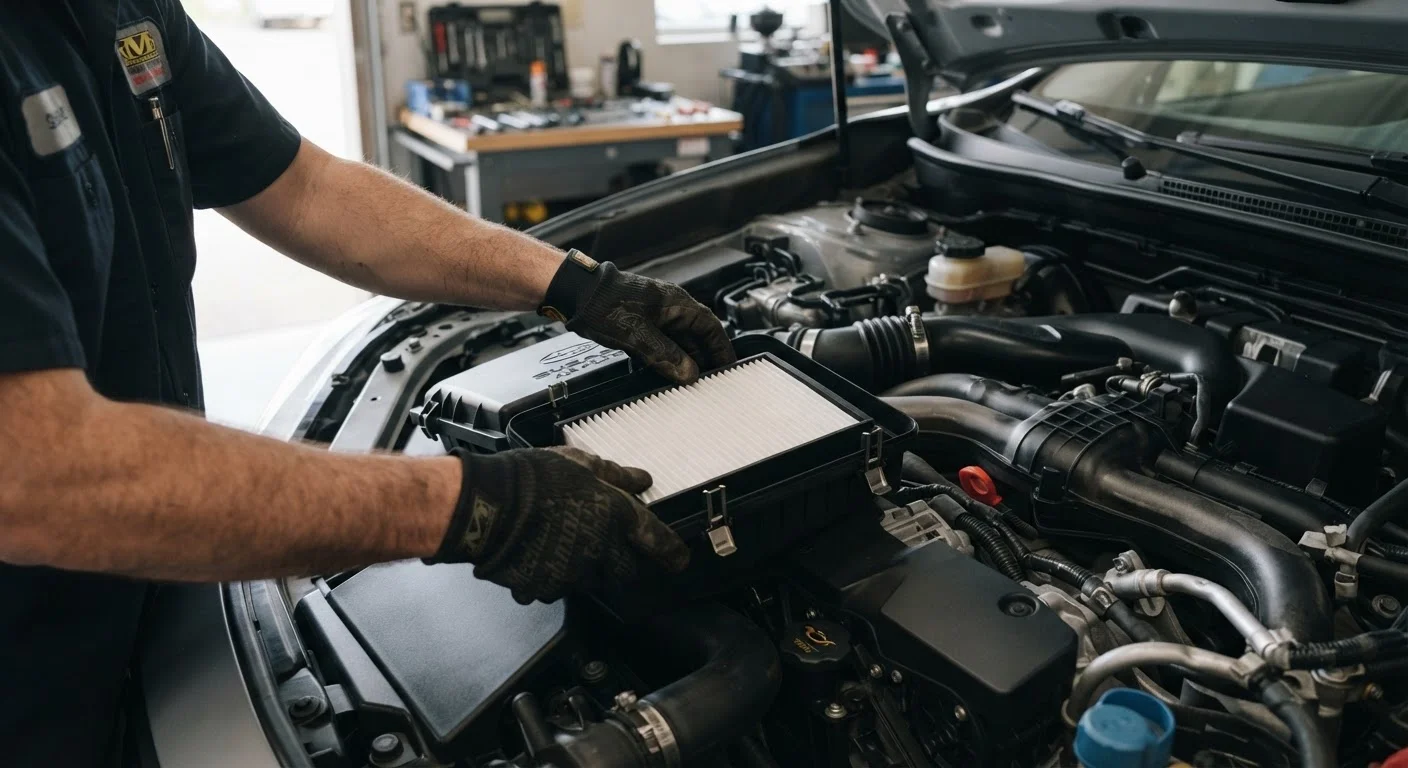
Replace your engine air filter on schedule - typically every 15,000 to 30,000 miles.
Your engine needs a precise ratio of air and fuel to combust efficiently. A clogged filter restricts incoming airflow, causing the engine control unit to compensate with a richer fuel mixture - meaning more fuel burned for the same output. In older vehicles without sophisticated fuel management, the impact is even more direct.
Inspect and replace spark plugs according to your vehicle's specified interval.
Spark plugs ignite the air-fuel mixture in each cylinder. When they wear, the spark becomes weaker or misfires occur - meaning fuel passes through the combustion chamber without fully burning. This wastes fuel directly and can foul other components downstream, including the catalytic converter.
Use the motor oil viscosity grade specified in your owner's manual.
Oil viscosity (its resistance to flow, indicated by ratings like 5W-30) affects how much internal friction your engine generates. Using a thicker grade than specified increases drag on moving parts, requiring more energy - and therefore more fuel - to maintain engine speed. Even a one-grade difference can produce a measurable efficiency gap.
Keep tires inflated to the manufacturer's recommended pressure, not the maximum listed on the sidewall.
Underinflated tires have a larger contact patch and higher rolling resistance - your engine must work harder to maintain speed. The pressure rating on the tire sidewall is a maximum limit, not a target; the correct spec is found on the driver's door jamb sticker or in your owner's manual.
Have wheel alignment checked annually or after any significant impact.
Misaligned wheels cause tires to scrub sideways as the vehicle moves forward, increasing drag and uneven wear. This is a source of fuel loss that most drivers never identify because it develops gradually, often after a pothole or curb strike.
Quick Wins You Can Act on Today
Some fuel-economy gains don't require a shop visit or even a tool kit. The following actions can be taken immediately and yield measurable results over time.
For a full pre-drive checklist that reinforces these habits, see the weekly car check that quietly saves you money at the pump.
Building a Schedule You'll Actually Follow
The most effective maintenance plan is a realistic one. Rather than overhauling everything at once, group related services by mileage milestone so each shop visit or DIY session accomplishes multiple goals efficiently.
Up to 40%
Fuel economy loss from a severely clogged air filter
The U.S. Department of Energy notes that fixing a faulty oxygen sensor alone can improve mileage significantly; a restricted air filter compounds this by disrupting the air-fuel ratio.
~0.5-3%
MPG improvement from correct tire inflation
The U.S. Department of Energy estimates that keeping tires properly inflated can improve gas mileage by around 0.5-3% depending on driving conditions.
A practical approach: every time you change your oil, check your tire pressure and inspect your air filter. Every 30,000 miles, revisit spark plugs, fuel filter, and PCV valve condition. If your car has passed 100,000 miles, the stakes for staying current are higher - the complete guide to keeping a high-mileage car running reliably covers the adjustments worth making at that stage.
Skipping small services to save money today reliably creates larger expenses later. An ignored air filter doesn't just cost fuel - it can cause long-term engine wear. An overlooked spark plug doesn't just reduce efficiency - it can damage a catalytic converter. The overlooked maintenance items that quietly run up repair bills covers this cycle in detail.