

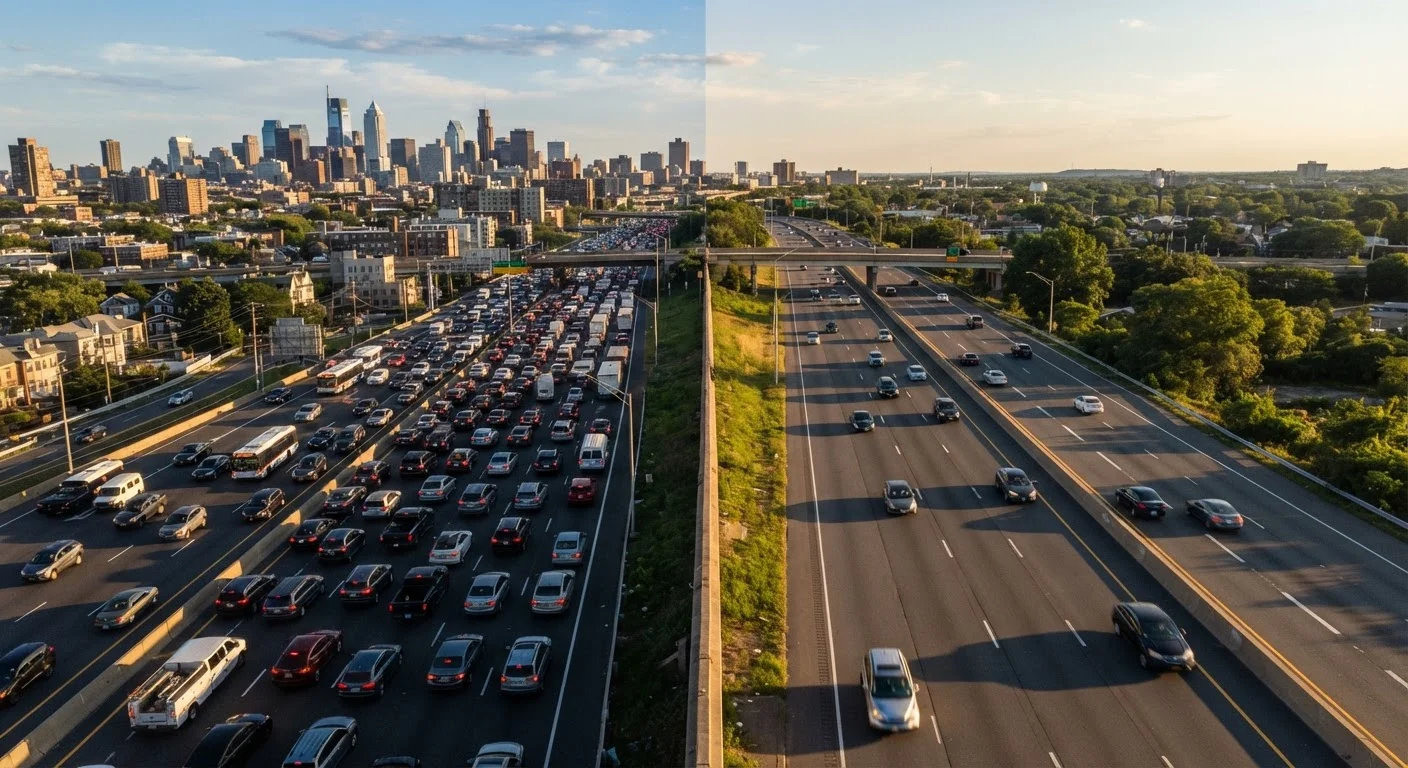
Key Takeaways
Option A
City Driving
The constant-demand, stop-and-go environment.
Best for: Short errands and commutes where distance is less important than navigating dense traffic.
Option B
Highway Driving
The steady-speed, aerodynamic-challenge environment.
Best for: Longer trips where sustained speed and predictable conditions allow the engine to operate efficiently.
If you primarily run short urban errands on a tight gas budget
City Driving (with adjusted habits)
You can't avoid city routes, but smoothing your acceleration and minimizing idle time are the highest-leverage habits to cut fuel waste in stop-and-go conditions.
If you have the choice between a highway route and a congested surface street route of similar distance
Highway Driving
Steady-speed highway travel is almost always more fuel-efficient than repeated stop-and-go, provided you keep speeds at or below 60-65 mph.
If you drive a hybrid or plug-in hybrid vehicle primarily in the city
City Driving
Hybrids recapture braking energy through regenerative braking, making city conditions far less punishing on fuel than they are for conventional gas engines.
If your trips are mostly highway but you often exceed 70 mph
Highway Driving (at moderated speed)
Aerodynamic drag rises sharply at higher speeds, eroding the highway efficiency advantage - easing back toward 60 mph can meaningfully stretch your miles per gallon.
Why Your Environment Shapes Fuel Consumption
Your car's fuel economy rating - the MPG figure on a window sticker - is split into two numbers for a reason. City and highway conditions place fundamentally different demands on your engine, drivetrain, and fuel system. Understanding those differences gives you a practical lens for reducing what you spend at the pump.
In simple terms, fuel is consumed whenever your engine is running. But how much fuel your engine demands at any moment depends on load - how hard it's working. City and highway driving create very different load profiles, and that's where the money goes.
For a deeper look at how specific behaviors compound these effects, see driving habits that silently drain your gas tank.
The City Driving Fuel Penalty: Stops, Starts, and Idle Time
City driving is hard on fuel for three interconnected reasons: frequent acceleration, repeated braking (which wastes kinetic energy as heat), and idling.
Acceleration is the biggest drain. Every time a light turns green, your engine must overcome inertia and bring the vehicle back up to speed. That demand spike requires a rich fuel mixture and significant throttle input - exactly the conditions that consume the most fuel per second.
Braking destroys the work you just paid for. In a conventional gas vehicle, the kinetic energy your engine built up is converted to heat at the brake pads when you slow down. You've essentially spent fuel to go nowhere useful. The harder and more frequently you brake, the more energy - and money - you discard.
Idling burns fuel at zero MPG. When you're sitting at a red light or stuck in gridlock, the engine is running and consuming fuel while the odometer doesn't move. Modern fuel-injected engines typically consume between 0.1 and 0.5 gallons per hour at idle, depending on engine size and accessories running.
| Criterion | City Driving | Highway Driving |
|---|---|---|
| Fuel efficiency (conventional gas) | Lower MPG due to stops and idling | Higher MPG at moderate speeds |
| Fuel efficiency (hybrid) | Often higher MPG via regen braking | Lower regen benefit; gas engine leads |
| Primary fuel drain | Repeated acceleration and idle time | Aerodynamic drag at speed |
| Idle fuel waste | Significant - lights, gridlock, queues | Minimal to none |
| Speed consistency | Constantly varying | Largely steady |
| Best driver habit to adopt | Gradual acceleration, early coasting | Moderate speed, cruise control on flats |
| Impact of excess vehicle weight | High - inertia cost paid repeatedly | Moderate - rolling resistance adds up |
Adopting a smoother, more anticipatory driving style - looking further ahead, accelerating gradually, and coasting toward red lights rather than braking hard - can meaningfully reduce city fuel waste. Hard acceleration and late braking are common culprits that compound city fuel costs.
The Highway Driving Equation: Aerodynamic Drag vs. Steady Efficiency
Highway driving eliminates most of what makes city driving so inefficient. There's no idling, far fewer acceleration events, and the engine can settle into a narrow, efficient operating range - typically in a high gear where it turns slowly relative to vehicle speed, reducing internal friction and fuel demand.
The catch is aerodynamic drag, which increases with the square of speed. That means going from 60 mph to 75 mph doesn't just add a little drag - it adds substantially more. The U.S. Department of Energy notes that fuel economy typically decreases significantly above 50 mph, with each 5 mph over 50 representing a meaningful efficiency penalty, though exact figures vary by vehicle.
~14%
Fuel economy drop per 10 mph over 50
The U.S. Department of Energy estimates that for most vehicles, each 5-10 mph above 50 mph reduces fuel economy noticeably, with losses accelerating at higher speeds.
0.1-0.5 gal/hr
Fuel consumed while idling
Engine size and accessory load (AC, headlights) influence idle fuel consumption; larger engines and running accessories push toward the higher end of this range.
~30%
City vs. highway MPG gap (typical gas vehicle)
EPA combined ratings for conventional gas vehicles often show city MPG running 20-35% below highway MPG, depending on vehicle class and powertrain.
This is why highway driving at moderate, consistent speeds is generally the most fuel-efficient mode for conventional gas vehicles. The sweet spot for most passenger cars tends to fall in the 45-60 mph range, where aerodynamic drag hasn't yet overwhelmed the engine's efficiency advantages.
If you use cruise control on the highway, it helps fuel economy most on flat terrain - on hilly roads it can actually cost you more by accelerating over crests unnecessarily.
Where Hybrids Change the Calculus
The conventional fuel economy hierarchy - highway better than city - flips for most hybrid and plug-in hybrid vehicles. Hybrids use regenerative braking, a system that converts the kinetic energy normally wasted as brake heat into electrical energy stored in a battery. That stored energy powers the electric motor during the next acceleration event, reducing how much the gas engine has to work.
City driving, with its frequent stops and starts, actually gives a hybrid more opportunities to recapture energy. On the highway, where there's little braking, the regenerative advantage largely disappears - and the gas engine must carry more of the load. This is why many hybrids show higher EPA city ratings than highway ratings, which is the reverse of conventional vehicles.
If you own a hybrid and do most of your driving in urban conditions, your vehicle is already better optimized for your environment than a conventional gas car would be. The key is still avoiding aggressive driving - regenerative braking captures energy efficiently, but it can't recover all of it.
Understanding how your dashboard fuel data reflects these patterns in real time is valuable. Your onboard fuel economy display can help you see exactly where your MPG is dropping and adjust accordingly.
Hybrid Ratings Can Look Counterintuitive
If you've ever noticed a hybrid's city MPG rating is higher than its highway rating, that's not a misprint. It reflects how regenerative braking captures energy during urban stop-and-go that would otherwise be lost. On the highway, where braking is rare, the gas engine carries more of the load and that advantage shrinks. Comparing your actual driving mix to a hybrid's rating breakdown can help you assess whether a hybrid would genuinely suit your route profile.
Practical Takeaways for Budget-Conscious Drivers
Knowing where your fuel actually goes is only useful if it changes something you do. Here are the highest-leverage adjustments based on your primary driving environment:
- City drivers: Accelerate gently from stops, coast toward red lights instead of braking at the last moment, and turn off the engine during extended waits when it's safe and legal to do so. These habits address the three core city fuel drains directly.
- Highway drivers: Keep speeds at or below 65 mph where traffic allows. Even modest speed reductions at highway speeds can produce noticeable MPG improvements over a long trip. Use cruise control on flat stretches.
- Mixed commuters: Route planning can shift your mix. The cheapest route isn't always the shortest - a slightly longer highway path may cost less in fuel than a congested surface street shortcut.
- All drivers: Excess weight and roof cargo affect both environments. Removing unnecessary cargo is a simple, free way to reclaim lost efficiency.
Finally, don't let common misconceptions steer you wrong. Several popular fuel-saving beliefs - like idling to warm up a modern engine - actually cost money rather than save it.