

Key Takeaways
Vehicle Load and Fuel Consumption
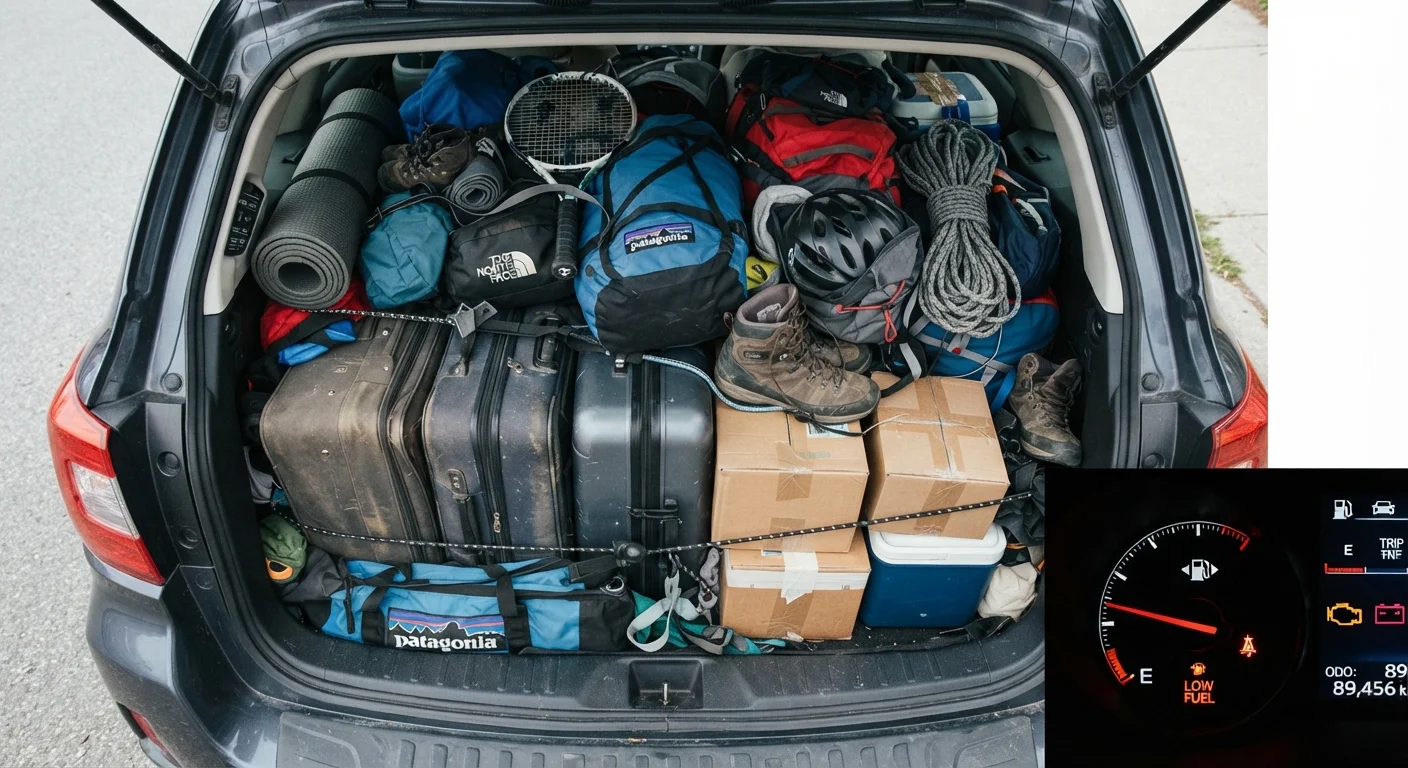
Vehicle load refers to the total weight a car carries beyond its own curb weight - passengers, cargo, roof racks, and gear. The heavier the load, the more energy the engine must produce to accelerate, maintain speed, and brake. This increased demand translates directly into higher fuel consumption and fewer miles per gallon.
The U.S. Department of Energy estimates that every 100 pounds of added weight can reduce fuel economy by roughly 1-2% for the average vehicle, though the actual impact varies by vehicle type, drivetrain, and driving conditions.
Why Weight Is Never Free in a Vehicle
Every pound your vehicle carries has to be accelerated from a stop, sustained at speed, and managed through braking - over and over, every trip. Your engine does all that work by burning fuel. This is why vehicle load is one of the most direct and predictable levers affecting fuel consumption.
The relationship is rooted in basic physics: kinetic energy scales with mass. A heavier vehicle requires more force - and therefore more fuel energy - to change its state of motion. Stop-and-go city driving amplifies this effect because you're constantly accelerating weight from zero. Highway driving is somewhat more forgiving, but added weight still increases rolling resistance and engine load at cruising speed.
For budget-conscious drivers, the practical takeaway is straightforward: unnecessary weight is a recurring tax on every gallon of gas you buy. Unlike aggressive driving habits, which require behavioral change, excess cargo is something you can simply remove.
1-2%
MPG reduction per 100 lbs of added weight
Estimate from the U.S. Department of Energy for the average passenger vehicle under typical driving conditions.
Up to 25%
Highway MPG loss from large roof cargo box
The U.S. Department of Energy cites this range for large, raised rooftop cargo carriers at highway speeds.
2-8%
Fuel economy reduction from empty roof rack
Bare crossbars and empty racks still alter aerodynamics enough to reduce highway efficiency, per DOE estimates.
The Hidden Penalty of Roof Cargo and Aerodynamic Drag
Weight isn't the only load-related fuel drain. Anything mounted to the outside of your vehicle - roof racks, cargo boxes, bike carriers, or kayak mounts - reshapes its aerodynamic profile. Aerodynamic drag increases with the square of speed, meaning it becomes significantly more punishing as you drive faster.
At highway speeds, a large rooftop cargo box can feel to your engine like driving into a constant headwind. Even a set of bare crossbars left on a roof year-round creates measurable drag. Research from automotive and energy organizations consistently shows that roof-mounted cargo is one of the most fuel-costly accessories a driver can leave installed between uses.
The fix is simple: remove roof racks, crossbars, and external carriers when you don't actively need them. If removal feels like a hassle, consider that the fuel cost over a year of daily driving can be substantial - even with a rack that looks lightweight.
Remove Racks Between Uses
If your roof rack or crossbars aren't holding cargo, take a few minutes to remove them before your regular driving routine resumes. Most modern racks are designed for tool-free or quick-release removal. The aerodynamic savings at highway speeds make the brief effort worthwhile - especially over weeks and months of daily commuting.
What to Audit Before Your Next Trip
Most drivers carry more in their vehicles than they realize. A common trunk inventory might include a spare set of jumper cables, emergency flares, sports equipment from last season, tools accumulated over years, and bags of items meant for donation. While some emergency gear is sensible to keep, much of the average trunk's contents is dead weight on most trips.
A quick load audit - physically checking what's in your trunk, back seat, and cargo area - is a zero-cost habit with long-term payoff. Seasonal items like winter tires stored in your trunk, or sand bags carried through summer, are easy wins. Similarly, if you're doing routine local errands, leaving bulky gear at home is straightforward.
For longer road trips, pack intentionally. Every item you're uncertain about is worth reconsidering. This pairs well with other fuel-efficiency practices - see how common fuel economy myths may also be costing you at the pump without your knowing it.
Putting Load in Context With Other Fuel Factors
Vehicle load is one piece of a larger efficiency picture. Tire pressure, for instance, affects rolling resistance independently of weight - under-inflated tires compound the fuel penalty of a heavy load. Speed and terrain matter too: heavy loads punish hill climbs and high-speed driving more than flat, moderate-speed cruising. And driving style - how smoothly you accelerate and brake - interacts directly with load, since smooth inputs are more efficient when the vehicle is heavier.
Understanding how city versus highway driving affects fuel use also helps you calibrate your expectations. A heavy load hurts city driving more than highway due to repeated acceleration cycles. By addressing load alongside pressure, speed, and driving smoothness, budget-conscious drivers can stack small gains into meaningful savings over time - no mechanical skills required.
“Reducing vehicle weight is one of the most effective strategies for improving fuel economy. Even modest reductions have a measurable impact over the life of the vehicle.”
— U.S. Department of Energy, Office of Energy Efficiency and Renewable Energy