

Key Takeaways
Start here
What Actually Happens When You Press the Gas Pedal
Next
Where Most of Your Fuel's Energy Goes
Then
How Modern Engines Are Designed to Recover Efficiency
Apply it
What This Means for How You Drive
What Actually Happens When You Press the Gas Pedal
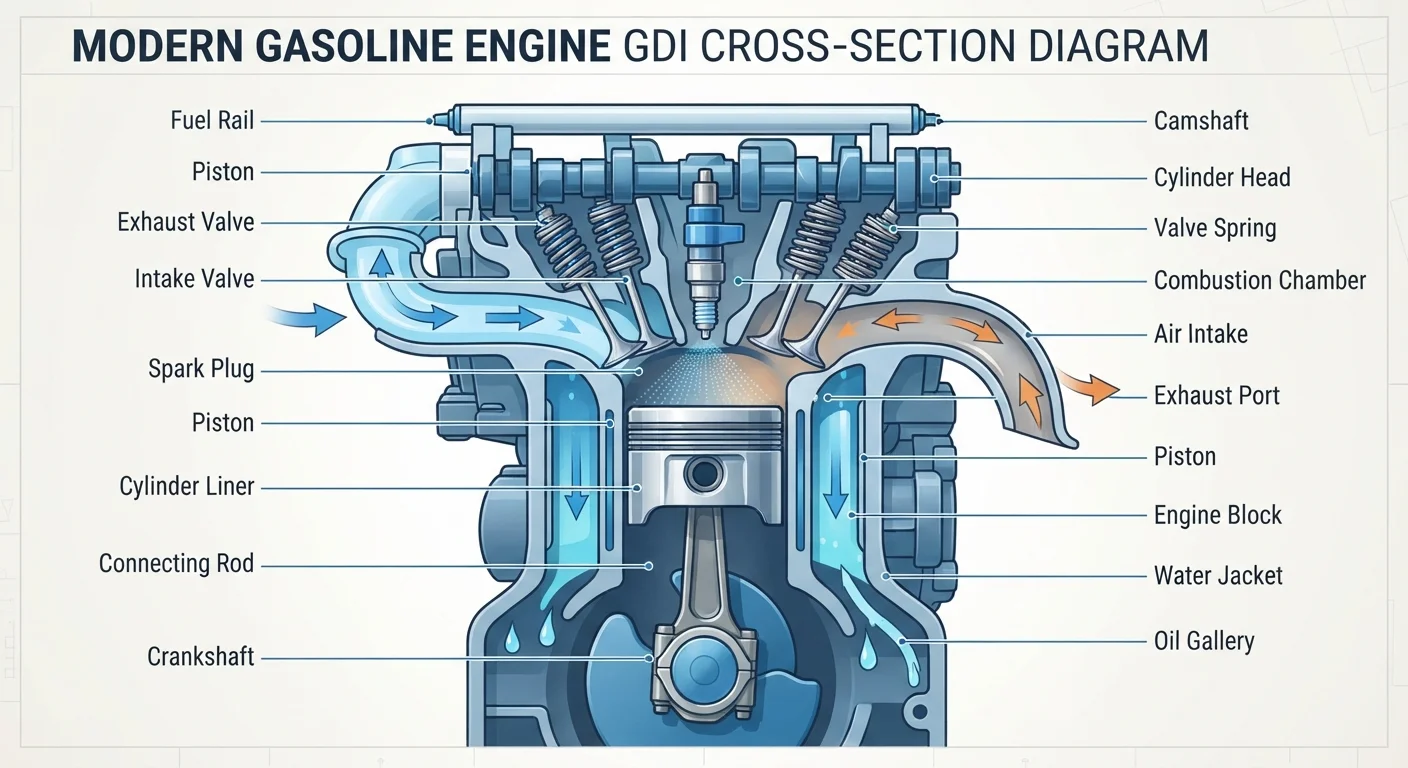
At its core, a gasoline engine is a heat engine - it converts the chemical energy stored in fuel into mechanical energy through controlled combustion. When you press the accelerator, you're telling the engine to admit more air and inject more fuel into the cylinders.
The process follows a four-stroke cycle:
- Intake: The piston moves down, drawing a mixture of air and fuel (or just air, in direct-injection engines) into the cylinder.
- Compression: The piston moves back up, compressing the mixture to increase combustion intensity.
- Power: The spark plug ignites the compressed mixture. Expanding gases push the piston down - this is the only stroke that generates mechanical work.
- Exhaust: The piston rises again, pushing burnt gases out of the cylinder.
This cycle happens hundreds of times per minute in each cylinder. The rotating crankshaft converts that up-and-down piston motion into the rotational force - called torque - that ultimately turns your wheels.
Four-stroke cycle
The sequence of intake, compression, power, and exhaust strokes that a gasoline engine repeats continuously to convert fuel into motion.
Torque
The rotational force the engine produces. Higher torque means the engine can push the vehicle forward with more authority, especially at lower speeds.
Thermal efficiency
The percentage of a fuel's heat energy that gets converted into useful mechanical work. In gasoline engines, a significant portion is always lost as heat.
Engine load
How hard the engine is working at any given moment. High load occurs during acceleration or climbing; low load occurs during steady cruising.
Direct injection
A fuel delivery system that sprays gasoline directly into the combustion chamber, allowing more precise control of the fuel-air mixture and improving efficiency.
Cylinder deactivation
An engine feature that temporarily disables some cylinders when full power isn't needed, reducing fuel consumption during light driving conditions.
Where Most of Your Fuel's Energy Goes
Here's the hard truth that every budget driver should understand: only a portion of the energy in your gasoline actually moves your car. The rest is shed as waste before it ever reaches the road.
Energy losses in a typical gasoline engine occur in several places:
- Exhaust heat (~30-35%): Hot combustion gases leave through the exhaust pipe carrying a large share of the fuel's energy with them.
- Engine cooling (~25-30%): Your radiator and coolant system deliberately remove heat to prevent engine damage - that heat is released into the air.
- Friction and accessories (~5-10%): Moving engine parts rub against each other, and accessories like the alternator and power steering pump draw mechanical power continuously.
- Drivetrain losses (~5%): Some energy is lost as the transmission, driveshaft, and differentials transfer torque to the wheels.
What remains - roughly 20-40% depending on conditions - is what actually propels the vehicle. Understanding this breakdown explains why small improvements in driving behavior can have a noticeable impact on your fuel bill. See how these efficiency figures translate into real-world MPG numbers for context on what the sticker estimate really represents.
Short Trips Are Harder on Efficiency Than They Look
A five-minute errand consumes a disproportionately high amount of fuel per mile because the engine never fully warms up and runs an enriched fuel mixture throughout. If your driving is mostly composed of short trips, your real-world fuel economy will likely fall well below any EPA estimate. Combining errands into a single outing is one of the simplest ways to improve average efficiency without changing how you drive.
How Modern Engines Are Designed to Recover Efficiency
Engineers have spent decades finding ways to recapture energy that older engines simply threw away. Several technologies now common in production vehicles are specifically aimed at reducing each category of loss:
- Direct fuel injection (DI)
- Injects fuel directly into the combustion chamber rather than the intake port, improving atomization, reducing fuel waste, and allowing higher compression ratios.
- Variable valve timing (VVT)
- Adjusts when intake and exhaust valves open and close depending on engine speed and load, keeping combustion efficient across a wider range of driving conditions.
- Cylinder deactivation
- Shuts down half the cylinders during light-load cruising (such as steady highway driving) to avoid burning fuel when full power isn't needed.
- Automatic start-stop
- Cuts the engine when the car is stationary and restarts it when the driver releases the brake, eliminating idle fuel burn at traffic lights.
- Turbocharging combined with engine downsizing
- A smaller turbocharged engine can produce the power of a larger naturally aspirated engine while consuming less fuel under typical loads.
These systems work together, but none of them override the physics of combustion. They reduce waste - they don't eliminate it.
What This Means for How You Drive
Knowing where fuel energy goes changes how you should think about driving efficiently. Because the power stroke is the only part of the four-stroke cycle that produces useful work, every unnecessary combustion event - idling, hard acceleration that immediately requires braking, rapid throttle changes - represents fuel burned without a proportional return in miles.
A few principles follow directly from the engine physics above:
- Smooth acceleration matters. Gradual throttle inputs keep the engine operating closer to its efficiency range rather than demanding peak fuel delivery.
- Maintaining speed is cheaper than recovering it. Every time you brake, you convert the kinetic energy your engine worked to build into heat in the brake pads - energy that must be re-purchased with more fuel.
- Warm engines are more efficient. Cold starts run rich fuel mixtures; short trips that never allow the engine to fully warm up are disproportionately costly per mile.
These principles connect directly to specific behaviors covered in common driving habits that quietly drain your tank. If you want to understand how your specific driving environment affects consumption, city versus highway fuel use breaks down how each setting interacts with engine efficiency differently. And before assuming popular fuel-saving tips will help, it's worth checking which fuel economy beliefs are myths.
Use Your Dashboard to See Engine Behavior Live
Many vehicles display instant fuel economy or fuel flow data in the instrument cluster or infotainment screen. Watching this readout while driving is one of the fastest ways to connect the physics described here to your actual behavior behind the wheel. See what your onboard fuel economy display is actually telling you for a full breakdown of those metrics.