

Key Takeaways
Start here
Setting Up Your Space
Next
Choosing the Right Movements
Then
Structuring Your First Four Weeks
When you're ready
Progressing Safely and Staying Motivated
Setting Up Your Space
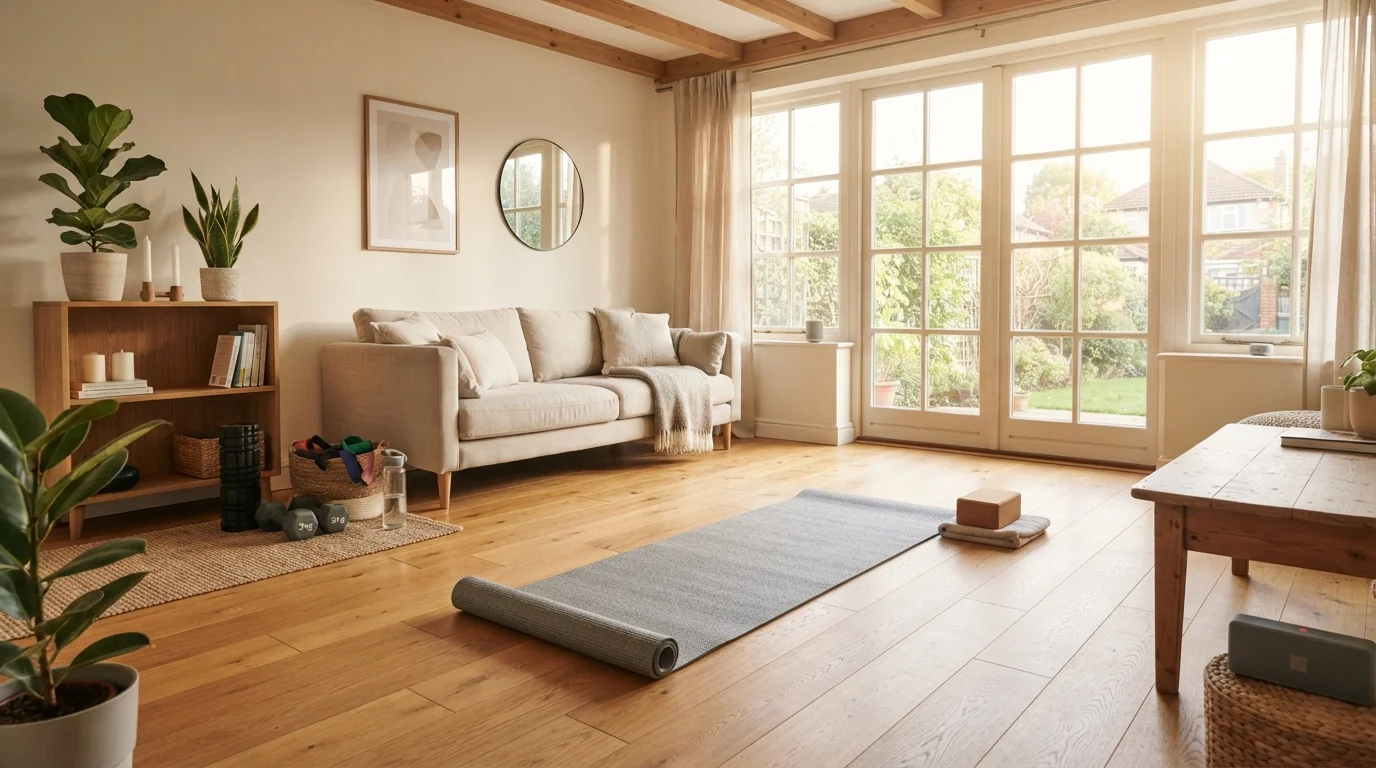
One of the most common reasons beginners delay starting is the belief that home exercise requires a dedicated room or expensive setup. In practice, a cleared area of approximately 6×6 feet - think a rolled-out yoga mat with a little breathing room - is sufficient for the vast majority of foundational movements. A living room, bedroom, or even a garage corner all work equally well.
Before your first session, remove obvious tripping hazards, check overhead clearance for any jumping movements, and ensure the surface isn't slippery. Hardwood floors or low-pile carpet are ideal. If you're working with a smaller footprint, our guide on moving well in a small apartment covers adapted approaches for studios and shared spaces.
Use Your Environment as Your Cue
Leaving your mat unrolled or placing your workout clothes in a visible spot the night before removes friction and signals your brain that exercise is part of the day's plan. Small environmental nudges like these are among the most researched and effective habit-formation strategies available.
Beyond physical space, consider a consistent time of day. Research consistently links habit formation to environmental cues, and exercising in the same spot at a predictable time reinforces the routine more effectively than varying both.
Choosing the Right Movements
Effective beginner programs are built around a small set of movement patterns rather than an overwhelming list of individual exercises. These patterns - squat, hinge, push, pull, and carry - together engage every major muscle group in the body.
Movement pattern
A fundamental category of how the body moves - such as pushing, pulling, or squatting - that groups many individual exercises together. Training by pattern ensures balanced muscle development.
Progressive overload
The principle of gradually increasing the challenge of exercise over time, so the body continues to adapt and grow stronger. This can mean more reps, slower tempo, or harder variations.
Rest day
A day without structured exercise, intentionally built into a training schedule to allow muscles and connective tissue time to recover and repair.
Bodyweight exercise
An exercise that uses only the weight of your own body as resistance, requiring no external equipment. Examples include push-ups, squats, and planks.
Time under tension
The total amount of time a muscle is under load or strain during an exercise set. Slowing down a movement increases time under tension and can make an exercise more challenging without adding weight.
Hinge
A movement pattern where the body bends primarily at the hips while the spine stays neutral. The glute bridge is a common hinge exercise beginners can do without equipment.
- Squat: Bodyweight squat, chair squat, or split squat
- Hinge: Glute bridge, single-leg deadlift (no weight)
- Push: Wall push-up, incline push-up, standard push-up
- Pull: Door-frame row, resistance band row (if available)
- Core: Plank (on knees or toes), dead bug, bird dog
Starting with two or three exercises per pattern - chosen at a difficulty level where you can complete all reps with good form - builds a complete, balanced foundation. For cardio, low-impact options like marching in place, step touches, or stair climbing require no gear. Our no-equipment cardio guide covers a wider range of options across fitness levels.
This content is general health information only and is not a substitute for guidance from a qualified healthcare or fitness professional. If you have a health condition, injury, or are new to physical activity, consult a professional before beginning.
Structuring Your First Four Weeks
The first month is about establishing a movement baseline, not pushing limits. A practical framework looks like this:
- Weeks 1-2
- Two sessions per week. Each session: 10-15 minutes. Focus on learning movement patterns with bodyweight only. Rest at least one full day between sessions.
- Weeks 3-4
- Three sessions per week. Each session: 15-25 minutes. Add a third exercise per session and begin exploring slightly harder variations (e.g., moving from a wall push-up to an incline push-up).
Keep a simple log - even a notes app entry - recording what you did and how it felt. This creates a visible record of progress and helps you spot patterns in energy or discomfort. For a ready-made weekly structure you can use after month one, the weekly movement template offers a balanced framework covering strength, cardio, and recovery.
Progressing Safely and Staying Motivated
Progression doesn't always mean doing more. In the early weeks, it can mean slowing a movement down (increasing time under tension), improving your range of motion, or holding a position for longer. These are legitimate, effective forms of overload that build strength without adding volume too quickly.
A few principles that support sustainable progress:
- Add one variable at a time. Increase reps or difficulty - not both simultaneously.
- Respect soreness. Mild muscle soreness 24-48 hours after a new workout is normal. Sharp or joint pain is a signal to stop and, if persistent, to consult a healthcare professional.
- Track what matters. Reps completed, perceived effort, and how a movement felt are more useful early-stage metrics than calories or heart rate. Our article on fitness metrics worth tracking explains which numbers are genuinely informative.
Motivation tends to fluctuate - that's normal for everyone, not a sign of failure. Building behavioral anchors (a set time, a playlist, a short warm-up ritual) makes showing up easier on low-motivation days. For a deeper look at the habits side, see our companion article on building a home workout habit that actually sticks.
After four weeks of consistent movement, you'll be ready to explore more structured programming. Our guide on programming your own home workouts covers sets, reps, and progression in detail.
This article is for general informational purposes only and does not constitute medical or fitness advice. Always consult a qualified healthcare professional before starting a new exercise program, especially if you have any existing health conditions or concerns.