

Key Takeaways
The 10% Rule and Why Treats Can Quietly Add Up
Treats are one of the most straightforward tools in a pet owner's toolkit - useful for training, bonding, and enrichment. But they're also an easy source of hidden calories. Veterinary nutritionists generally recommend keeping treats to no more than 10% of a pet's daily caloric intake. For a small dog eating 400 calories a day, that's just 40 calories from extras - a number that gets eaten up fast.
The problem isn't treats themselves; it's the assumption that they're nutritionally neutral. Many commercial treats are calorie-dense, high in fat or sodium, and formulated for palatability rather than nutrition. Offering a few too many over weeks adds up to weight creep, which carries real health consequences - joint stress, increased diabetes risk, and cardiovascular strain.
Practical approach: weigh or count treats per day, not per training session. If you're doing frequent training work, consider breaking treats into smaller pieces rather than giving full portions each time. You can also use part of your pet's measured daily kibble as training rewards - this keeps calories constant while still giving your pet something to work for. For more on how training and food overlap, see enrichment activities that double as training.
Training with Kibble Saves Money and Calories
Most dogs will work for pieces of their regular dry kibble during training sessions - especially if meals are served after, not before, training. This approach keeps calories consistent, reduces treat spend, and still gives your pet clear reinforcement. Reserve higher-value treats for more demanding tasks like recall or distraction training.
Food Toppers: When They Help, When They Hurt
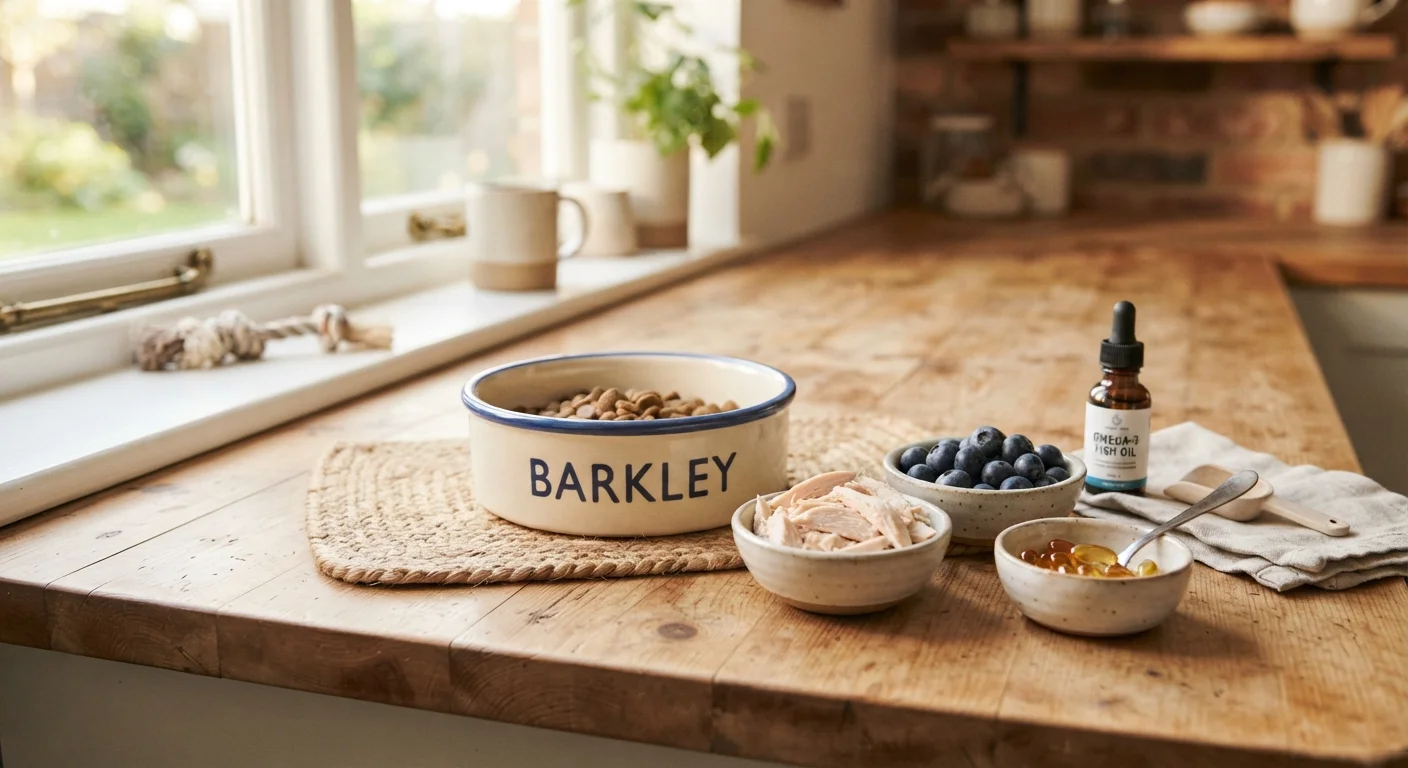
Toppers - small additions mixed into or placed on top of a pet's main meal - range from a spoonful of plain canned food to raw egg, bone broth, or cooked vegetables. Some serve a genuine purpose: increasing palatability for picky eaters, adding hydration for cats prone to urinary issues, or easing the transition to a new food. Others are more about the owner feeling good than providing measurable benefit.
The key principle is displacement: any topper that adds calories must be offset by a proportional reduction in the main meal. A tablespoon of plain cooked chicken might add 25-30 calories. If that goes on top of an already-full portion, the pet is eating over their target - consistently. Over time, even small daily surpluses translate to weight gain.
10%
Maximum treat share of daily calories
Veterinary nutrition guidelines broadly recommend treats and extras account for no more than 10% of a pet's total daily caloric intake to maintain dietary balance.
~60%
US pets estimated overweight or obese
The Association for Pet Obesity Prevention's annual surveys have consistently found over half of US dogs and cats classified as overweight or obese, with excess treat and calorie intake cited as a contributing factor.
What actually works well as a topper? Low-sodium broth (made without onion or garlic, both toxic to dogs and cats), plain cooked meat without seasoning, or a small amount of plain canned food of the same protein type. These are cost-effective and carry a lower risk of introducing ingredients your pet can't tolerate. For a deeper look at reading ingredient labels on any product you add to the bowl, see how to decode pet food labels.
Supplements: Evidence, Hype, and What Vets Actually Recommend
The pet supplement market is large and growing - and largely under-regulated. Unlike pet medications, supplements in the US are not subject to pre-market approval by the FDA. This means quality, potency, and label accuracy vary widely between products. Owners can spend significant money on supplements with little assurance that what's on the label is what's in the product.
That said, certain supplements have a credible evidence base for specific conditions. Omega-3 fatty acids (particularly EPA and DHA from fish oil) are among the most studied, with research supporting their role in coat health, inflammation management, and joint support in dogs. Probiotics have a growing body of evidence for certain digestive conditions. Glucosamine and chondroitin are commonly recommended for joint support in older dogs, though the evidence is more mixed than marketing suggests.
AAFCO 'Complete and Balanced' Means Something Specific
When a pet food label states it meets AAFCO nutritional profiles or has passed an AAFCO feeding trial, it has been formulated or tested to meet defined nutrient minimums for a life stage. This doesn't mean every food is identical in quality, but it does mean supplementing vitamins and minerals on top of such a diet is generally unnecessary for healthy pets. Adding fat-soluble vitamins (A, D, E, K) beyond what a balanced diet already provides carries real toxicity risk.
Where supplements clearly don't belong: healthy pets eating a complete and balanced commercial diet. Commercial pet foods labeled as meeting AAFCO (Association of American Feed Control Officials) nutritional standards are formulated to provide complete nutrition. Adding fat-soluble vitamins on top of an already balanced diet risks toxicity, not benefit - vitamin A and D in particular can reach harmful levels.
Always discuss supplements with your veterinarian before starting. This matters especially for pets with underlying health conditions, where certain additions can interfere with treatment or worsen symptoms. See what general feeding advice gets wrong for pets with health conditions for condition-specific context.
Count calories from treats and toppers as part of the daily total, not in addition to it.
Treats and toppers carry real caloric weight. Treating them as extras outside the main meal is one of the most common drivers of gradual weight gain in pets. Consistent accounting keeps intake in check without requiring strict elimination of extras.
Only add supplements in response to a confirmed need, not preventively.
Over-supplementing a balanced diet can disrupt nutrient ratios and, in the case of fat-soluble vitamins, cause toxicity. Supplements are most effective and safest when targeted at a specific, identified gap or health concern.
Use plain, single-ingredient whole foods as toppers rather than processed topper products where possible.
Processed toppers often contain added salt, flavoring agents, and preservatives. Plain options - cooked chicken, plain canned fish, low-sodium broth made without alliums - deliver palatability and moisture without the additives, typically at lower cost.
Check that any supplement carries a third-party quality certification.
Because pet supplements aren't pre-approved by regulators, certification from organizations that test for label accuracy and contaminants is one of the few practical quality signals available to owners. Without it, potency and safety are harder to verify.
Adjust the main meal whenever a regular topper is introduced.
Failing to reduce the primary food portion when adding a topper creates a chronic caloric surplus. Even modest daily overfeeding compounds into measurable weight gain over months.
Spending Smart: Prioritizing What Actually Earns Its Place in the Bowl
For budget-conscious owners, the supplement and topper aisle is a place where money is easily spent on things that deliver more marketing than measurable value. A useful mental filter: does this addition address a specific, identifiable need in my pet - or am I buying reassurance?
Actual need might look like: a senior dog with confirmed joint stiffness, where your vet has recommended an omega-3 or glucosamine product. Or a cat recovering from a gastrointestinal episode, where a vet-recommended probiotic may help stabilize gut flora. Or a picky eater refusing a new food, where a small amount of warm broth makes the transition workable without requiring a more expensive formula.
Reassurance might look like: buying a 'superfood' topper because it sounds nutritious, or adding a multivitamin because you take one yourself. Human nutritional logic does not map cleanly onto pet biology, and both cats and dogs have species-specific requirements that differ significantly from ours.
The most budget-responsible approach is to start with a complete, balanced main diet and add only what a veterinarian confirms is warranted. For broader strategies on managing pet food costs without compromising quality, see practical approaches to stretching your pet food budget. And if you're considering preparing some meals yourself, the risks of nutritional gaps are real - what to know before making homemade pet food covers what a complete diet actually requires.
This article is for general informational purposes only and is not a substitute for veterinary advice. Always consult a licensed veterinarian before making changes to your pet's diet or adding supplements.