

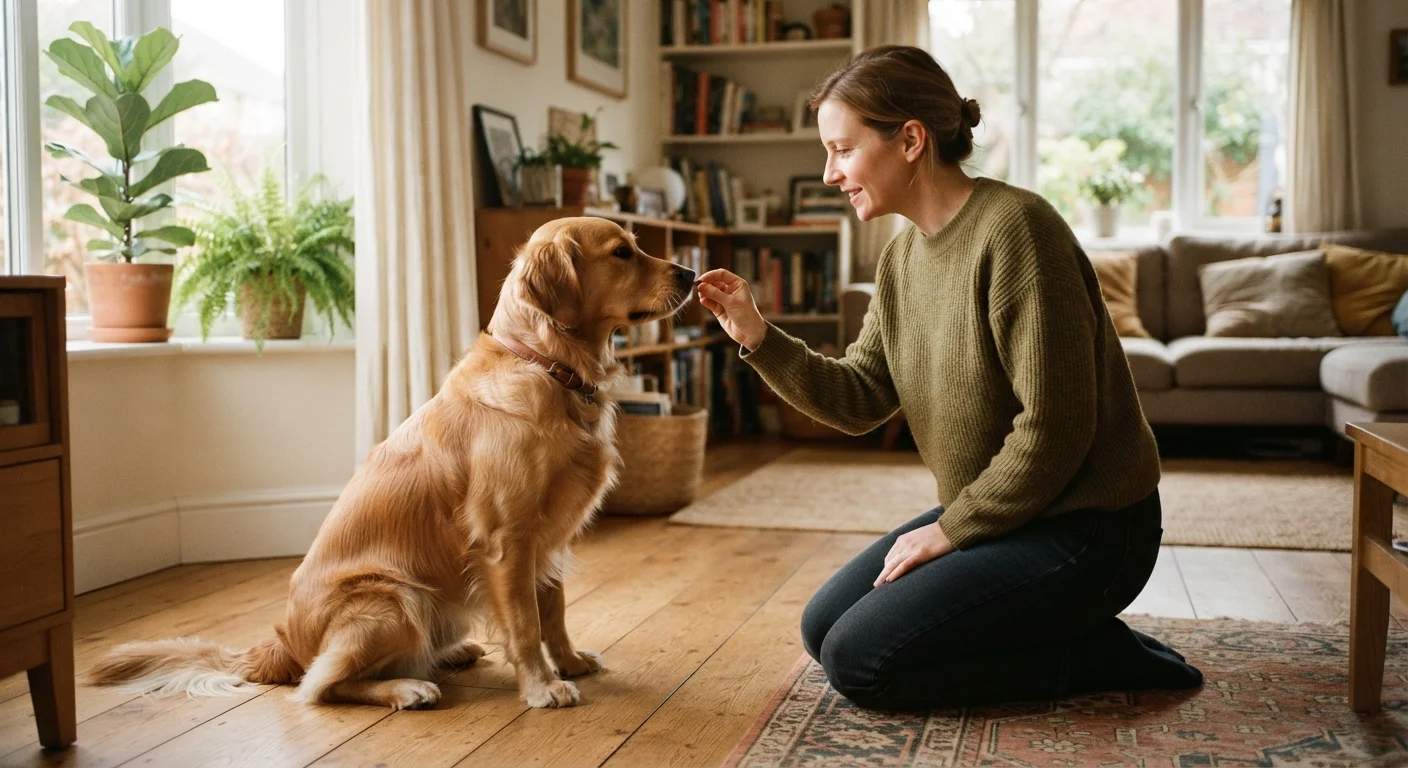
Key Takeaways
No cost beyond everyday treat rewards
Home training requires no enrollment fee, no equipment, and no travel cost - making it accessible for any household budget.
Flexible scheduling fits any lifestyle
Sessions can happen morning, evening, or in two-minute windows throughout the day, removing the barrier of fixed weekly class times.
Addresses your dog's specific problem behaviors
You can focus exclusively on the habits that actually affect your daily life, rather than following a standardized curriculum.
Training occurs in the real environment
Dogs initially learn behaviors in context, so training at home can make generalization to everyday situations more direct.
Strengthens the owner-dog bond through repetition
Daily interaction during training sessions builds communication and trust in ways that a once-weekly class cannot sustain on its own.
No professional feedback on handler mistakes
Owners often reinforce unwanted behaviors accidentally through mistimed rewards or inconsistent cues - errors a trainer would catch immediately.
Limited access to controlled distractions
Home environments rarely reproduce the level of distraction a dog will face in public, making it harder to build truly reliable obedience.
Socialization opportunities are difficult to engineer
Safe, structured exposure to other dogs and unfamiliar people - critical during puppyhood - requires deliberate logistics that classes provide automatically.
Owner confidence gaps can stall progress
Without external validation, unsure owners may abandon approaches too quickly or misread their dog's responses, slowing skill development.
Problem behaviors may worsen without expert guidance
Reactivity, fear-based behavior, and aggression require professional assessment; home training attempts can inadvertently make these patterns harder to resolve.
Our Verdict
Home training is a genuinely viable path for motivated owners willing to invest time and structure, especially for basic obedience and daily manners. Group classes add professional oversight and real-world distraction exposure that home environments simply cannot duplicate. For most dogs, a blended approach - starting with professional guidance, then maintaining skills through daily home practice - delivers the strongest long-term results.
Home training suits budget-conscious owners with consistent schedules and dogs that are not reactive or severely undersocialized; group classes are most valuable for first-time owners, puppies in their socialization window, and dogs with established problem behaviors.
What Each Approach Actually Involves
Home training means you, your dog, and whatever free resources you can find - library books, reputable veterinary behavior websites, or video content from credentialed trainers. Sessions happen on your timeline, in your space, using your household as the training environment. There are no enrollment fees, no fixed schedules, and no commute.
Group classes are structured programs - typically six to eight weeks - led by a professional trainer or certified behaviorist. Dogs and handlers work through exercises together in the same room, deliberately surrounded by other dogs and people. Most programs follow a set curriculum covering sit, stay, recall, and loose-leash walking, though quality and methodology vary considerably between providers.
If you're entirely new to dog training, this starting point for first-time owners covers the foundational principles worth understanding before choosing either route.
The Case for Training at Home
No cost beyond everyday treat rewards
Home training requires no enrollment fee, no equipment, and no travel cost - making it accessible for any household budget.
Flexible scheduling fits any lifestyle
Sessions can happen morning, evening, or in two-minute windows throughout the day, removing the barrier of fixed weekly class times.
Addresses your dog's specific problem behaviors
You can focus exclusively on the habits that actually affect your daily life, rather than following a standardized curriculum.
Training occurs in the real environment
Dogs initially learn behaviors in context, so training at home can make generalization to everyday situations more direct.
Strengthens the owner-dog bond through repetition
Daily interaction during training sessions builds communication and trust in ways that a once-weekly class cannot sustain on its own.
The single biggest advantage of home training is cost - there is none, beyond treats. That matters for households running tight budgets. It also lets you address the specific behaviors that actually disrupt your life: counter-surfing, door-bolting, or pulling on the leash during your particular neighborhood walk.
Home training also allows you to work in short, frequent bursts. Research in animal learning consistently supports that multiple brief sessions outperform one long one. Building short sessions into a daily routine is more achievable at home than coordinating weekly class attendance.
The environment itself is an asset: your dog generalizes behaviors faster when initially learned in the context where they'll actually be needed.
The Case for Group Classes
No professional feedback on handler mistakes
Owners often reinforce unwanted behaviors accidentally through mistimed rewards or inconsistent cues - errors a trainer would catch immediately.
Limited access to controlled distractions
Home environments rarely reproduce the level of distraction a dog will face in public, making it harder to build truly reliable obedience.
Socialization opportunities are difficult to engineer
Safe, structured exposure to other dogs and unfamiliar people - critical during puppyhood - requires deliberate logistics that classes provide automatically.
Owner confidence gaps can stall progress
Without external validation, unsure owners may abandon approaches too quickly or misread their dog's responses, slowing skill development.
Problem behaviors may worsen without expert guidance
Reactivity, fear-based behavior, and aggression require professional assessment; home training attempts can inadvertently make these patterns harder to resolve.
The most significant thing a group class provides that home training cannot is controlled distraction. Learning to sit reliably in your quiet kitchen is a very different skill from holding a sit while another dog trots past. Group settings create that gap-bridging challenge systematically.
Professional instructors also catch handler errors in real time - misaligned timing, inadvertent reward of unwanted behavior, or tension on the leash that undermines the lesson. These are subtle mistakes that owners often cannot self-diagnose from a video tutorial. Understanding why dogs repeat bad habits often comes down to exactly these kinds of unintentional reinforcement patterns.
For puppies specifically, the socialization window closes around 12-16 weeks. A class attended during that period delivers exposure to novel dogs, people, and surfaces in a supervised environment - an outcome home training genuinely cannot replicate alone.
Reactive or Fearful Dogs Need Different Planning
Group classes are not appropriate for every dog. Dogs showing significant reactivity, fear-based responses, or any history of aggression toward other dogs or people should be evaluated by a veterinary behaviorist or certified applied animal behaviorist before joining a group setting. Placing a reactive dog in close proximity to unfamiliar dogs can worsen the problem rather than resolve it. Ask any class provider about their assessment process before enrolling.
When to Blend Both Approaches
The most practical answer for most owners is not either/or. A six-week foundational class gives you professional feedback and socialization opportunities early on; consistent daily home practice is what actually builds reliable behavior over time. Enrichment activities that double as training are a low-effort way to reinforce class lessons without carving out dedicated drill time.
Owners of newly adopted rescue dogs should read what to establish before starting training - some dogs need a decompression period before any formal training environment is appropriate, whether at home or in a group.
12-16 weeks
Critical puppy socialization window
Veterinary behaviorists generally agree that primary socialization in dogs closes between 12 and 16 weeks of age, making early exposure especially time-sensitive.
5-10 min
Recommended session length per training block
Animal behavior guidance from organizations such as the American Kennel Club suggests keeping individual training sessions short to maintain attention and reduce frustration.
Whichever route you choose, consistency in timing, cues, and consequences matters more than the setting itself. A dog trained imperfectly at home by a committed owner will often outperform one who attends class but receives no follow-through the rest of the week.