

Key Takeaways
Why Puppies Jump and Why It Persists
Jumping up is a natural puppy greeting behavior - in the wild, young dogs lick the mouths of returning pack members as a social signal, and jumping up is how they reach human faces. The problem isn't that puppies jump; it's that humans inadvertently teach them that jumping works.
Every time someone pushes a puppy down, makes eye contact, or says "no" while the puppy has its paws up, the puppy receives exactly what it wanted: engagement. Even negative attention is still attention. This is why scolding alone rarely solves the problem. Understanding this dynamic is the first shift owners need to make.
If you're new to training principles, the first-time owner's training guide provides useful grounding before you start. And if you've recently adopted a rescue dog, the rescue dog checklist covers what to observe and avoid in the early weeks.
What you will need
How to Train the Calm Greeting
The steps below require no equipment beyond a handful of small, soft treats. Keep sessions short - five to ten minutes - and practice multiple times per day. Vary who plays the role of the greeter so your puppy generalizes the behavior across people.
Set a consistent house rule before you start
Decide on one clear rule - such as "four paws on the floor to receive attention" - and make sure every person in the household agrees to it before beginning. Write it down if needed. This step costs nothing and is the single most important factor in success.
Practice approach-and-ignore
Approach your puppy calmly. The moment all four paws leave the ground, turn your back completely and cross your arms. Do not speak, make eye contact, or push the dog away. Wait silently until all four paws return to the floor - even if only briefly.
Mark and reward the moment all four paws land
The instant all four paws touch the floor, turn back, say a short marker word such as "yes" in a calm tone, and offer a small treat at knee level - not at face level, which could encourage the puppy to jump toward your hand. Keep your voice calm; over-the-top praise can re-trigger excitement.
Add a sit once four-paws-down is reliable
Once your puppy consistently keeps all four paws on the floor for a few seconds, begin asking for a sit as the greeting behavior. Ask once in a neutral tone, wait, and reward immediately when the puppy sits. A sitting dog physically cannot jump - it becomes an incompatible replacement behavior.
Gradually introduce real-world greetings
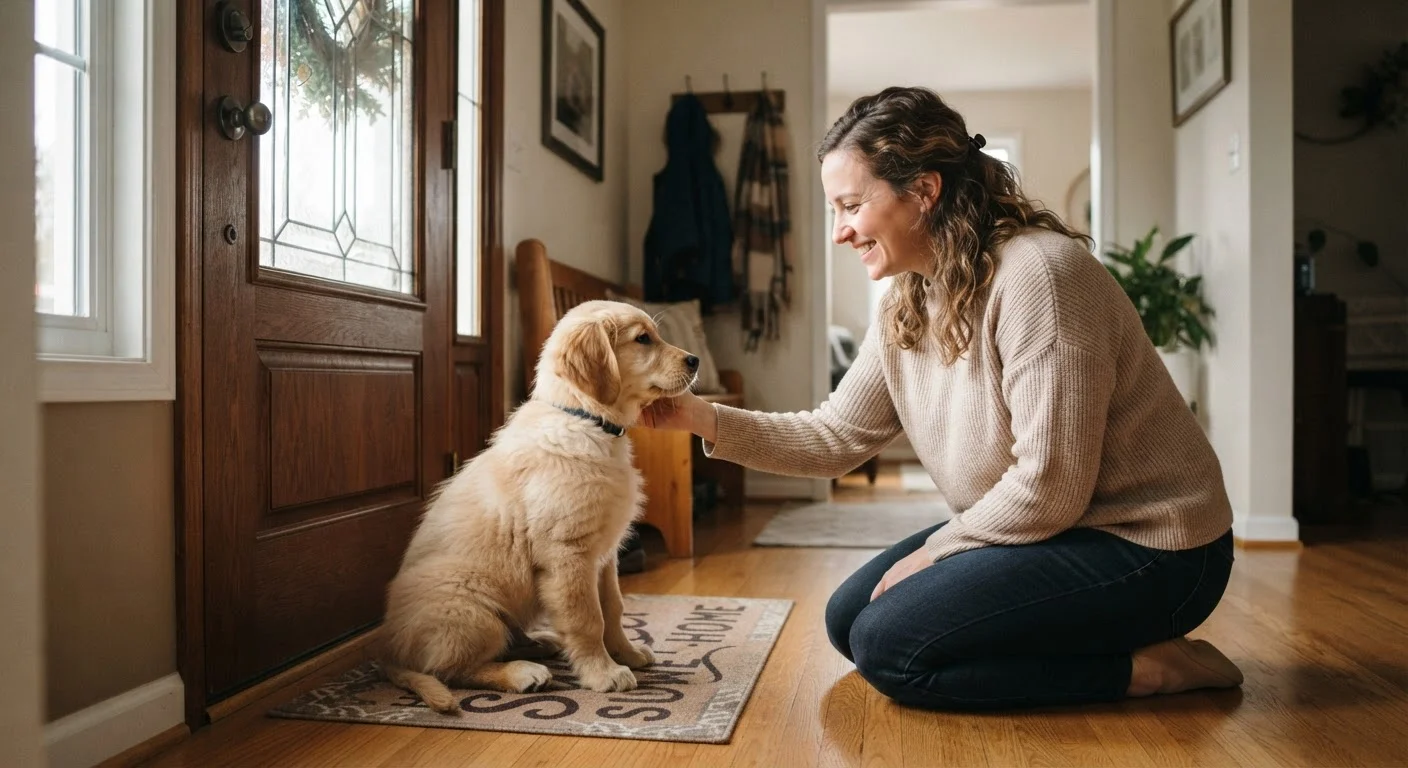
Start practicing with familiar, calm visitors who agree to follow the same rules. Before a guest enters, ask them to wait outside until the puppy is sitting or standing calmly. If the puppy jumps the moment the door opens, the guest turns away, waits for calm, and tries again. Repeat until the puppy connects calm behavior with the guest entering.
Keep Greetings Low-Key on Your End Too
Your own energy sets the tone. If you burst through the door with high-pitched excitement, your puppy will mirror that state and jumping becomes almost inevitable. Try entering calmly, ignoring your puppy for thirty seconds, and only greeting once it has settled. This small change alone makes a noticeable difference for many owners.
Common handler habits, such as inconsistent cues or delayed rewards, can slow progress significantly. See the article on training signals that confuse pets for a practical breakdown of what to avoid.
Making the Behavior Stick
Once your puppy reliably keeps four paws on the floor during practice, start applying the rule in real-life situations: guests arriving, returning from a walk, or greeting a neighbor outdoors. Real-world greetings are more exciting and will require patience before the behavior holds in those contexts.
Ask visitors to follow the same rule before they enter your home. One guest who allows jumping - even once - can reset days of progress. This is one of the most common failure points owners face. If household consistency is a challenge, it's worth exploring home training versus group classes to find an approach the whole family can commit to.
For a broader view of how greeting behavior fits into your puppy's overall development, the complete pet behavior and training resource covers learning theory and how to maintain progress over time.
This article is for general informational and educational purposes. For behavioral concerns that go beyond typical puppy training - such as aggression, fearfulness, or signs of anxiety - consult a qualified veterinarian or certified professional dog trainer.