

| Most common failure reason | Product or category exclusion |
| Typical expiry window | 7-30 days from issue date |
| Codes allowed per order | Usually 1 (retailer-dependent) |
| Minimum threshold calculated | Before tax and shipping; after prior discounts |
| New-customer codes | Tied to email address; not reusable on existing accounts |
| Sitewide codes exclude | Sale items, gift cards, select brands (check terms) |
Why Promo Codes Fail at Checkout
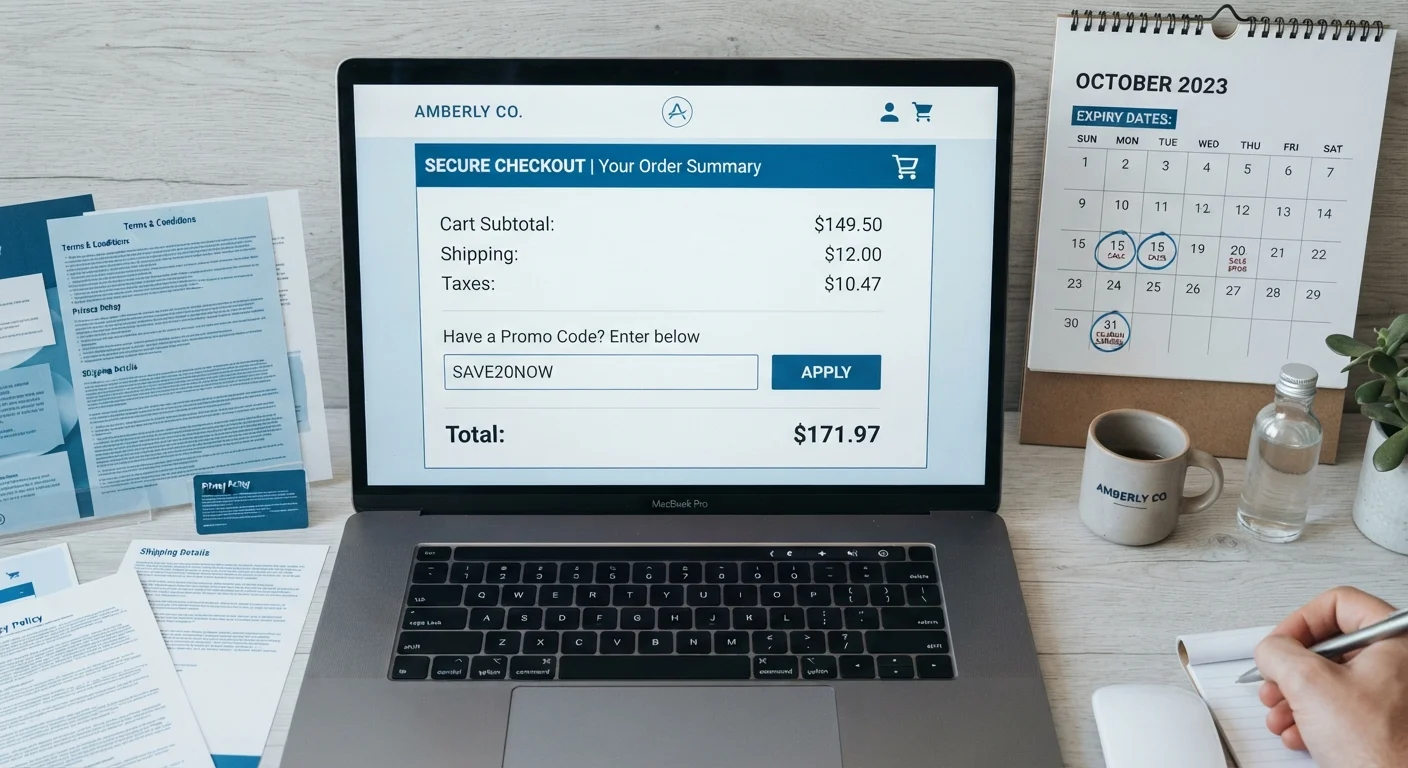
You've found a promo code, added items to your cart, and hit apply - only to see "code invalid" staring back at you. This happens more often than it should, and almost every failure has a specific, preventable cause. Understanding the mechanics of a promo code before you shop saves frustration and, more importantly, saves money.
Promo codes are retailer-issued discount triggers tied to a specific set of conditions. The discount only fires when all conditions are satisfied simultaneously. Most shoppers focus on the headline discount - 20% off, free shipping - and skip the conditions entirely. That's the gap this guide closes.
For a broader overview of how promo codes differ from paper coupons and cashback offers, see how each savings tool actually works.
| Most common failure reason | Product or category exclusion |
| Typical expiry window | 7-30 days from issue date |
| Codes allowed per order | Usually 1 (retailer-dependent) |
| Minimum threshold calculated | Before tax and shipping; after prior discounts |
| New-customer codes | Tied to email address; not reusable on existing accounts |
| Sitewide codes exclude | Sale items, gift cards, select brands (check terms) |
The Four Restriction Categories You Must Check
1. Expiry Dates and Time Windows
Every promo code has either a hard expiry date, a usage-count cap, or both. A hard expiry cuts the code off at a specific date and time - often midnight in the retailer's local time zone, not yours. A usage cap (e.g., "first 500 redemptions") means a code can die before its printed end date. Always verify the exact date and, if possible, apply the code early in the day rather than at 11:58 p.m.
2. Product and Category Exclusions
The most common fine-print clause is the exclusion list. Sale items, clearance merchandise, new arrivals, gift cards, and specific brand lines are routinely excluded - even when the code says "sitewide." Exclusions are usually listed in a collapsed terms section beneath the offer. Look for phrases like "excludes select items," "not valid on already-reduced merchandise," or brand names listed after "excluding."
3. Minimum Order Thresholds
Many codes require a minimum cart subtotal - calculated before tax and shipping, and after any other discounts already applied. If a $15-off code requires a $75 subtotal, and you've already applied a store credit that brings your cart to $68, the code will reject. Always confirm the qualifying subtotal calculation method in the terms.
4. Single-Use and Account Restrictions
Some codes are one-time-use per account, tied to a specific email address, or issued only to new customers. Attempting to reuse a single-use code, or applying a new-customer code to an existing account, will trigger an error. Loyalty program members sometimes receive member-exclusive codes that are not stackable with public promotions.
Hard expiry
A fixed date and time after which a promo code is permanently deactivated by the retailer's system. Once passed, the code cannot be reactivated regardless of circumstances.
Usage cap
A limit on the total number of times a promo code can be redeemed across all customers. A code with a usage cap can expire before its printed end date once the redemption limit is reached.
Qualifying subtotal
The cart total used to determine whether a minimum order threshold is met. Typically calculated before tax and shipping, and after any previously applied discounts or store credits.
Exclusion list
A set of products, categories, or brands explicitly ineligible for a promo code discount. Exclusions are usually disclosed in the offer's terms and conditions, often in collapsed or small-print format.
Single-use code
A promo code that can only be redeemed once, either per account or in total. Attempting a second redemption with the same code or on the same account will result in an error.
Code stacking
Applying more than one discount code to a single order. Most retailers prohibit stacking multiple promo codes, though a code may still stack with store credits, gift card balances, or loyalty rewards depending on retailer policy.
Stacking Rules and Cashback Interactions
Retailers typically allow only one promo code per order. If you have two valid codes, you'll need to determine which yields greater savings and use that one. Some retailers allow a promo code to stack with a store credit or gift card balance, but not with another promo code.
The more critical stacking question involves cashback portals. Applying a promo code sourced from outside a cashback portal - such as a code found on a deal forum - can sometimes disrupt portal tracking, depending on how the retailer's affiliate system handles the discount. This is a nuanced scenario worth understanding before checkout. See when stacking backfires for specific scenarios where the combination doesn't work in your favor.
Browser extensions that auto-apply coupons also interact with promo codes in unpredictable ways. Understand their limitations before relying on them to catch every valid code at checkout.
Before finalizing any order, run through a quick savings verification routine. A structured pre-checkout habit - confirming code validity, cashback activation, and exclusion status - takes under two minutes and prevents most of these failures. A pre-checkout checklist can make this systematic.