

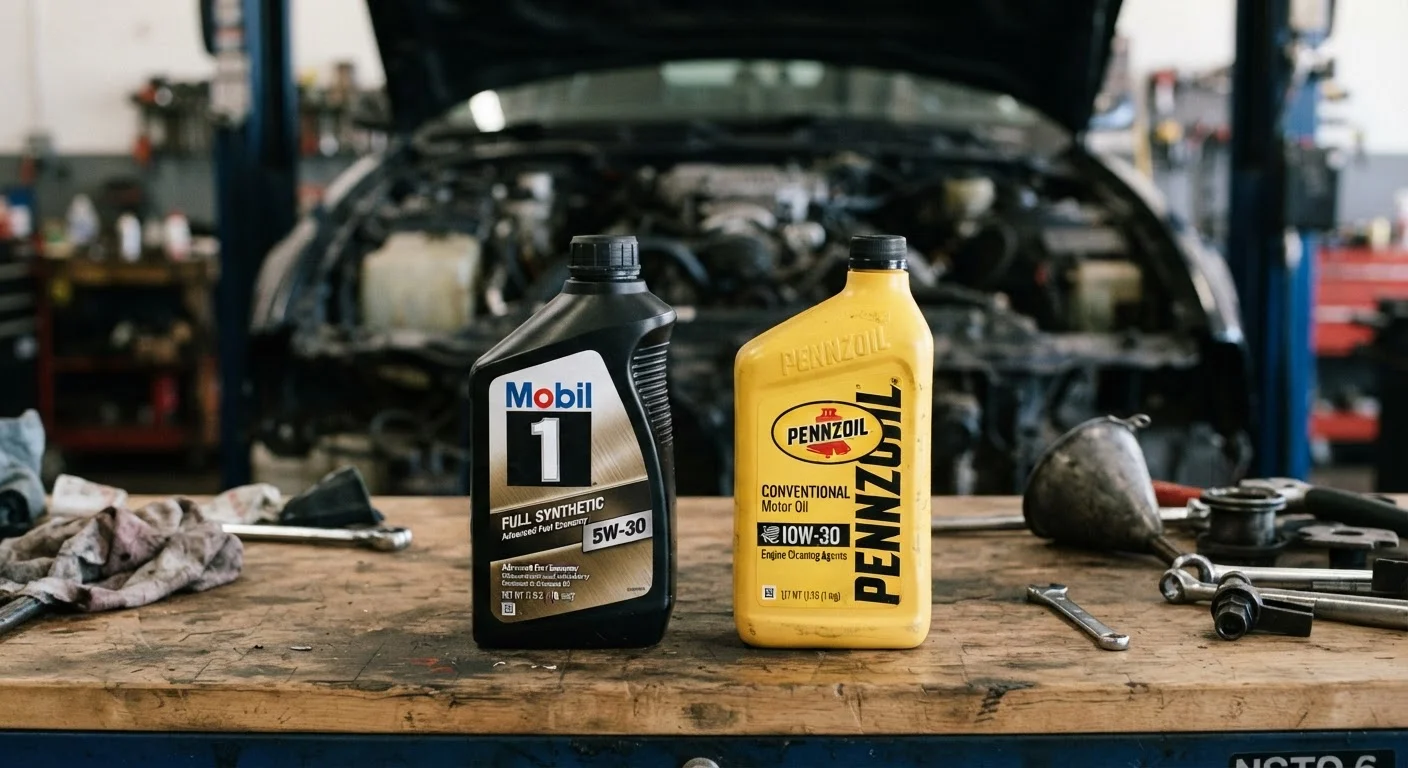
Key Takeaways
Option A
Synthetic Motor Oil
The engineered, high-performance formulation.
Best for: Drivers with newer vehicles, turbocharged engines, extreme climates, or longer intervals between oil changes.
Option B
Conventional Motor Oil
The time-tested, budget-friendly standard.
Best for: Drivers with older, simpler engines, mild climates, and frequent oil change habits who want to minimize upfront cost.
If your vehicle manufacturer specifies synthetic oil
Synthetic Motor Oil
Manufacturer requirements exist for engine protection and warranty compliance - this is non-negotiable regardless of cost.
If you drive a high-mileage older vehicle with a simple naturally aspirated engine
Conventional Motor Oil
Older engines with looser tolerances often perform reliably on conventional oil, and the lower cost per change is a real budget advantage.
If you drive a turbocharged or performance engine
Synthetic Motor Oil
Turbochargers generate intense heat that breaks down conventional oil faster; synthetic's thermal stability provides meaningful protection here.
If you want to stretch oil change intervals to save time and money
Synthetic Motor Oil
Synthetic formulations are generally rated for longer service intervals, which can offset the higher per-quart price over time.
If you're on the tightest possible budget with a well-maintained older car
Conventional Motor Oil
When your owner's manual permits it, conventional oil used at the correct interval provides adequate protection at a lower out-of-pocket cost.
What Makes These Two Oils Different
Motor oil's primary job is to lubricate moving metal parts, carry away heat, and suspend contaminants until your next oil change. Both synthetic and conventional oils do this - they just do it with different raw materials and to different degrees of precision.
Conventional motor oil is refined directly from crude petroleum. The refining process removes many impurities, but the resulting oil still contains a mix of hydrocarbon molecules of varying sizes and shapes. That inconsistency affects how the oil behaves under temperature extremes.
Synthetic motor oil is either fully synthesized from chemical compounds or heavily re-engineered base stocks. The molecules are more uniform in size and shape, which gives synthetic oil several measurable advantages: it flows more readily at cold startup (reducing the critical seconds when most engine wear occurs), it resists breakdown at high temperatures, and it generally carries more effective additive packages.
One thing both oil types share: they use the same viscosity grading system. When you see 5W-30 on a label, the "5W" describes cold-weather flow performance and the "30" describes viscosity at operating temperature. Always match the grade your owner's manual specifies - using the wrong viscosity is a more urgent problem than choosing synthetic versus conventional.
| Criterion | Synthetic Motor Oil | Conventional Motor Oil |
|---|---|---|
| Base material | Engineered chemical compounds | Refined crude petroleum |
| Cold-start flow | Flows faster in low temps | Thicker at cold startup |
| Heat resistance | Higher thermal stability | Breaks down faster under heat |
| Typical change interval | 7,500-10,000+ miles | 3,000-5,000 miles |
| Cost per quart (approximate) | Higher (roughly 2-3x) | Lower upfront cost |
| Turbocharged engine suitability | Generally recommended | Not ideal under high heat |
| Older engine compatibility | Safe for most well-maintained engines | Long-established compatibility |
The Real Cost Comparison
Synthetic oil typically costs two to three times more per quart than conventional. For a five-quart change, you might spend $8-$15 for conventional versus $25-$45 for full synthetic, before labor if you're not doing it yourself. That gap looks significant in isolation.
But the math gets more nuanced when you factor in change intervals. Conventional oil is generally recommended every 3,000-5,000 miles under normal driving conditions, while many synthetic formulations are rated for 7,500-10,000 miles or more (always verify with your owner's manual and your specific driving conditions). If synthetic gets you twice as many miles between changes, the per-mile cost difference narrows considerably.
~40%
Engine wear occurring at cold startup
Industry engineering literature commonly attributes a significant share of total engine wear to the first seconds after a cold start, before oil fully circulates.
2-3x
Typical synthetic-to-conventional price ratio
Retail pricing across auto parts retailers consistently shows full synthetic costing roughly two to three times more per quart than conventional equivalents in the same viscosity grade.
Up to 2x
Longer interval potential for synthetic
Many synthetic oil manufacturers and OEM maintenance schedules rate full synthetic for service intervals up to twice as long as conventional, though actual intervals depend on driving conditions and the specific product.
There's also the labor variable. If you're paying a shop for changes, fewer visits per year adds up. If you're doing your own changes - see our guide to DIY oil changes for a clear picture of what that involves - the cost of oil and a filter is your main concern, and that's where synthetic's higher sticker price feels most immediate.
Budget-conscious drivers should run the numbers for their own mileage patterns rather than defaulting to either extreme.
When Your Engine Type Changes the Equation
Not all engines have the same oil demands. Here's where engine type makes a genuine difference:
- Turbocharged engines: Turbochargers spin at extremely high speeds and reach temperatures that can cook conventional oil, leaving behind carbon deposits called coking. Synthetic oil's thermal stability makes it the practical choice for most turbocharged applications.
- Older, naturally aspirated engines: A well-maintained older engine running conventional oil at the correct interval has been doing exactly that for decades. There's no inherent need to upgrade to synthetic if the manual doesn't require it and the engine is healthy.
- High-mileage engines: Some drivers worry that switching to synthetic in an older engine will cause leaks by cleaning away oil sludge that was "sealing" worn gaskets. This concern is largely outdated with modern synthetic formulations. However, if an engine already has seal or gasket issues, those should be addressed regardless of oil type.
Understanding how your engine uses energy also helps frame oil's role. Our overview of how modern engines use fuel explains where mechanical friction fits into the efficiency picture.
Blend Options Exist in the Middle
Synthetic blend oils (sometimes called semi-synthetic) mix conventional base stock with synthetic base stock. They typically offer better cold-start performance and heat resistance than full conventional, at a cost between the two. For drivers whose budgets don't stretch to full synthetic but whose engines operate in moderate temperature extremes, a blend can be a reasonable middle ground. Always confirm compatibility with your owner's manual.
Reading Your Owner's Manual - and Trusting It
The single most important step in the synthetic vs. conventional decision is checking your owner's manual. Manufacturers specify oil type and viscosity based on engineering requirements, not guesswork. If your manual says "synthetic required," that's the baseline - using conventional oil to save money risks inadequate protection and potential warranty complications.
If your manual says "conventional oil acceptable" or simply specifies a viscosity grade without mandating synthetic, you have genuine flexibility. That's where your driving conditions, budget, and change-interval preferences should guide the call.
This same logic applies to fuel grade decisions. Just as many drivers overspend on premium fuel their engine doesn't require, some drivers default to synthetic without checking whether their engine actually demands it. Our article on what octane ratings actually mean walks through an analogous situation worth reading alongside this one.
The bottom line: your owner's manual is the only document that knows your specific engine's tolerances, clearances, and design requirements. Marketing language on oil bottles is not a substitute for that guidance.