

Key Takeaways
Option A
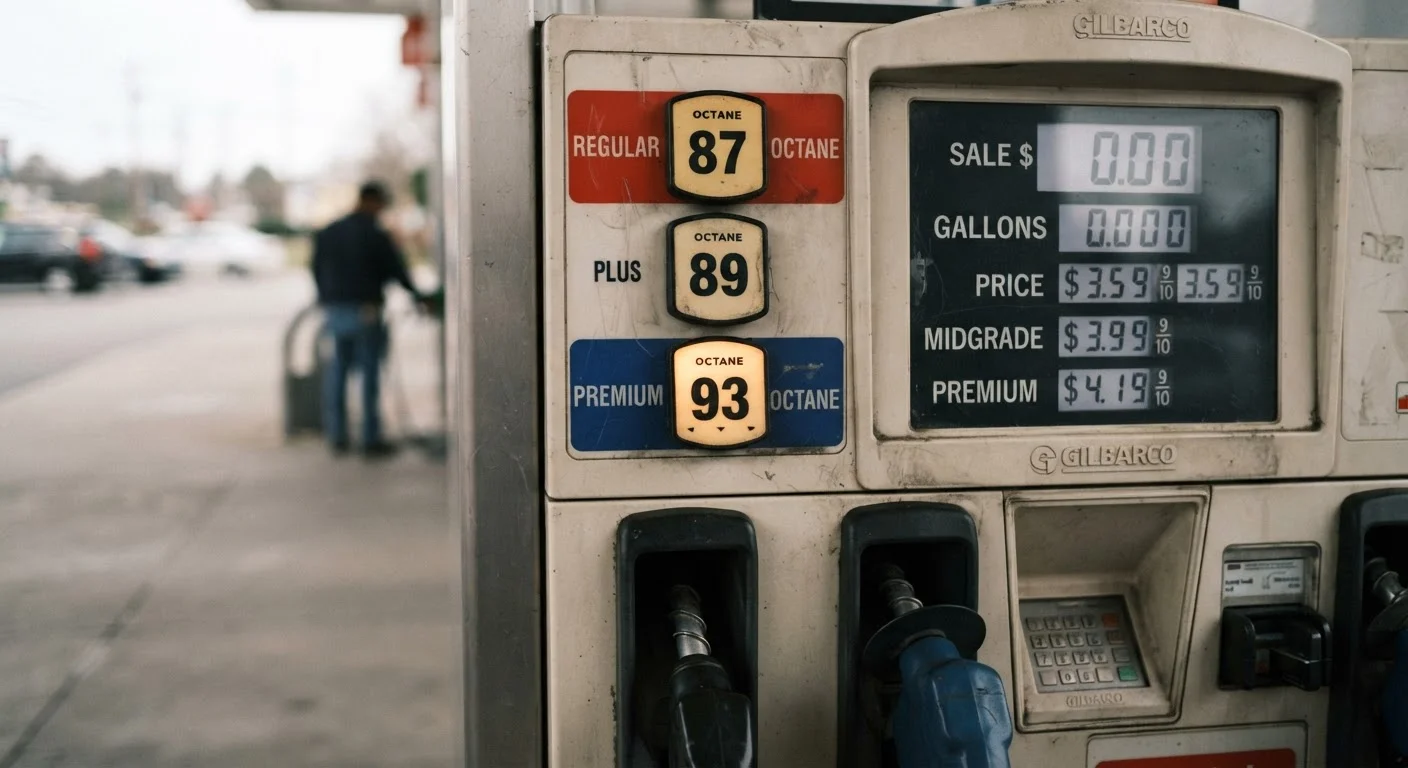
Regular Fuel (87 Octane)
The everyday workhorse for most passenger vehicles.
Best for: Vehicles whose manufacturer specifies regular unleaded - the vast majority of cars on American roads.
Option B
Premium Fuel (91-93 Octane)
Higher knock resistance for engines that genuinely need it.
Best for: Turbocharged, supercharged, or high-compression engines where the manufacturer requires or recommends premium.
If your owner's manual specifies regular unleaded
Regular Fuel (87 Octane)
Your engine is tuned for 87 octane. Premium fuel will not improve performance or mileage, and you'll spend more at every fill-up for no gain.
If your manual says premium is required
Premium Fuel (91-93 Octane)
High-compression or forced-induction engines depend on premium's knock resistance to operate safely. Using regular risks pre-ignition damage over time.
If your manual says premium is recommended (not required)
Regular Fuel (87 Octane)
Modern knock sensors will adapt the engine tune, so regular is safe to use. You may notice a marginal reduction in peak power, but the cost savings are real.
If you're on a tight budget and drive a turbocharged vehicle with 'required' premium
Premium Fuel (91-93 Octane)
Skipping required premium to save a few cents per gallon risks repair costs that far outweigh the short-term savings.
What Octane Rating Actually Measures
The number on the pump - 87, 89, 91, 93 - is an octane rating, which measures a fuel's resistance to pre-ignition, commonly called engine knock or pinging. In a gasoline engine, the fuel-air mixture is compressed by the piston and then ignited by the spark plug at a precise moment. If the mixture ignites too early - before the spark - the pressure wave collides with the still-rising piston. That collision is knock, and repeated knock stresses engine components over time.
Higher octane fuel resists that premature ignition. What it does not do is contain more energy, burn cleaner by nature, or make your engine run better if it wasn't designed to need it. The energy density of gasoline grades is nearly identical. Paying for premium in a regular-fuel engine is roughly equivalent to buying a heavier-duty lock for a door that was never under threat.
For a deeper look at how gasoline energy actually moves your car, see our foundational guide to engine fuel use.
| Criterion | Regular (87 Octane) | Premium (91-93 Octane) |
|---|---|---|
| Octane rating | 87 (AKI standard) | 91-93 (AKI standard) |
| Knock resistance | Standard - suits most engines | High - suits high-compression engines |
| Energy content | Essentially identical | Essentially identical |
| Typical price premium | Baseline | ~20-50 cents more per gallon |
| Who needs it | Most passenger cars and trucks | High-compression or forced-induction engines |
| Performance gain in wrong engine | None (using premium in regular engine) | None (using regular in required-premium engine may cause harm) |
Why Engine Design Determines the Right Grade
Engines that require premium typically have high compression ratios - often above 10:1 - or use forced induction (turbochargers or superchargers) that compress the air-fuel mixture far more aggressively than naturally aspirated engines. That extra compression generates heat, which raises the risk of pre-ignition. Premium fuel's higher octane tolerance keeps combustion controlled under those conditions.
Most everyday commuter engines are engineered with compression ratios suited to 87 octane. They produce perfectly efficient combustion at that grade. The distinction between required and recommended on your window sticker or in your owner's manual is significant: required means the engine's safe operation depends on premium; recommended means the engine is optimized for premium but protected by knock sensors if you use regular.
~70%
US vehicles designed for regular unleaded
The U.S. Department of Energy estimates the large majority of light-duty vehicles on American roads are engineered to run on 87 octane regular fuel.
$72-$180
Potential annual waste on unneeded premium
Based on a 15-gallon fill-up twice monthly and a 20-50 cent per gallon price difference - money that has no performance return in a regular-fuel engine.
Modern knock sensors (found on virtually all vehicles built in the last two decades) detect early combustion and retard ignition timing automatically - preventing damage when lower octane fuel is used. The trade-off is a modest reduction in peak horsepower and, in some cases, fuel economy. For most drivers, that trade-off is acceptable. For high-performance and luxury vehicles with required premium, however, consistent use of lower-grade fuel can degrade engine health over time despite the sensors' best efforts.
The Real Cost of Getting It Wrong - in Either Direction
The financial math on fuel grade is straightforward. Premium typically costs 20-50 cents more per gallon than regular. For a driver filling a 15-gallon tank twice a month, that's $72-$180 per year spent on a benefit that doesn't exist for a regular-fuel engine. Over five years of ownership, that's a meaningful sum redirected away from tires, oil changes, or an emergency fund.
The more serious mistake runs the other direction: consistently using regular in an engine that requires premium. Knock sensors provide a buffer, but they can't fully compensate under sustained high-load conditions - highway merging, towing, or hill climbing. Over thousands of miles, that persistent marginal stress can contribute to carbon buildup, valve wear, and in severe cases, piston or bearing damage. Repair costs in those scenarios dwarf any pump savings.
This mirrors the logic behind other maintenance decisions - like the synthetic vs. conventional oil trade-off: the right answer depends on what your specific engine actually needs, not what sounds premium.
Check the Door Jamb, Not Just the Pump
Many vehicles display the required fuel grade on a label inside the fuel filler door, in addition to the owner's manual. If you're unsure which grade your vehicle needs - especially after buying a used car - that label and the manual are the authoritative sources. Asking a dealership service department for your specific model is also a reliable option.
Avoid falling for a common misconception: that mid-grade fuel (typically 89 octane) is a smart compromise. For almost all engines, it's neither necessary nor beneficial - you get slightly higher knock resistance than you need or slightly less than you need, at a cost between the two grades. Your owner's manual won't recommend mid-grade for most vehicles.
Want to track whether your grade choice is affecting real-world efficiency? Our guide on reading your car's onboard fuel economy data explains how to use your dashboard display to spot changes.