

| Recommended rotation interval | Every 5,000-7,500 miles (General industry and manufacturer guidance) |
| FWD standard pattern | Forward Cross |
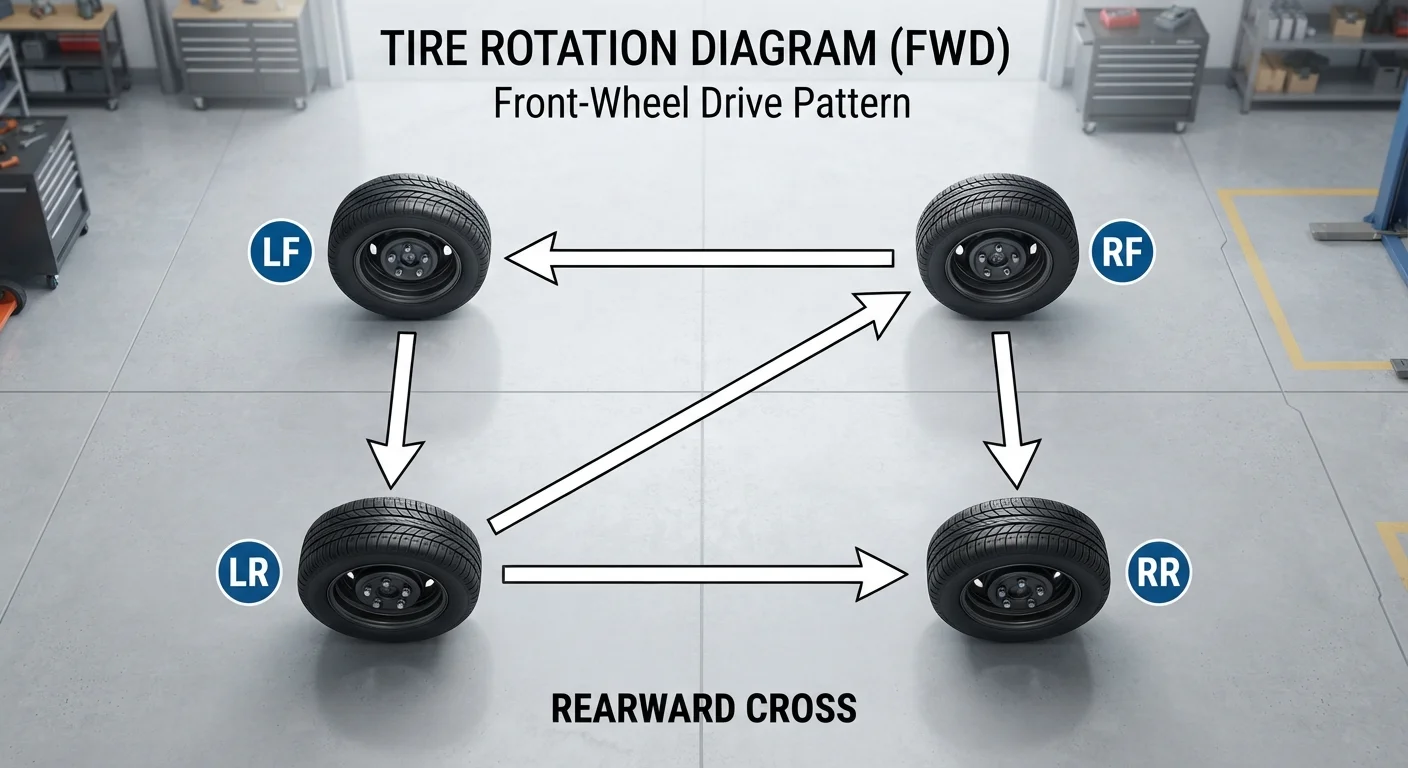
| RWD/4WD standard pattern | Rearward Cross |
| Directional tire movement | Same side only (front-to-back) |
| Staggered fitment pattern | Side-to-Side (same axle only) |
| AWD tread depth tolerance | Tires should stay within ~2/32" of each other (Common AWD manufacturer guidance) |
What Tire Rotation Actually Does
Tires don't wear evenly on their own. Front tires shoulder the bulk of steering and braking forces, so they typically wear faster and unevenly across the tread. Rear tires carry more static load on rear-wheel-drive vehicles. A rotation moves each tire to a different position so wear is distributed more evenly over the full set - extending overall tire life and helping your vehicle handle predictably.
Skipping rotations doesn't just cost you tire longevity. Uneven wear can contribute to vibration, pulling, and compromised traction. See our guide to why cars pull to one side for related causes that rotations alone won't fix.
| Recommended rotation interval | Every 5,000-7,500 miles (General industry and manufacturer guidance) |
| FWD standard pattern | Forward Cross |
| RWD/4WD standard pattern | Rearward Cross |
| Directional tire movement | Same side only (front-to-back) |
| Staggered fitment pattern | Side-to-Side (same axle only) |
| AWD tread depth tolerance | Tires should stay within ~2/32" of each other (Common AWD manufacturer guidance) |
Common Rotation Patterns and When Each Applies
The pattern you use depends on your drivetrain, whether your tires are directional or non-directional, and whether your vehicle uses a full-size spare. Using the wrong pattern for your setup can accelerate uneven wear rather than correct it.
Forward Cross
The front tires move straight back; the rear tires cross to the opposite front positions. This is the standard pattern for front-wheel-drive (FWD) vehicles. Because FWD front tires wear faster, moving them to the rear and crossing the rears to the front helps balance the wear cycle.
Rearward Cross
The rear tires move straight forward; the front tires cross to the opposite rear positions. This is recommended for rear-wheel-drive (RWD) and four-wheel-drive (4WD) vehicles, where the rear tires handle more driving load.
X-Pattern
Every tire crosses to the opposite axle and opposite side simultaneously. This pattern is sometimes used on FWD vehicles, particularly when wear differences between front and rear are significant and a more aggressive redistribution is warranted.
Side-to-Side
Tires swap left-to-right on the same axle. This applies only to vehicles with different-sized tires front and rear (staggered fitment), which is common on some performance cars. These tires cannot move between axles without remounting.
Directional Tires
Directional tires - identifiable by a V-shaped or arrow tread pattern - are designed to rotate in one direction only. They can only move front-to-back on the same side of the vehicle. Crossing them to the opposite side requires dismounting and remounting the tire on the rim, which adds cost.
Directional tire
A tire with a tread pattern engineered to rotate in one specific direction, typically indicated by an arrow on the sidewall. Reversing the direction can reduce performance and void the tire warranty.
Staggered fitment
A wheel and tire setup where the rear tires are wider or larger than the front. Common on performance vehicles, it prevents tires from swapping between axles without remounting.
Tread wear
The gradual loss of tire tread depth caused by friction with the road surface. Uneven tread wear means some areas of the tire degrade faster than others, reducing safety and tire lifespan.
Drivetrain
The system that transfers engine power to the wheels. Common configurations include front-wheel drive (FWD), rear-wheel drive (RWD), all-wheel drive (AWD), and four-wheel drive (4WD), each affecting how tires wear.
Forward Cross pattern
A rotation method where front tires move straight to the rear and rear tires cross to opposite front positions. Standard for FWD vehicles.
Rearward Cross pattern
A rotation method where rear tires move straight to the front and front tires cross to opposite rear positions. Standard for RWD and 4WD vehicles.
How Often to Rotate by Drive Type
Most manufacturers and tire industry guidelines suggest rotating tires every 5,000-7,500 miles as a general baseline - often coinciding with oil changes. However, the right interval varies by drivetrain and driving conditions.
- FWD vehicles: Rotate closer to every 5,000 miles. Front tires wear substantially faster under steering and drive loads combined.
- RWD vehicles: Every 5,000-7,500 miles is generally appropriate. Wear differences between axles are less dramatic than FWD.
- AWD/4WD vehicles: Follow the tighter end of the interval - every 5,000 miles. All-wheel-drive systems are sensitive to tread depth differences between tires; running mismatched wear can stress differentials and transfer cases.
- High-performance or track use: More frequent checks are warranted. Aggressive driving accelerates uneven wear patterns.
Always cross-reference your owner's manual, which accounts for your specific vehicle's design. For a broader look at how rotation fits into your full service schedule, see your car's maintenance schedule decoded.
One more reason to stay consistent: uneven wear patterns can mask or worsen brake-related issues. Uneven brake pad wear and uneven tire wear sometimes share root causes worth investigating together.