

Key Takeaways
Why Ground Covers Beat Weeds on a Budget
Bare soil is an open invitation for weeds. Every patch of exposed ground receives wind-blown seeds, and without competition, those seeds germinate freely. The most cost-effective, chemical-free solution isn't pulling weeds every weekend - it's replacing bare ground with plants that close the canopy themselves.
Ground covers accomplish this by forming a dense mat of foliage that blocks the sunlight weed seeds need to sprout. Once established, many varieties need little more than an occasional trim and a drink during dry spells. Compared to maintaining turf grass - with its mowing, fertilizing, and reseeding cycles - the math tends to favor ground covers for difficult spots like slopes, tree roots, and shaded areas. For a broader look at lawn alternatives that cut labor and water costs, see our guide on native plants and lawn alternatives.
The seven options below cover a range of conditions - sun, shade, dry soil, and wet - so you can find a fit for your specific yard without overspending.
Creeping Thyme
Creeping thyme is one of the most reliable sun-loving ground covers for weed suppression. It grows just two to four inches tall, spreads steadily, and produces small purple or pink flowers that attract pollinators. Once established, it tolerates drought and foot traffic better than most low-growing plants.
It works especially well between stepping stones or along dry, rocky slopes where grass struggles. Because it's a herb, the foliage releases a pleasant scent when brushed - a bonus in high-traffic garden paths. Creeping thyme spreads slowly enough that it's unlikely to become invasive in most US regions, though it's worth checking with your local extension office if you're in the Pacific Northwest or similar mild, moist climates.
Creeping thyme tolerates drought and foot traffic better than most low-growing alternatives.
Ajuga (Bugleweed)
Ajuga is a shade-tolerant spreader that forms a tight rosette of glossy leaves, making it nearly impenetrable to weeds. It produces upright spikes of blue-purple flowers in spring, adding visual interest without any extra effort. It spreads by runners, so one flat of plants can cover a surprising amount of ground within two seasons.
It handles deep shade under trees - one of the toughest gardening spots to keep weed-free - and tolerates occasional mowing at a high blade setting. Avoid planting it in areas that stay waterlogged, as it's susceptible to crown rot in poorly drained soil.
Ajuga's tight rosettes form a nearly weed-impenetrable mat even in deep shade under trees.
Creeping Phlox
Creeping phlox is a spring bloomer that carpets slopes and borders with a dense cushion of needle-like foliage topped by a flush of pink, white, or lavender flowers. After blooming, the evergreen foliage continues suppressing weeds through summer and winter.
It thrives in full sun with well-drained soil and is particularly effective on banks where mowing is difficult and erosion is a concern. Division is straightforward - pull apart established clumps in early fall and replant sections to expand coverage without buying new plants.
Creeping phlox covers slopes where mowing is impractical and erosion control is needed.
White Clover
White clover has made a comeback as a lawn alternative and ground cover because it does something most plants can't: it fixes nitrogen from the air into the soil, naturally fertilizing surrounding plants. It stays low (under six inches), tolerates mowing, and produces small white flowers that support bees and other pollinators.
It handles moderate foot traffic, stays green in drought conditions longer than most grass varieties, and seeds cheaply. For homeowners looking to replace patchy lawn areas without chemical inputs, it's one of the most cost-effective starting points. Note that it's not suitable for areas where family members or pets have bee-sting allergies, since the flowers attract pollinators actively.
White clover fixes nitrogen into the soil, naturally feeding surrounding plants at no cost.
Pachysandra
Pachysandra is a classic shade ground cover for a reason: it forms a tidy, uniform mat of dark green foliage that genuinely crowds out weeds once established. It's evergreen in most US hardiness zones (typically Zone 4 and warmer), so it provides year-round coverage and weed suppression even when other plants die back.
It grows slowly in its first season but spreads reliably by underground runners thereafter. It prefers acidic, well-drained soil and deep to partial shade - making it one of the few options that thrives under mature evergreen trees where little else survives. Japanese pachysandra (Pachysandra terminalis) is widely available; if you're in the Eastern US, consider the native alternative Pachysandra procumbens (Allegheny spurge) to support local ecosystems.
Pachysandra thrives under mature evergreens where most ground covers fail to establish.
Creeping Jenny
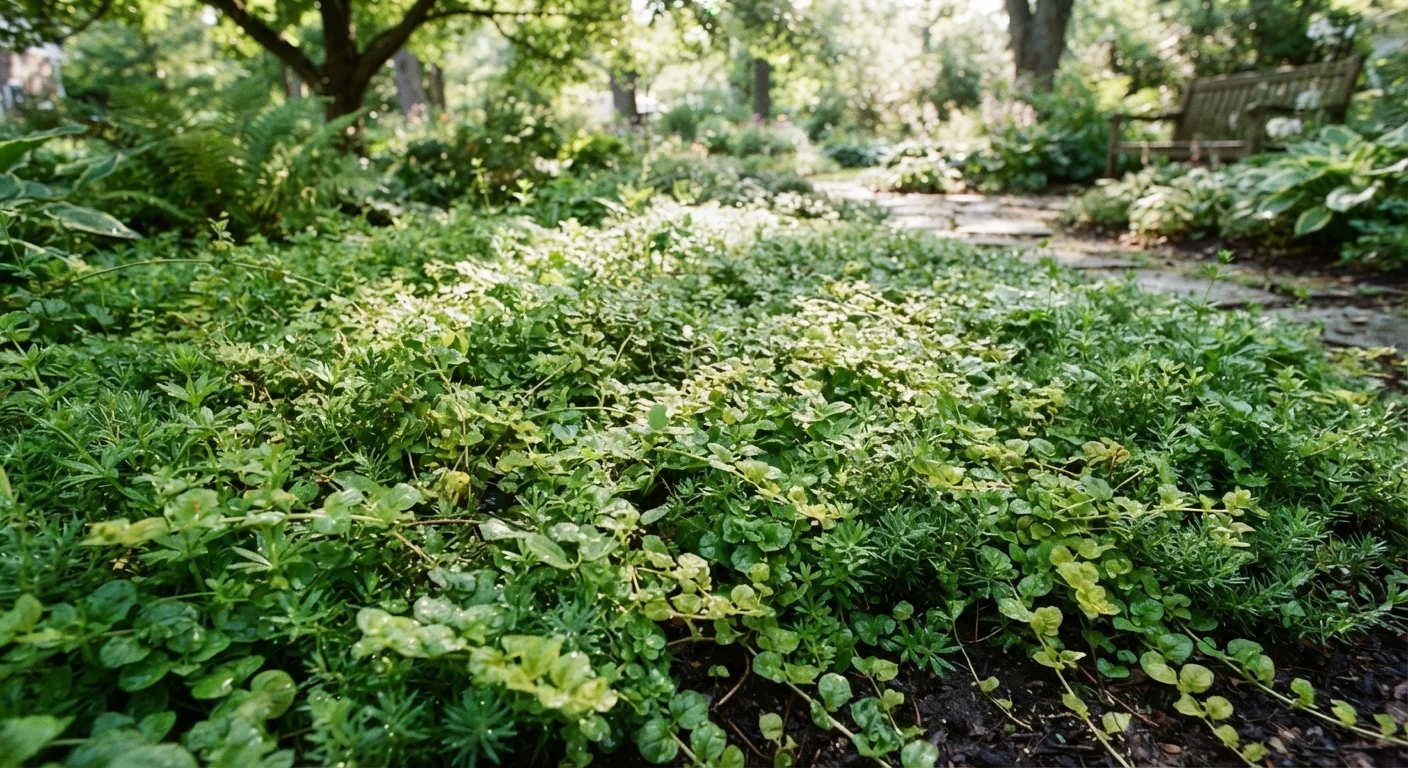
Creeping Jenny (Lysimachia nummularia) spreads quickly along the ground with bright chartreuse or golden-green foliage that stays low and dense. It's particularly effective in moist, partially shaded spots - rain gardens, low-lying areas, or the edges of ponds - where weed pressure is high and few other plants perform well.
It does spread vigorously, so it's best used in contained areas rather than open beds near natural spaces. Check whether it's considered invasive in your state before planting; in some regions, the golden-leafed cultivar 'Aurea' is preferred as it's less aggressive than the straight species.
Creeping Jenny fills moist, low-lying spots where most weed-suppressing plants struggle.
Sedum (Stonecrop)
Low-growing sedum varieties - sometimes called stonecrop - are outstanding for hot, dry, sunny spots where keeping anything alive is a challenge. They store water in their succulent leaves, making them exceptionally drought-tolerant once established, and they spread slowly but steadily to fill gaps between rocks or along sunny borders.
Because they thrive in poor, well-drained soil, they're ideal for spots where amending the soil would be expensive or impractical. They offer seasonal color through their flower clusters and foliage tones, and they require virtually no supplemental watering after the first season in most US climates. Look for spreading varieties like Sedum spurium or Sedum album rather than upright clump-forming types for ground cover purposes.
Sedum thrives in poor, dry soil where amending the ground would be costly or impractical.
Getting the Most Out of Your Ground Cover
Even the toughest ground cover needs a fair start. Before planting, clear existing weeds thoroughly - smothering them with cardboard for four to six weeks before planting is a free and effective method. Then, during the first growing season, lay a light layer of mulch between new transplants to suppress weeds while the ground cover fills in. Our guide on mulch types and depths explains which mulch works best in different situations.
Spacing matters too. Planting closer together costs more upfront but reduces weeding labor for the first one to two years - often a worthwhile trade-off for budget-focused homeowners. Division is your best cost-cutting tool: many ground covers, including creeping phlox and ajuga, can be divided and replanted from a single starter plant, multiplying your coverage at no extra cost.
Divide Before You Buy More
Many ground covers - including ajuga, creeping phlox, and sedum - can be divided from existing plants in early spring or fall. Dig up a clump, pull or cut it into sections, and replant the divisions immediately with good watering-in. This is the most budget-friendly way to expand coverage without repeat purchases. Ask neighbors or local gardening groups whether anyone has excess divisions to share.
Finally, if you've been weighing whether to replace a struggling lawn section with ground cover or reseed it, our comparison of grass seed vs. sod puts the true effort and cost of turf in perspective. Ground covers often win on both counts in high-stress areas.