

Key Takeaways
Why Popular Organization Advice Often Backfires
Home organization content is everywhere - social media feeds, lifestyle blogs, weekend TV shows. Most of it looks polished and convincing. But a surprising amount of widely repeated advice is either oversimplified or flat-out counterproductive, especially for homeowners working with limited budgets and real-world constraints.
The problem isn't a lack of effort. Many people reorganize rooms only to watch clutter rebuild within weeks. Often, the culprit is advice that addresses symptoms rather than causes. Before you buy another storage bin or rearrange your shelving, it's worth questioning a few assumptions. The myth-and-fact pairs below cover some of the most persistent misconceptions - and what actually works instead.
For a deeper look at the behavioral and spatial reasons clutter accumulates, see why your home feels cluttered.
Myth
You need to buy more storage containers to get organized.
Fact
Buying storage before decluttering usually adds to the problem rather than solving it.
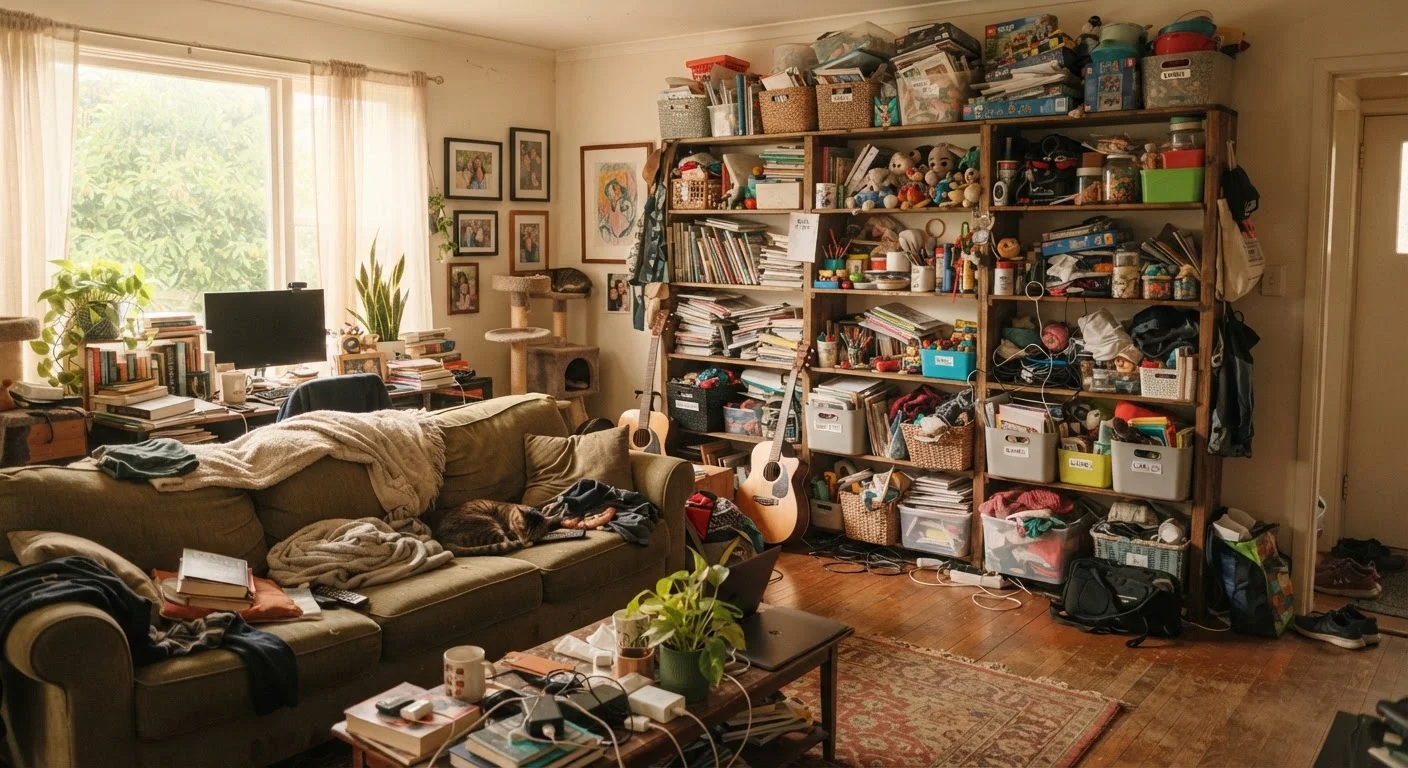
This is perhaps the most common and costly organization mistake. Containers, bins, and drawer organizers feel like progress - but if you haven't removed what you don't need first, you're just packaging clutter more neatly. Research on hoarding and accumulation behavior consistently shows that acquiring storage products can actually reinforce keeping too many items by making excess feel managed.
The more useful sequence is: sort and remove first, measure your actual remaining items, then consider whether a container would genuinely help - and whether you already own something that could serve the same purpose. Many organization problems can be solved with boxes already in your home, repurposed jars, or cardboard dividers cut to size.
Myth
A big one-day declutter will solve your clutter problem for good.
Fact
Single large purges rarely stick without small daily habits to prevent clutter from rebuilding.
The satisfaction of a full-day cleanout is real, but clutter doesn't care about your effort. If the habits and entry points that created the mess remain unchanged, items will quietly accumulate again within weeks or months. Studies on behavior change suggest that one-time interventions are far less durable than small repeated actions tied to existing routines.
A more sustainable approach involves pairing a declutter session with at least one ongoing habit - like a nightly five-minute reset, or applying a one-in, one-out rule when bringing new items home. The cleanout creates the conditions; the habits maintain them. Without both, the cycle simply repeats.
Myth
Everything needs a labeled, categorized home to stay organized.
Fact
Over-engineered systems often fail because they don't match how people naturally behave in their spaces.
Elaborate labeling and categorization can work well for some people and some areas - a pantry with clear containers and labels, for example, genuinely helps many households. But imposing a rigid system on every surface in every room often creates more maintenance than it eliminates. If the system doesn't match your actual retrieval habits, you'll bypass it constantly and clutter forms around it.
Before setting up any organization system, it helps to observe how you actually use a space for a week. Where do things naturally land? What do you reach for most? Systems built around real behavior patterns hold up; systems built around aspirational behavior patterns rarely do. Sometimes the right solution is simply consolidating like items in one loose zone - no labels required.
Myth
Keeping items 'just in case' is smart and saves money.
Fact
Holding too many items for hypothetical future use is one of the primary drivers of clutter accumulation.
'Just in case' thinking is understandable, especially for budget-conscious households where replacing something you gave away feels wasteful. But the cost of storing excess - in usable space, in time spent searching for things, and in the mental load of managing a full home - is real, even if it's less visible than a purchase price.
A practical test: if you haven't used an item in 12 months, consider whether its storage cost (space occupied, difficulty finding other things near it) outweighs the replacement cost if you ever actually need it again. For many items, especially multiples of the same thing, the honest answer favors letting it go. Donating usable items to local organizations also means someone else benefits from what you no longer need.
Myth
Small spaces are the reason for clutter - bigger homes stay organized naturally.
Fact
Available space tends to fill regardless of size; organization habits matter far more than square footage.
This myth can lead homeowners to feel helpless about clutter until they can afford a larger space - which keeps them from making meaningful improvements now. In practice, research and anecdotal evidence from professional organizers consistently shows that larger homes often have more clutter, not less, because more storage space creates more room to defer decisions about items.
Small spaces can actually encourage better organization discipline because the consequences of clutter are immediate and visible. The most effective strategies for small spaces - vertical storage, multi-use furniture, strict item limits per category - often work equally well in larger homes. See zone-based organization strategies for a method that scales to any size home.
Building Habits That Outlast Any Cleanout
Debunking these myths points toward a common truth: lasting organization is less about systems and more about behavior. The most effective changes tend to be small, repeatable, and matched to how you actually live - not how an idealized version of you lives.
That means resisting the urge to over-engineer solutions. A shallow basket on the counter that you actually empty every few days beats an elaborate labeled filing system you abandon after a week. Friction matters - the harder a system is to maintain, the faster it collapses.
Avoid Spending to Solve an Accumulation Problem
It's tempting to treat clutter as a product problem with a product solution - more bins, better shelving, a new closet system. But if accumulation habits don't change, new storage fills up just like the old storage did. Spending money on organizational products before addressing why items are entering and staying in your home can leave you with more clutter and less money. Start with sorting and removing; only spend on storage if a genuine gap remains afterward.
If you want to go further, clutter-prevention habits worth building explores low-effort routines that prevent accumulation from quietly restarting. For room-specific challenges like a packed bathroom, small bathroom organizing strategies offers practical approaches that don't require a renovation. And if paper is a recurring problem, understanding paper clutter patterns can help you get ahead of one of the fastest-accumulating types of mess.
Organization doesn't have to be expensive or perfect. It just has to work for your space, your schedule, and your budget - consistently.