

Key Takeaways
Paper Clutter
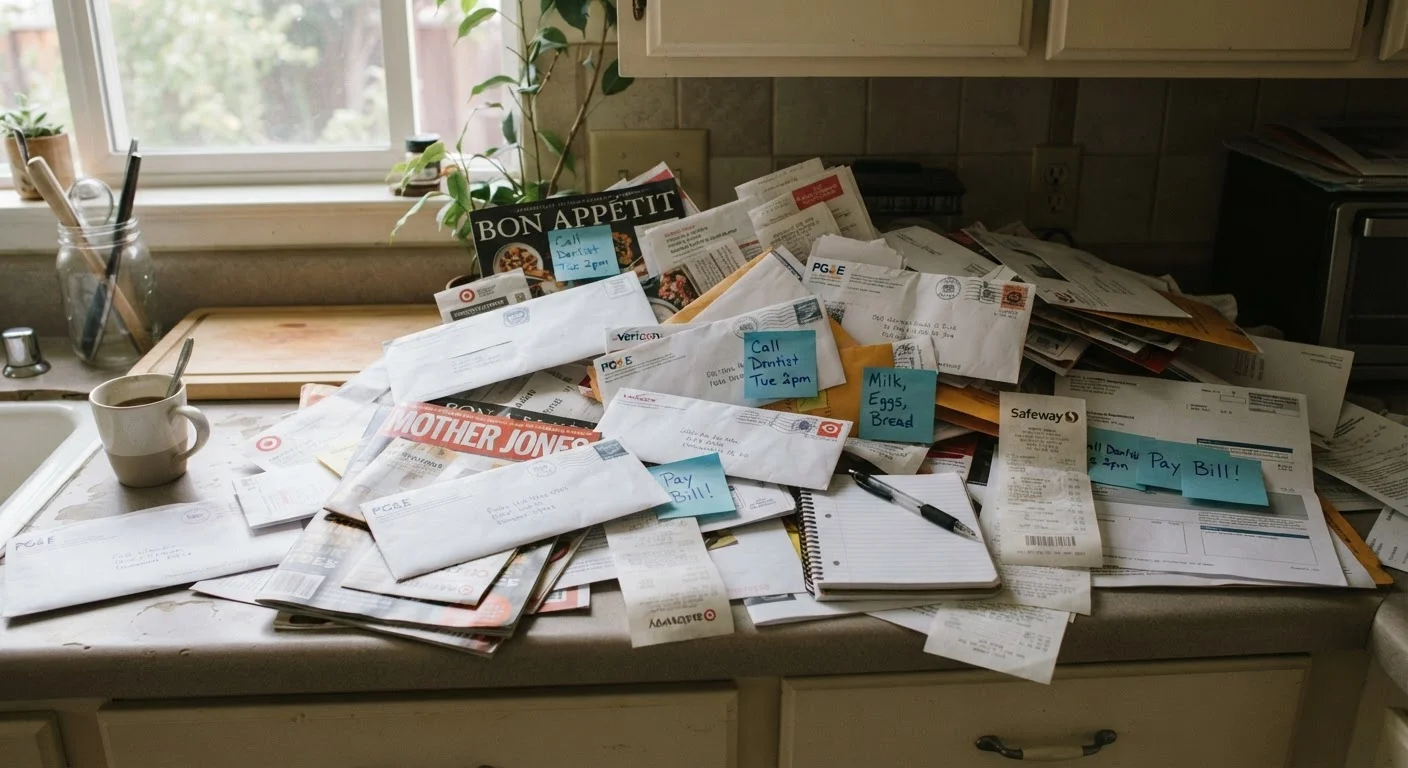
Paper clutter refers to the accumulation of physical paper items - mail, receipts, bills, flyers, catalogs, and documents - that pile up faster than they're sorted, filed, or discarded. Unlike other household clutter, paper arrives daily through multiple channels and carries a built-in sense of urgency that makes it hard to dismiss without reading. Over time, unsorted paper becomes both a visual nuisance and a practical problem when important documents get buried.
Organizational researchers sometimes call this 'deferred decision clutter' - paper that hasn't been acted on or categorized, left in a holding pattern that never resolves.
Where Paper Clutter Actually Comes From
Paper clutter rarely arrives in one dramatic wave. It trickles in steadily through several predictable channels - and understanding those channels is the first step toward managing them.
Mail is the primary culprit for most households. Between catalogs, credit card offers, insurance notices, utility bills, and neighborhood flyers, the average American household receives a significant volume of physical mail each week. The majority of it is unsolicited and disposable, but sorting it takes a moment of decision - and when that moment doesn't happen, paper stacks up.
Receipts and transaction records are the second major source. Paper receipts from grocery runs, gas stations, and retail purchases pile up in wallets, bags, and on countertops. Most are never needed again, but discarding them on the spot requires intention.
School and work documents add another layer - permission slips, meeting notes, handouts, and reports that come home with family members. These often feel too important to discard immediately, so they land on counters or tables and stay there.
Magazines and catalogs seem harmless in small numbers but accumulate into unwieldy stacks. Many people save them with vague plans to read them later - a plan that rarely materializes.
Most Incoming Paper Can Be Discarded Immediately
Organizational experts commonly estimate that the vast majority of mail and paper that enters a home requires no long-term storage - it needs only a quick action (pay the bill) or immediate disposal. Keeping this in mind can reframe sorting from a complex task to a quick triage. When in doubt, ask: 'Would I miss this in six months?' If the answer is no, discard it.
Why Paper Spreads Faster Than Other Clutter
Paper has a unique behavioral profile that makes it spread more aggressively than physical objects. A misplaced chair stays where it is. A pile of paper invisibly grows, sheet by sheet, until it becomes a stack, then a problem.
Three factors drive the spread:
- Flat surfaces invite it. Countertops, dining tables, and desks are natural landing zones. Paper naturally migrates to horizontal surfaces and, once a small pile exists, more paper joins it instinctively.
- Decisions feel costly. Every piece of paper requires a small judgment call - keep it, act on it, or throw it away. Decision fatigue causes people to defer, which means paper waits indefinitely.
- It carries implicit urgency. Unopened envelopes feel like potential obligations. Even junk mail triggers a moment of 'what if this matters?' That hesitation delays disposal.
This is why a single organizational purge rarely solves paper clutter long-term. Without addressing the daily decision habit, paper simply rebuilds. For a broader look at why that pattern repeats, see common organization myths worth questioning before your next big tidy-up.
Create a 'Landing Zone' Near Your Entry Point
Designating a single, visible spot near your door - a small tray, a wall-mounted pocket, or even a labeled folder - gives incoming paper a defined home instead of your nearest flat surface. When everything arrives in one place, sorting becomes a contained, predictable task rather than a hunt across multiple rooms. A dollar-store accordion folder works as well as anything more expensive.
A Practical System for Stopping the Buildup
The most effective paper management systems share one feature: they make the decision point immediate rather than deferred. Here's how to build that into your daily routine without buying anything expensive.
Sort at the entry point
Deal with mail the moment it enters your home - directly over the recycling bin or shred pile if possible. Catalogs you didn't request and promotional offers go immediately. Bills and actionable items go into a single designated spot, not a general pile.
Use three categories, not more
Label three folders or trays: Act (needs a response or payment), File (worth keeping for records), and Recycle/Shred. Resist adding categories - complexity causes people to abandon the system.
Schedule a weekly paper review
Set a 10-minute weekly habit to process your 'Act' folder and move filed items to their permanent home. This prevents any category from overflowing.
Go paperless wherever possible
Switch utility bills, bank statements, and subscription notices to digital delivery. This is one of the highest-impact changes available at zero cost. Most providers offer paperless options in their account settings.
Before investing in elaborate filing products, consider whether your space actually calls for them. The room-by-room audit checklist can help you evaluate what your home genuinely needs.
80%+
Of household paper that can be discarded immediately
Professional organizers commonly estimate that the large majority of paper entering a home requires no long-term storage - it needs only an action or immediate disposal.
7 years
Recommended retention period for tax documents
The IRS generally has up to three years to audit a return and up to six years in cases of substantial underreporting, making a seven-year window a widely cited safe benchmark.
41 lbs
Average junk mail received per American per year
Estimates from environmental and postal research suggest the average US household receives dozens of pounds of unsolicited direct mail annually, much of which is never opened.
Keeping It Under Control Long Term
Paper clutter is a maintenance problem, not a one-time fix. The households that manage it well tend to treat incoming paper as a daily habit - small, consistent decisions - rather than a periodic project.
Building that habit is more straightforward than it sounds. Pair paper sorting with something you already do: reviewing mail while waiting for the coffee to brew, or clearing the counter before dinner. Habit stacking reduces the friction of starting.
It also helps to address the volume problem at the source. Opting out of mailing lists, switching to electronic statements, and informing senders that you prefer digital contact all reduce the incoming flow. Less paper entering the home means fewer decisions to make each day.
For households that struggle with clutter returning after cleanups, the pattern is almost always behavioral rather than spatial. Having the right container is secondary to building the right habit. The low-effort routines that prevent clutter from rebuilding offers practical starting points for making that shift. Similarly, the same dynamic plays out in spaces like kitchen drawers - understanding how kitchen drawer chaos keeps coming back can reinforce why systems matter more than storage solutions.