

Key Takeaways
Household Clutter
Household clutter is any accumulation of objects that don't have a consistent, designated place to live in your home. It's less about having too much stuff and more about a mismatch between your possessions and the systems you use to manage them. When items lack a clear home, they pile up on surfaces and in corners by default.
Behavioral researchers sometimes refer to this as 'decision fatigue accumulation' - clutter grows when the mental cost of deciding where something goes repeatedly exceeds the effort of just setting it down.
The Real Culprit: Missing Systems, Not Missing Space
If your home feels perpetually messy no matter how often you tidy, the problem almost certainly isn't that you need more storage. The core issue is that your home lacks clear systems - consistent rules for where things live and how they return there after use.
When an object doesn't have a designated spot, it lands wherever it's convenient at that moment. A jacket gets draped over a chair. Mail drops on the counter. Shoes cluster near the door. None of these are lapses in discipline - they're predictable outcomes of a home where those items simply have nowhere to go. The clutter you see is the visible symptom of invisible organizational gaps.
This distinction matters because it changes the solution. Cleaning addresses the symptom. Designing better systems addresses the cause. And systems, once in place, require far less ongoing effort than repeated tidying. See how common organization myths can backfire before you overhaul your entire setup.
80%
Of home clutter is items never used
Professional organizers widely cite that the large majority of accumulated household items go unused; the National Soap and Detergent Association has been quoted referencing similar figures in discussions of home organization patterns.
40%
More time spent looking for misplaced items
Various time-use studies suggest Americans spend significant time each week searching for misplaced objects, with estimates commonly reported in productivity and organization research ranging from 30 to 60 minutes per week.
Why Clutter Collects in the Same Spots Every Time
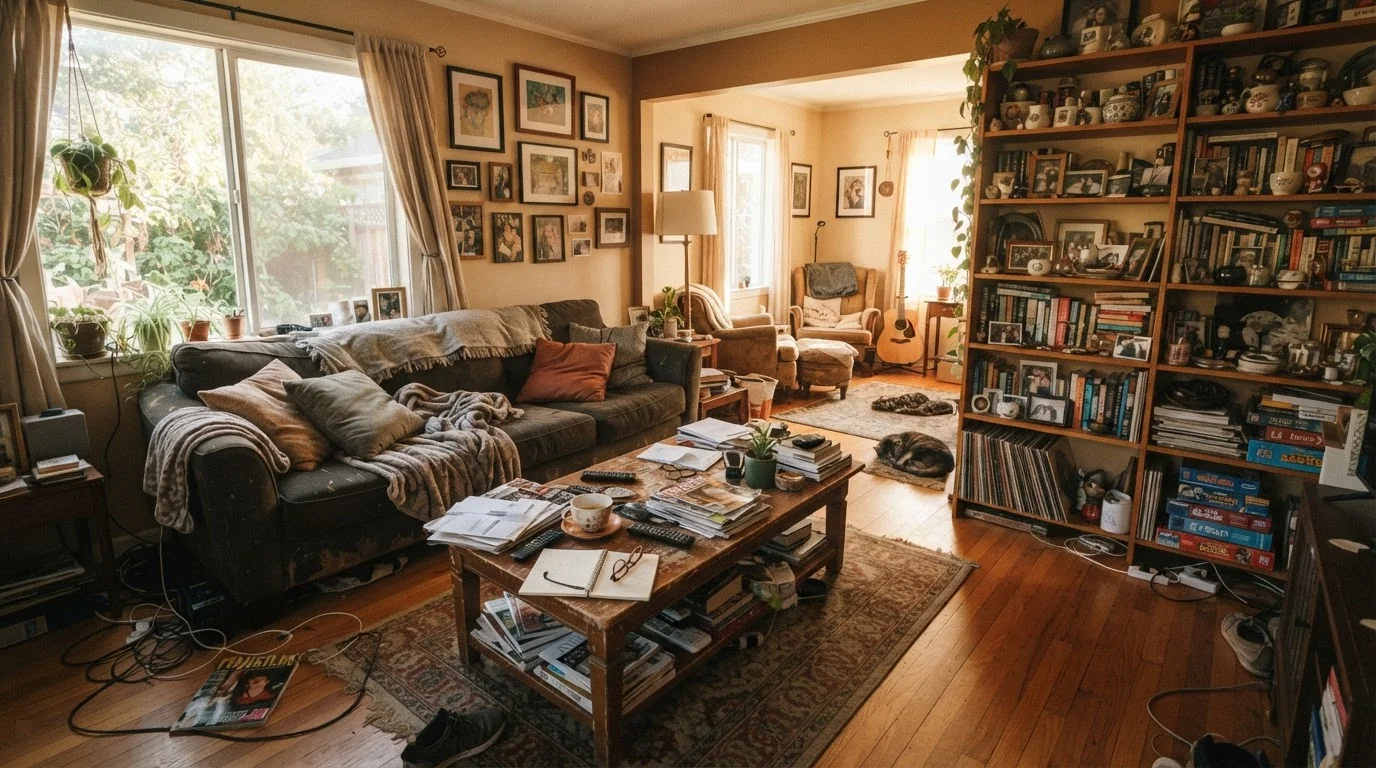
Homes develop predictable clutter hotspots - areas where items accumulate faster than anywhere else. Entryways, kitchen counters, bathroom vanities, and the area around sofas are the most common. These aren't coincidences. They're the points where daily routines begin and end, and where people are most likely to set something down and move on.
Behavioral researchers call these areas transition zones: places where you shift from one activity to another and objects get temporarily parked. The problem is that 'temporary' rarely stays that way without a prompt to act. A bill set down 'just for a second' stays for a week because there's no trigger - and no obvious place - to put it away.
Understanding this pattern is genuinely useful. Rather than fighting the behavior, you can work with it: place a small tray or basket at the drop zone so items land intentionally. That simple act converts a clutter magnet into a managed collection point. It costs little and requires no willpower.
For a specific example of how this plays out, the cycle of kitchen drawer chaos follows the exact same behavioral loop.
The Storage-Buying Trap (And What to Do Instead)
One of the most common responses to feeling overwhelmed by clutter is buying more storage: bins, baskets, shelving units, organizers. The home organization product market is enormous precisely because this impulse is so universal. But adding containers without first addressing what you own and how it's arranged usually moves clutter around rather than eliminating it.
A shelf full of unlabeled bins is still a shelf full of mystery. Items go in but don't come back out in any organized way, and the surface clutter simply shifts into hidden disorder. Before spending anything, a more effective sequence is: reduce first, then assign homes, then contain.
Start With a Reduce Step, Not a Shopping Trip
Before buying a single organizer or storage bin, spend 30 minutes walking through one room and pulling out items you haven't used in over a year. Donate, recycle, or discard what you can. You'll almost always find that your existing storage is adequate once it isn't holding things you don't actually need.
Reducing means setting aside items you genuinely don't use. Assigning homes means every remaining item has a specific location - not a general zone, but an actual spot. Containing means adding physical helpers (hooks, trays, drawer dividers) only for items that need them after the first two steps are done.
This approach often reveals that you already have enough storage. You just haven't allocated it intentionally. Repurposing boxes, jars, or containers you already own works just as well as purchasing dedicated organizers for most household categories.
Building Habits That Keep Clutter From Coming Back
One-time organizing sessions feel productive, but clutter reliably returns within weeks or months if daily habits don't change. The maintenance is where most people struggle - not because they lack motivation, but because the systems they set up require too many decisions or too much effort to maintain consistently.
The most durable habits are small and frictionless. A 'one in, one out' approach - where bringing something new into the home means something else leaves - naturally caps accumulation without requiring periodic big purges. A five-minute end-of-day reset, where items are returned to their assigned spots, prevents the gradual drift that leads to overwhelming mess.
Spaces that tend to generate their own specific clutter patterns benefit from targeted strategies. Small bathrooms, for instance, need solutions scaled to limited square footage, while paper clutter requires its own disposal and filing habits to stay manageable. For a broader look at the routines that actually hold over time, low-effort clutter-prevention habits are worth understanding before diving into any room-specific projects.
The goal isn't a perfect home - it's a home that recovers quickly because the systems are simple enough to use every day.