

Key Takeaways
Why Kitchen Drawers Keep Filling Back Up
If you've cleaned out a kitchen drawer only to find it chaotic again two months later, you're not failing at organization - you're caught in a pattern. Kitchen drawers are high-traffic, low-accountability zones. They sit at arm's reach, they close easily, and they ask nothing of you when you toss something inside. That combination makes them a magnet for anything without a better home.
The real problem isn't the drawer itself. It's a set of repeating mistakes that most households make without realizing it. Understanding those mistakes - and the specific reasons they happen - is what makes the difference between a drawer that stays organized and one that quietly reverts to chaos. Before you check out common organization myths that can backfire, start here with the behavioral patterns happening right in your own kitchen.
Organizing before decluttering - sorting items into a drawer that's still full of things you don't need.
Why it happens: It feels productive to arrange and categorize, and throwing things away feels wasteful or risky. Many people organize around clutter rather than removing it first.
Buying storage containers without measuring or matching them to what you actually own.
Why it happens: Attractive organizers feel like a solution in themselves. People purchase them optimistically, then fit their items around the containers rather than the reverse.
Assigning a drawer as a catch-all for 'miscellaneous' items without a defined limit.
Why it happens: Every home has genuinely hard-to-categorize objects. Labeling one drawer 'miscellaneous' feels like a reasonable solution, but without boundaries it becomes an expanding default.
Keeping items in the drawer 'just in case' long after their usefulness has passed.
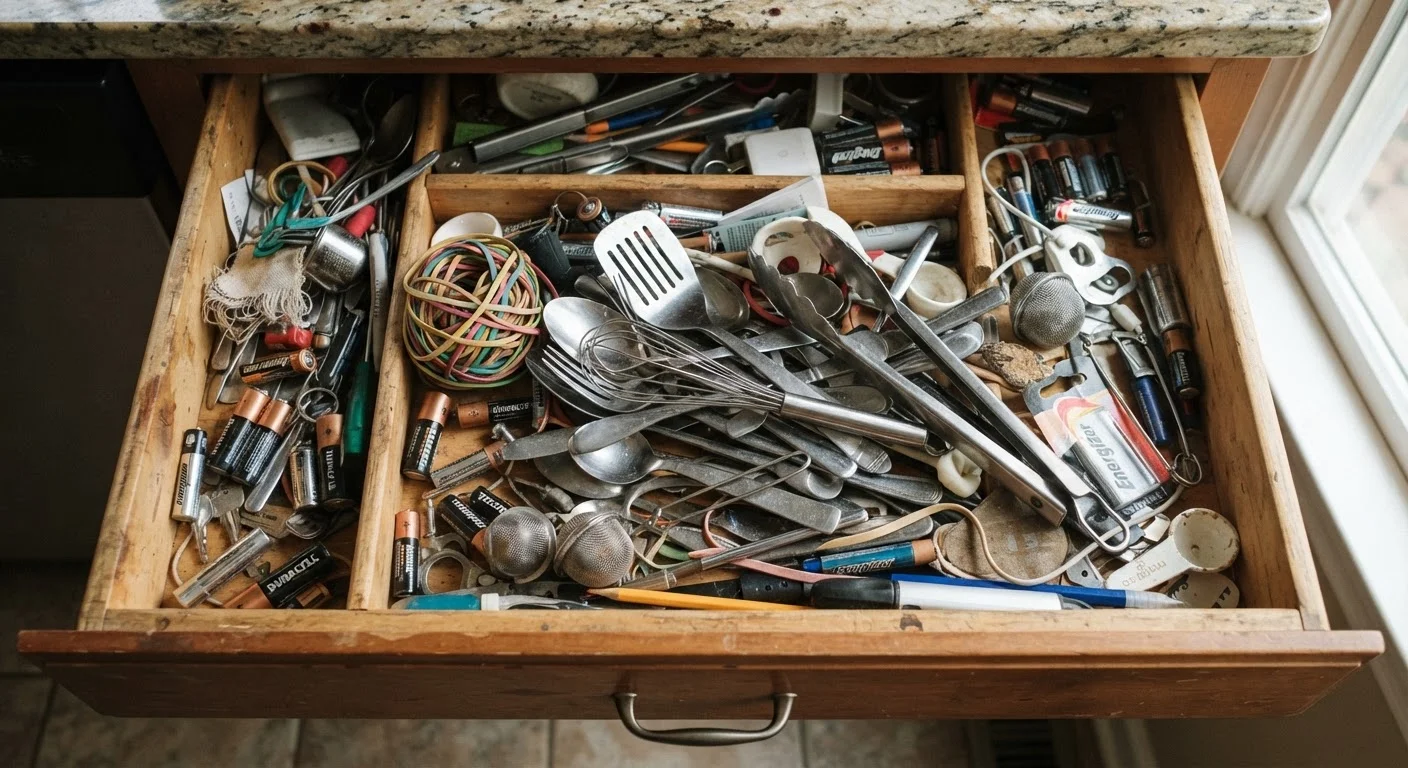
Why it happens: Loss aversion makes it hard to discard things that might theoretically be useful. Batteries of unknown charge, expired coupons, and mystery keys all survive on this logic.
Letting the drawer become the default landing zone for items displaced from other areas.
Why it happens: When other spaces in a home are over-full or poorly organized, the kitchen drawer absorbs the overflow. It becomes a symptom of broader organizational gaps.
Building a System That Actually Holds
Fixing drawer chaos for good takes more than a one-afternoon clean-out. The goal is a system where items flow predictably in and predictably out - not one where you periodically reset the same mess.
23 min
Average daily time lost searching for misplaced items
Research by organizational psychologists suggests adults spend significant time each day locating everyday household items due to inconsistent storage habits.
80%
Of clutter linked to disorganization, not lack of space
Professional organizers commonly report that the majority of household clutter results from unclear systems and habits rather than insufficient storage capacity.
Start by identifying what your drawer is actually being used for versus what it's supposed to hold. Often, drawers absorb items that belong somewhere else entirely - a charging cable that needs a dedicated spot near an outlet, takeout menus that can move to a phone app, duplicate tools that can be donated. Once you've removed what doesn't belong, you'll likely find you need far less additional storage than you thought. Audit your space before buying any new containers - that step alone can save real money.
From there, maintaining order is mostly about habit reinforcement. The one-in, one-out rule and other low-effort routines are practical tools that prevent the slow rebuild of clutter without requiring daily effort. And if paper is part of your drawer problem - expired coupons, instruction manuals, loose receipts - the patterns behind paper clutter and how to stop it are worth understanding separately. Systems work when they match how you actually live, not how you think you should live.
More Organizers Won't Fix a Behavior Problem
Purchasing additional dividers or bins addresses symptoms, not causes. If the underlying habits that fill a drawer haven't changed, a newly organized drawer will simply reach capacity faster with better-arranged clutter. Identify the pattern first, then add structure around it - not before.