

Key Takeaways
No risk to your security deposit
Damage-free solutions leave walls, floors, and surfaces intact, so you're not scrambling to patch holes or touch up paint before move-out.
Fully portable when you move
Freestanding shelves, bins, and organizers relocate with you, making them a longer-term investment rather than a sunk cost tied to one apartment.
No landlord negotiation required
Most reversible solutions fall clearly within standard lease terms, so you can implement them immediately without waiting for approval.
Encourages deliberate, low-accumulation habits
Working within space limits naturally discourages excess purchasing and encourages keeping only what genuinely fits and functions in your home.
Flexible and easy to reconfigure
Unlike built-in shelving, freestanding and adhesive-based systems can be adjusted as your needs change without any tools or permanent commitment.
Adhesive products have real weight limits
Even quality adhesive strips are rated for specific loads - typically a few pounds per strip - meaning they can't substitute for wall-anchored shelving when heavier storage is needed.
Freestanding furniture uses floor space
A bookshelf or wardrobe rack solves a storage problem but consumes square footage, which is already scarce in most rental apartments.
Cumulative product costs can add up
Buying multiple over-door organizers, tension rods, and storage bins piece by piece can become expensive without a clear plan; costs should be weighed against the benefit each item provides.
Not every surface works with adhesive solutions
Textured walls, old paint, or certain finishes cause adhesive products to fail or leave residue, limiting where they can reliably be used.
Some storage problems genuinely need permanent fixtures
Deep pantry organization, heavy tool storage, or large media collections may ultimately require wall anchoring that only becomes possible when you own.
Our Verdict
Renter-friendly organizing is genuinely effective for most everyday storage challenges - it just requires working within a different set of constraints than homeowners face. The approach rewards creativity, careful product selection, and a willingness to prioritize function over permanence. Where it falls short is in situations requiring heavy-duty storage or structural changes, and the cumulative cost of quality damage-free products can add up.
Renters on tight budgets who want functional, clutter-free living spaces without risking their security deposit or violating lease terms.
Why Organizing as a Renter Is a Different Problem
Renters navigate a real tension: you want a functional, organized home, but the lease agreement - and the security deposit at stake - limits what you can permanently install. Drilling into walls, patching and painting, or replacing fixtures typically requires landlord permission, and many landlords simply say no.
That constraint isn't a dead end. It's a design problem with a growing set of practical solutions. Before spending anything, though, it helps to start by reducing what needs to be stored in the first place. The no-cost decluttering methods covered in our companion guide can cut down the volume before you ever buy a bin.
Once you know what you're keeping, the strategies below give you a framework for organizing it - all without touching a wall with a drill.
What Actually Works: Damage-Free Organizing Approaches
The most effective renter-friendly tools fall into a few categories:
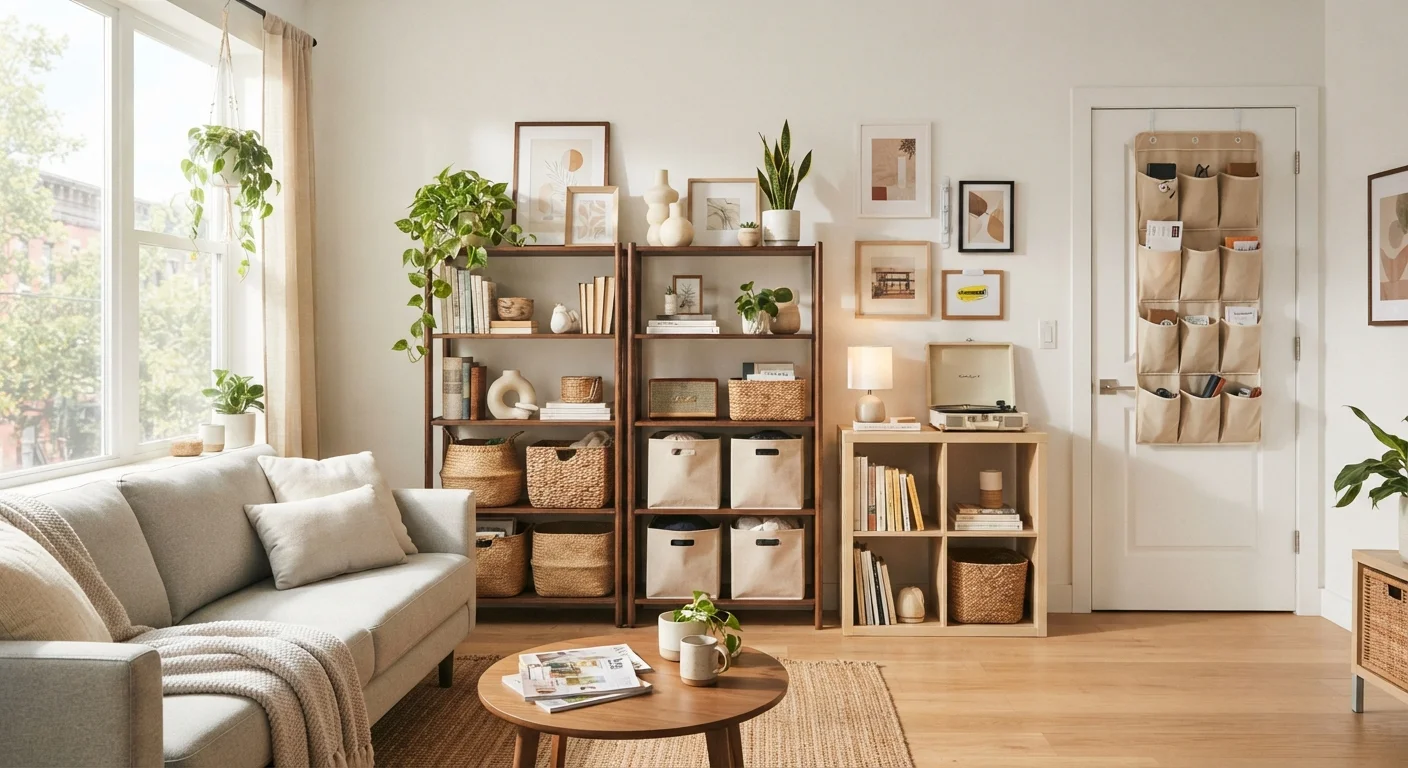
- Freestanding furniture: Bookshelves, rolling carts, wardrobe racks, and storage ottomans add storage without any wall contact. They move with you when the lease ends.
- Tension rods: These work horizontally inside cabinets to create extra shelf layers, or vertically in narrow spaces to divide storage. They're removable in seconds. See our guide on repurposing everyday items as storage for creative tension rod uses you may not have considered.
- Over-door organizers: Hooks, pocket organizers, and racks that hang over a door panel require no hardware and are especially useful in bathrooms and closets. For small bathrooms specifically, bathroom organization strategies can help you apply this approach room by room.
- Removable adhesive strips and hooks: When installed on clean, smooth surfaces and loaded within their rated weight limits, quality adhesive products can hold a surprising amount. Always follow the removal instructions carefully to avoid paint damage.
- Under-bed and vertical storage: Bed risers, stackable bins, and tall freestanding shelves exploit the space most renters ignore - the floor beneath furniture and the wall above eye level.
~36%
Share of U.S. households that rent
According to U.S. Census Bureau data, roughly one in three American households occupies a rental unit, making renter-specific organizing strategies relevant to a large portion of the population.
Top reason
Why renters lose part of security deposit
Property management surveys consistently identify damage to walls and surfaces - including nail holes and paint - as among the most common reasons landlords make deposit deductions.
Pros of Renter-Friendly Organizing
There are genuine advantages to working within these limits - not just compromises.
No risk to your security deposit
Damage-free solutions leave walls, floors, and surfaces intact, so you're not scrambling to patch holes or touch up paint before move-out.
Fully portable when you move
Freestanding shelves, bins, and organizers relocate with you, making them a longer-term investment rather than a sunk cost tied to one apartment.
No landlord negotiation required
Most reversible solutions fall clearly within standard lease terms, so you can implement them immediately without waiting for approval.
Encourages deliberate, low-accumulation habits
Working within space limits naturally discourages excess purchasing and encourages keeping only what genuinely fits and functions in your home.
Flexible and easy to reconfigure
Unlike built-in shelving, freestanding and adhesive-based systems can be adjusted as your needs change without any tools or permanent commitment.
Portability is one of the most overlooked benefits. Everything you buy travels with you to the next place, meaning your organizational system doesn't have to start from scratch every time you move.
Cons and Real Limitations to Acknowledge
No approach is without trade-offs, and it's worth being honest about where renter-friendly organizing falls short.
Adhesive products have real weight limits
Even quality adhesive strips are rated for specific loads - typically a few pounds per strip - meaning they can't substitute for wall-anchored shelving when heavier storage is needed.
Freestanding furniture uses floor space
A bookshelf or wardrobe rack solves a storage problem but consumes square footage, which is already scarce in most rental apartments.
Cumulative product costs can add up
Buying multiple over-door organizers, tension rods, and storage bins piece by piece can become expensive without a clear plan; costs should be weighed against the benefit each item provides.
Not every surface works with adhesive solutions
Textured walls, old paint, or certain finishes cause adhesive products to fail or leave residue, limiting where they can reliably be used.
Some storage problems genuinely need permanent fixtures
Deep pantry organization, heavy tool storage, or large media collections may ultimately require wall anchoring that only becomes possible when you own.
Check Your Lease Before Any Modification
Even seemingly minor changes - like installing a tension rod that contacts a door frame, or using adhesive on freshly painted walls - can be interpreted differently by different landlords. Some leases prohibit any alteration without written consent. Reading your specific lease terms, and asking questions in writing if anything is unclear, protects you from misunderstandings at move-out time.
If you're ever unsure whether a modification - even a small one - crosses a line, consult your lease or ask your landlord in writing. Our article on renter vs. owner repair responsibilities explains where those legal and practical boundaries typically sit.
Making It Work on a Tight Budget
Renter-friendly products range widely in price, and it's easy to overspend if you shop for solutions before assessing what you actually need. A useful order of operations:
- Declutter first - donated or discarded items reduce storage demand.
- Audit existing furniture for unused capacity (drawer dividers, shelf risers inside existing cabinets).
- Identify your highest-priority problem areas and solve those first rather than organizing everything at once.
- Check secondhand sources for freestanding furniture - wardrobes, bookshelves, and rolling carts turn up frequently and can cost a fraction of new.
If you share a rental, organizing decisions get more complex. The strategies in our guide on organizing shared household spaces address how to create functional systems when not everyone is on the same page.