

Key Takeaways
Start here
How Digital Grocery Coupons Actually Work
Next
Store Loyalty Cards and App-Clipped Offers
Then
Manufacturer Digital Coupons and Third-Party Sites
Level up
Stacking Rules: What Combinations Are Allowed
Put it together
Building a Repeatable Couponing Routine
How Digital Grocery Coupons Actually Work
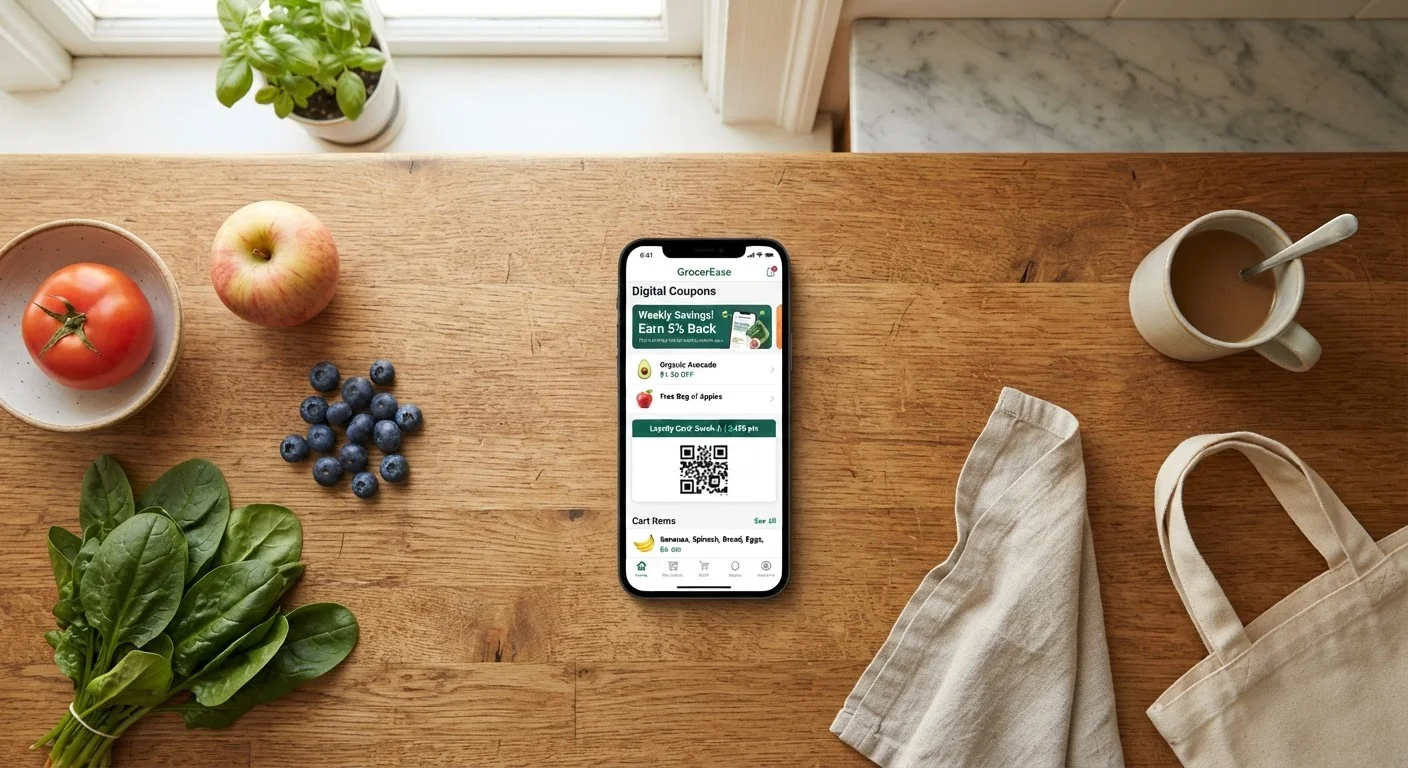
A digital grocery coupon is a discount offer stored in a database, tied to your loyalty account, and triggered automatically when you scan your card or app at checkout. No cutting, no fumbling - the deduction happens in the background. Before you can use one, you typically need to "clip" it: tap a button in your store's app or website to attach that offer to your account. If you skip this step, the discount will not apply even if you bought the qualifying product.
Understanding the mechanics matters because the same product may have multiple digital offers available simultaneously - from the store itself and from the product's manufacturer. Learn how coupons differ from promo codes and cashback before assuming all savings tools behave identically.
Digital coupon clipping
The act of tapping a button in a store app or website to attach a discount offer to your loyalty account before you shop. Without clipping, the offer will not apply at checkout.
Loyalty account
A free membership account with a grocery chain that stores your purchase history and enables personalized digital coupons, member pricing, and reward points.
Manufacturer coupon
A discount issued by the company that makes a product, valid at any participating retailer. It is separate from store-issued coupons and can often be combined with them.
Stacking
Applying two or more separate discounts to the same item in one transaction - most commonly one store coupon plus one manufacturer coupon on a single product.
Coupon aggregator
A third-party platform that collects manufacturer coupon offers from multiple brands and lets you load them to your existing store loyalty account in one place.
Member price
A discounted shelf price available only to loyalty cardholders, applied automatically at checkout when your card is scanned - no separate coupon clipping needed.
Store Loyalty Cards and App-Clipped Offers
Your grocery store's loyalty card (or its app equivalent) is the foundation of digital couponing. When you create an account and link it to transactions, the store can attach personalized and weekly offers directly to your profile. These fall into two sub-types:
- Member prices: A lower shelf price displayed only to cardholders - no clipping required, just scan your card.
- Clipped digital offers: Additional percentage-off or dollar-off deals you must actively select in the app before shopping.
The practical workflow is: open the app before writing your grocery list, browse that week's digital deals, clip anything relevant, then shop. Doing this in reverse - shopping first, then checking - means you will miss offers that require pre-loading.
Clip coupons before you write your list
Browsing your store app's weekly deals before finalizing your grocery list lets the available discounts influence what you buy, not the other way around. This approach can surface deals on items you already planned to purchase and occasionally surfaces a deal good enough to add a pantry staple at a low cost.
Manufacturer Digital Coupons and Third-Party Sites
Manufacturer coupons originate with the brand that makes a product, not with any specific store. Historically paper-based, they now appear in several digital forms. The most common approach today: manufacturer offers published on coupon aggregator platforms that partner directly with grocery store loyalty programs, allowing you to load those offers to your existing store account.
Some manufacturers also run their own loyalty portals where shoppers accumulate points or load coupons tied to specific retailers. These are separate from store-issued coupons and follow their own terms. Compare retailer and manufacturer coupons in detail to understand how the two systems differ in origin, rules, and stacking potential.
A key limitation: manufacturer digital coupons loaded through aggregator sites typically count as a single use per account per offer period. Attempting to load the same offer across multiple accounts at the same address may violate coupon terms.
Stacking Rules: What Combinations Are Allowed
Stacking means combining more than one discount on a single item. In grocery couponing, the most common permitted stack is: one store coupon + one manufacturer coupon on the same product. Both are valid simultaneously because they come from different sources.
What is generally not permitted: two manufacturer coupons on one item, or two store coupons on one item. Individual store policies vary, so check the terms in your store's app or ask at customer service if you are unsure.
A practical stack example: a store app offers $0.75 off a specific pasta brand (store coupon), while an aggregator platform loaded a $1.00 manufacturer coupon for the same product to your account. Both apply at checkout, together reducing the price by $1.75 before any sale price discount.
Store stacking policies vary
Not every grocery chain permits the same stacking combinations. Some stores allow only one coupon per item regardless of source; others permit stacking with clear rules. Check your specific store's coupon policy - usually found in the app's help section or on the store's website - before counting on a particular stack at the register.
For a broader view of how this applies beyond groceries, see the end-to-end coupon and cashback playbook.
Building a Repeatable Couponing Routine
Ad-hoc coupon hunting is inefficient. A consistent weekly routine captures far more savings with less effort. Here is a practical structure:
- Sunday or Monday: Open your store app and review the new weekly digital deals. Clip everything that matches items you regularly buy, regardless of whether they are on your list this week - many offers stay active for multiple weeks.
- Before writing your list: Cross-reference clipped offers with what you need. If an item you already planned to buy has a coupon, note it. If a coupon makes a pantry staple cheap enough to stock up, add it.
- Check aggregator platforms: Spend two minutes on any manufacturer coupon sites linked to your store account and load relevant offers.
- At checkout: Scan your loyalty card or app QR code first, before the cashier totals your order, to ensure all clipped coupons fire correctly.
Once this routine is consistent, the next step is integrating cashback apps and building a fuller savings system. See how to build a personal savings system around coupons and cashback for a structured approach that extends beyond the grocery aisle.