

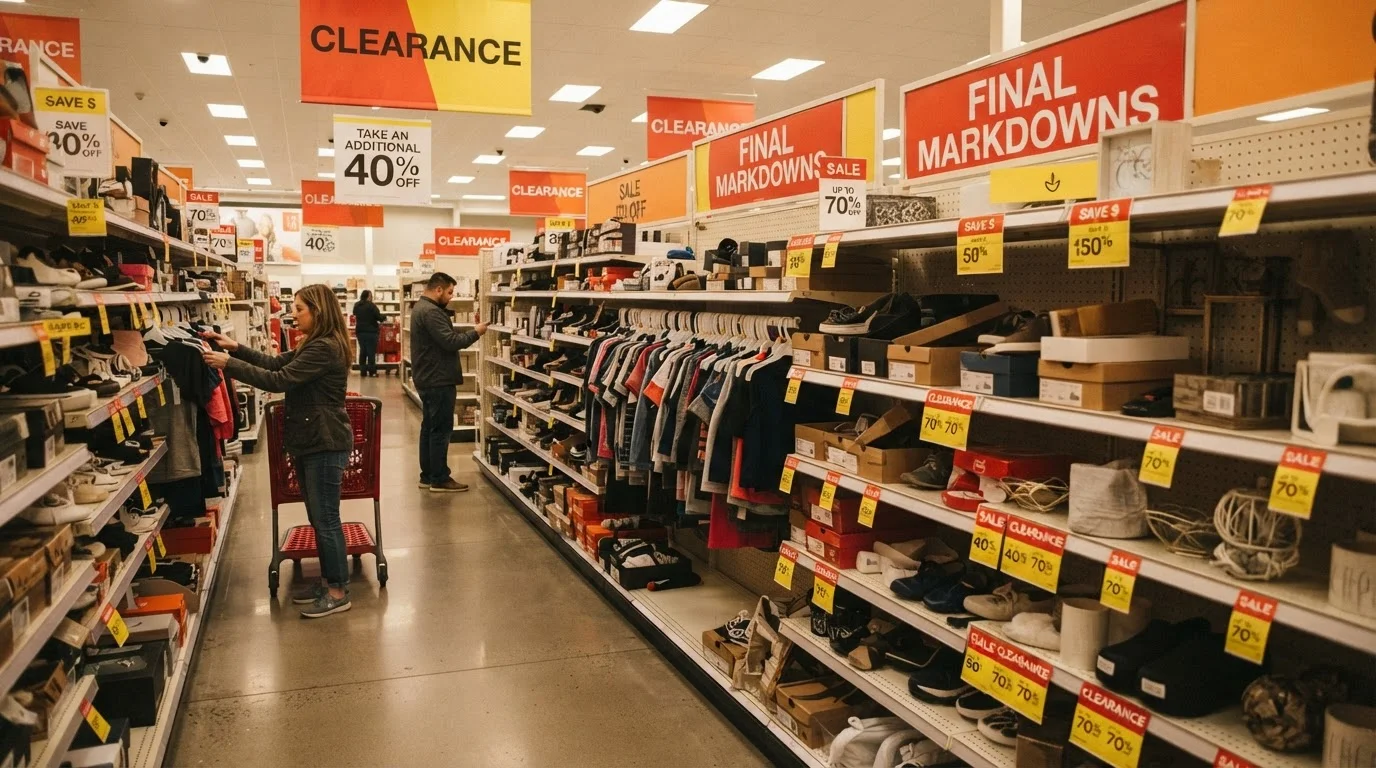
Key Takeaways
Retail Clearance Cycle
A retail clearance cycle is the predictable sequence of markdowns a store applies to seasonal or slow-moving inventory to free up shelf space for incoming merchandise. Retailers typically begin with modest price cuts, then deepen discounts over several weeks until the stock sells out or is liquidated. This cycle repeats seasonally across virtually every product category.
In retail operations, this process is formally called "markdown optimization" - stores use sell-through rate targets (often 85-95% of a seasonal buy) to trigger successive price reductions on a pre-set schedule.
Why Clearance Cycles Exist
Every product a retailer buys occupies one of two things: shelf space or cash flow. When a seasonal line stops selling at full price, it ties up both. Clearance cycles are the operational mechanism stores use to recover that capital and make room for the next season's buy.
This isn't driven primarily by a desire to reward shoppers - it's an inventory management imperative. Retailers work from open-to-buy budgets, meaning the money needed to stock the next season is often locked up in unsold current inventory. Clearance markdowns are the release valve.
Understanding this dynamic shifts how you think about timing. The question isn't "when is there a sale?" - it's "when does the retailer's inventory pressure peak?" Those are different questions, and the second one has a more predictable answer. For a full month-by-month view of when that pressure peaks by category, see the annual retail price calendar.
4-8 weeks
Typical length of a retail clearance cycle
Industry retail operations generally structure markdown schedules in 2-4 week intervals, with most seasonal clearances completing within two cycles.
60-75%
Common final clearance markdown depth
When retailers reach the final phase of a clearance cycle - driven by shelf space and open-to-buy pressure - discounts on remaining inventory frequently reach this range.
85-95%
Target sell-through rate before season ends
Retail buyers typically plan for 85-95% of seasonal inventory to sell at or above initial markdown price; remaining stock triggers deeper clearance cuts.
The Structure of a Typical Clearance Cycle
Most clearance cycles move through three distinct phases:
- Initial markdown (20-30% off): Triggered when sell-through rates fall below target. Often not advertised - the product just quietly gets repriced. This phase lasts 1-3 weeks.
- Secondary markdown (40-50% off): If inventory remains after the first cut, a deeper markdown follows. This phase often coincides with public "sale" announcements, meaning competition for remaining stock increases.
- Final clearance (60-75%+ off): The last phase before items are pulled, returned to vendors, or sent to liquidators. Selection is thin, but prices are at floor level.
The whole cycle typically runs 4-8 weeks depending on category and retailer. Apparel tends to move faster; large appliances and furniture cycle more slowly because floor space costs are higher per unit.
For shoppers willing to buy a season ahead, the final phase of one category's clearance is often the lowest price that item will ever carry at retail. End-of-season apparel clearance in late winter is a textbook example of this principle working in a shopper's favor.
Track Tag Colors at Your Regular Stores
Spend a few minutes on your next in-store visit noting which tag color is currently being used for clearance items. Many retailers rotate through a fixed sequence (e.g., yellow, then green, then red) to signal successive markdown tiers. Once you know the sequence at your regular stores, you can spot early-cycle markdowns before they're announced - giving you first pick at mid-cycle prices.
How to Read Clearance Signals Before Prices Are Announced
Retailers rarely send press releases when a clearance cycle begins. But they do leave visible operational clues:
- Tag color rotation: Many major retailers use a rotating color system for price tags, with each new color indicating a fresh markdown tier. Learning a specific store's color rotation gives you a real-time markdown map.
- Shelf repositioning: When items migrate from their normal location to end caps, clearance bins, or a dedicated section, the cycle has started regardless of the price tag.
- Reduced facing: Fewer units on the shelf (called "facing") signals the store isn't restocking - a reliable sign inventory is being wound down.
- Inventory management apps: Some retailers expose real-time in-store stock counts through their apps or websites. A sharply declining unit count combined with a modest markdown often precedes deeper cuts.
Learning to read these signals puts you ahead of public sale announcements. Reading a retailer's markdown schedule before you shop goes deeper on this technique.
Clearance vs. Promotional Sales: A Critical Distinction
Not all discounts are clearance. Promotional sales - holiday weekends, manufacturer rebate periods, anniversary events - are marketing tools designed to drive traffic at controlled margin concessions. The retailer chooses when they happen and how deep they go, and inventory is often replenished to support them.
Clearance, by contrast, is inventory reduction under operational pressure. The retailer needs the item gone. That's a fundamentally different negotiating dynamic, and it explains why clearance prices frequently beat promotional prices on the same items.
Holiday sales vs. off-season buying windows explores this contrast in detail. The short version: if you can plan ahead and tolerate imperfect timing, clearance buying typically delivers lower prices than waiting for a named sale event.
The most effective budget-buying strategies treat clearance cycles as a purchase calendar, not a reactive behavior. Timing purchases around seasonal price cycles and broader budget buying frameworks can help you build that calendar in a systematic way.