

Key Takeaways
End-of-Season Clearance Pricing
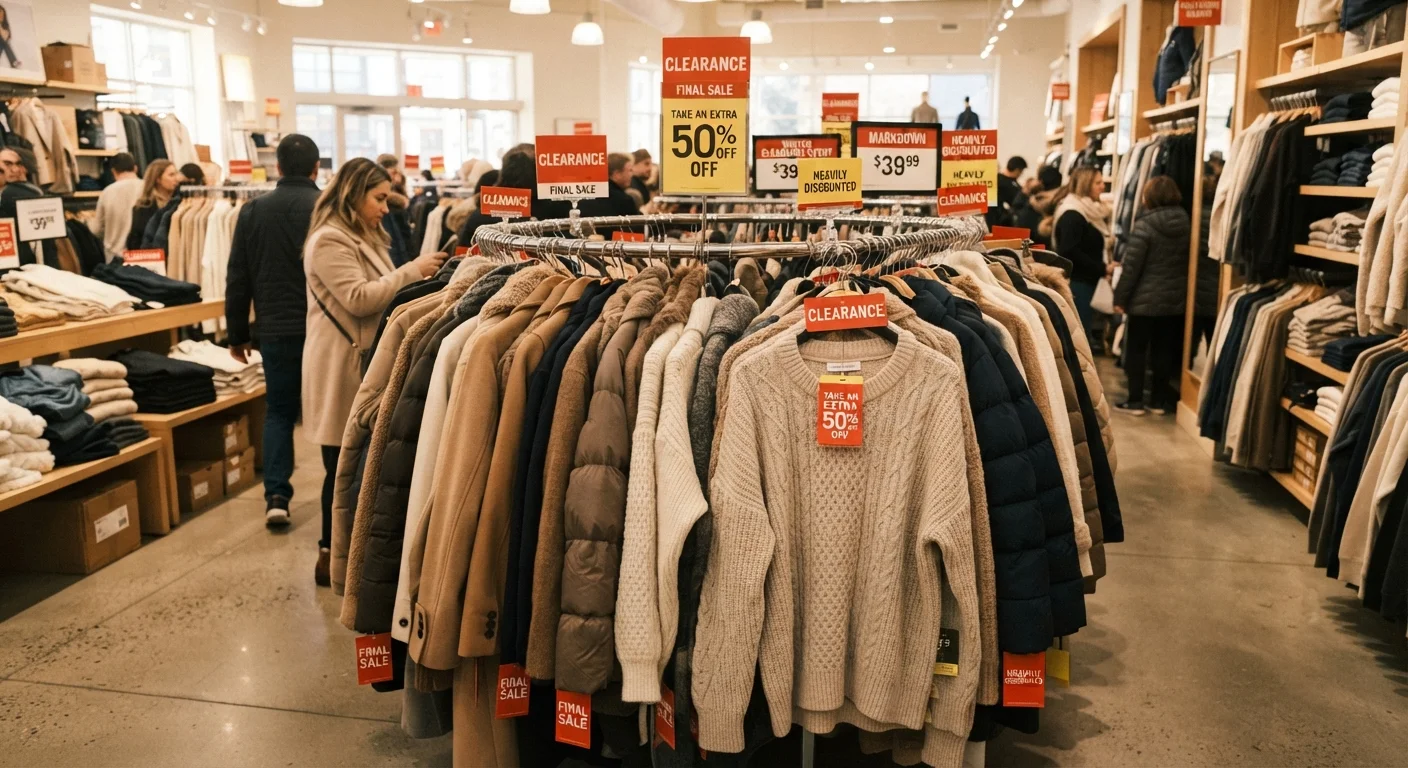
End-of-season clearance pricing happens when retailers cut prices on seasonal merchandise to clear shelf space for incoming inventory. For winter clothing, this typically occurs in late January through February, when stores need to make room for spring lines. The result is often the lowest prices of the year on coats, sweaters, boots, and cold-weather accessories.
Retailers use markdown algorithms that accelerate price reductions as the sell-through deadline approaches. Prices often drop in stages - 25% off, then 40%, then 60% or more - over a span of several weeks.
Why February Is the Pricing Inflection Point
Retail apparel planning runs months ahead of what's on the floor. By the time February arrives, most large retailers have already committed to their spring purchase orders. That creates urgency: winter inventory sitting on shelves is a liability, occupying space and capital that needs to rotate. The pressure to move that stock is what drives meaningful markdowns.
This pattern is consistent across department stores, specialty apparel retailers, and many online sellers. It's part of a broader set of predictable retail clearance cycles that repeat each season. Understanding when those cycles peak gives shoppers a reliable timing advantage.
It's worth noting that February clearance isn't unique - a parallel dynamic plays out in late summer for outdoor goods, as covered in our look at late-summer outdoor furniture pricing. The underlying mechanic is identical: inventory must move before new seasonal stock arrives.
50-70%
Typical peak clearance discount range for winter apparel
Retail industry observers commonly report end-of-season winter clothing markdowns reaching 50-70% off original prices at major apparel retailers during February clearance events.
6-8 weeks
Typical duration of a winter clearance window
Most retailers run clearance markdowns across a multi-week period starting in mid-January and extending into late February or early March, with pricing deepening over time.
30%+
Inventory typically sold through before peak clearance
Retailers expect meaningful sell-through during the holiday season, meaning popular sizes and styles are often already depleted before the deepest markdowns are applied.
How the Markdown Progression Works
Clearance pricing rarely jumps straight to its lowest point. Most retailers use a tiered markdown schedule. A coat that started the season at $180 might hit 25% off in mid-January, 40% off by late January, and 60% or more by the first week of February - sometimes deeper if sell-through is slow.
The tradeoff is inventory. As markdowns deepen, selection thins. Popular sizes and colors sell first. If you need a specific size or have particular style requirements, shopping earlier in the window - even at a shallower discount - often makes more practical sense than waiting for maximum savings on a rack of leftover stock that doesn't fit your needs.
Track Prices Before the Clearance Window Opens
Note the original full prices on winter items you're considering during the active season (November-December). That baseline makes it easier to evaluate whether a February markdown is genuinely deep or just a modest reduction from an already-inflated 'compare at' price. Screenshot or bookmark product pages so you have a real reference point.
This staged pricing logic applies broadly across seasonal categories. The same principles that govern winter apparel clearance also explain why January is historically favorable for furniture shoppers - post-holiday inventory pressure forces markdowns.
What to Buy (and What to Skip)
Not everything on a February clearance rack is worth buying for next year. The stronger candidates are classic, non-trend-dependent pieces: heavyweight wool or down coats, thermal base layers, waterproof boots in neutral colors, and plain knit sweaters. These items don't go out of style quickly and represent genuine utility purchases.
Be more cautious with fashion-forward items - bold prints, trendy silhouettes, statement outerwear. Trends shift enough season-to-season that a heavily-styled piece bought in February may feel conspicuously dated by the following December.
Also consider fit carefully when buying ahead. If you're buying for a child, factor in growth. If your own size tends to fluctuate, size-sensitive items like fitted coats carry more risk than relaxed-fit options.
Stacking Additional Savings on Clearance Prices
Clearance pricing is a starting point, not a ceiling. A few additional tactics can increase total savings - though they require attention to terms and conditions, since not all apply to clearance merchandise.
- Cashback portals: Many apparel retailers participate in cashback portal networks. Activating cashback before checkout adds a percentage back on eligible purchases, including some clearance items. Check portal terms carefully - some exclude already-reduced products.
- Store credit cards and loyalty points: If you already hold a retailer's loyalty account or co-branded card, redemption periods during clearance can amplify savings. Use accumulated points against clearance-priced items rather than full-priced ones.
- Price adjustment policies: If you purchased something within the last 7-14 days and the price has since dropped further, many retailers will refund the difference. Ask before assuming this applies.
For a broader framework on how off-season timing compares to more visible sale events, see our breakdown of holiday sales versus off-season buying windows. The data generally favors off-season timing for categories like apparel.
Building This Into Your Annual Shopping Calendar
The most consistent way to benefit from end-of-season clearance is to plan for it in advance rather than stumble into it. That means estimating your clothing needs for the following winter before the current season ends - taking stock of what wore out, what still fits, and what gaps exist.
This approach fits neatly into a broader strategy of timing purchases around seasonal price cycles. Rather than buying at the moment of need (typically full price), you're decoupling the purchasing decision from the usage timeline.
The limitation is cash flow: buying ahead requires having money available in February for clothing you won't wear until October. For shoppers on tight budgets, that's a real constraint. In those cases, even capturing one or two key pieces - a quality coat, a durable pair of boots - at clearance pricing represents meaningful savings over buying the same items at full price in November.
This article provides general retail timing information for educational purposes. Specific discounts, retailer policies, and availability vary and are not guaranteed.