

| Red light urgency | Stop driving - act immediately |
| Amber light urgency | Investigate within days, not weeks |
| TPMS required since | 2008 (all US passenger vehicles) (NHTSA Federal Motor Vehicle Safety Standard No. 138) |
| OBD-II required since | 1996 (all US cars and light trucks) (US EPA and CARB mandate) |
| Check engine light causes | Hundreds of possible fault codes |
| Correct tire pressure source | Door jamb sticker - not the tire sidewall |
Why Dashboard Warning Lights Exist
Your vehicle's onboard diagnostic system constantly monitors dozens of systems - from engine pressure to tire inflation - and communicates problems through dashboard warning lights. Ignoring them rarely makes a problem disappear; it usually gives it time to worsen. If you're new to reading your vehicle's signals, our practical troubleshooting primer is a solid foundation before diving into specific lights.
Warning lights generally fall into three urgency tiers: red (stop driving or act immediately), yellow/amber (investigate soon, but not necessarily an emergency), and green or blue (informational - a system is active). Never assume a red light can wait.
OBD-II
On-Board Diagnostics, second generation - a standardized system built into vehicles sold in the US after 1996 that monitors engine and emissions components. When a fault is detected, it stores a diagnostic trouble code (DTC) that a scanner can read.
TPMS
Tire Pressure Monitoring System - a sensor-based system that alerts the driver when one or more tires drops significantly below the recommended inflation level. Required on all US passenger vehicles built after 2008.
SRS
Supplemental Restraint System - the technical term for your vehicle's airbag system, including sensors and pyrotechnic inflators. An SRS warning light indicates a fault that may prevent proper airbag deployment.
Oil Pressure
The force at which oil circulates through the engine's lubrication passages. Low oil pressure - distinct from low oil level - means engine components aren't being adequately lubricated and can seize within minutes of operation.
Alternator
A belt-driven generator that recharges the battery while the engine runs and powers the vehicle's electrical systems. A failing alternator causes the battery warning light to illuminate.
ABS
Anti-lock Braking System - a safety feature that rapidly pulses brake pressure during hard stops to prevent wheel lockup and help the driver maintain steering control.
The Most Critical Warning Lights
These red-tier lights signal conditions that can cause immediate engine damage or a safety hazard if ignored.
| Red light urgency | Stop driving - act immediately |
| Amber light urgency | Investigate within days, not weeks |
| TPMS required since | 2008 (all US passenger vehicles) (NHTSA Federal Motor Vehicle Safety Standard No. 138) |
| OBD-II required since | 1996 (all US cars and light trucks) (US EPA and CARB mandate) |
| Check engine light causes | Hundreds of possible fault codes |
| Correct tire pressure source | Door jamb sticker - not the tire sidewall |
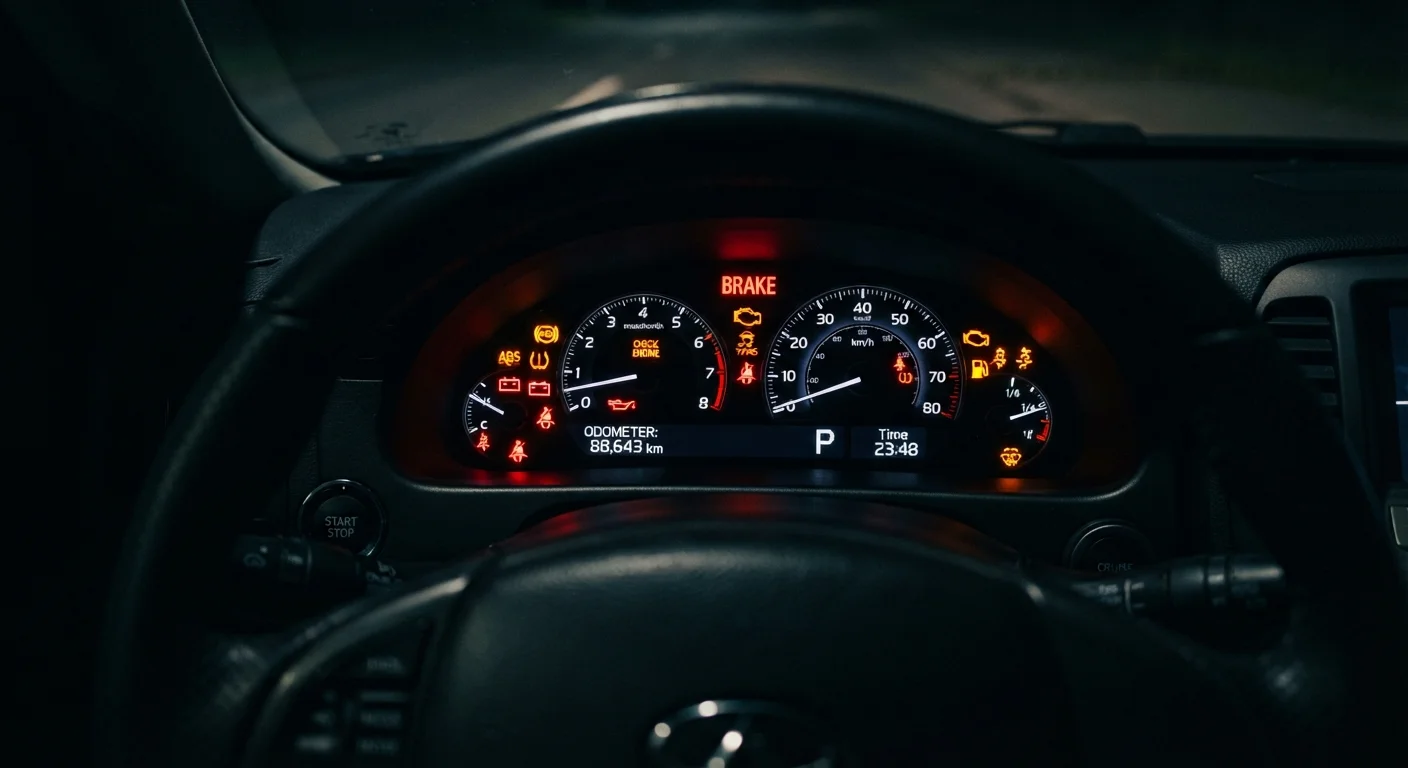
- Oil Pressure Warning (oil can icon): Indicates dangerously low oil pressure - not simply low oil level. Pull over safely and shut the engine off. Driving even a short distance with inadequate oil pressure can destroy bearings and seize the engine. Check oil level first; if it's fine, do not restart without a mechanic's diagnosis.
- Engine Temperature Warning (thermometer in liquid): Your coolant is too hot. Shut off the A/C, turn on the heater to draw heat away from the engine, and pull over if the gauge stays in the red. Our guide to engine overheating signs walks through exactly what to do next.
- Battery / Charging System (battery icon): The charging system isn't maintaining voltage. The alternator or battery may be failing. You have limited time before the car loses power entirely - minimize electrical load and head to a shop.
- Brake Warning Light (exclamation in circle or "BRAKE"): Could signal the parking brake is engaged, or - more seriously - low brake fluid or a hydraulic fault. Check the parking brake first. If it's disengaged and the light stays on, have brakes inspected immediately.
Common Amber Warning Lights
Amber lights indicate systems that need attention within days to weeks, not necessarily right this moment - though you should investigate promptly.
- Check Engine Light (engine outline): One of the most misunderstood lights. It can range from a loose gas cap to a misfiring cylinder. An OBD-II scanner reads the stored fault code and narrows down the cause. See our OBD-II code reading walkthrough to do this yourself before paying a shop.
- TPMS - Tire Pressure Monitoring System (exclamation inside a tire cross-section): One or more tires is significantly under-inflated. Check all four tires with a gauge and inflate to the pressure listed on your door jamb sticker - not the number on the tire sidewall.
- Traction Control / Stability Control (car with squiggly lines): If flashing, the system is actively working. If illuminated solid, the system may be disabled or faulty. On slippery roads, a disabled stability system is a genuine safety concern.
- Low Fuel Warning: Typically triggers at roughly 10-15% of tank capacity. Running a tank dry repeatedly can strain the fuel pump, which relies on fuel for cooling.
While investigating these lights, a quick fluid inspection takes only minutes. Our five-minute fluid check guide covers what to look for under the hood.
Lights You Might Overlook
Several less-dramatic warning lights are easy to dismiss - but shouldn't be.
- Service Required / Maintenance Due: A mileage-based reminder set by the manufacturer or dealer. It doesn't reflect a sensor reading, but skipping scheduled maintenance has real long-term costs.
- ABS Warning ("ABS" in a circle): The anti-lock braking system has a fault. Your standard brakes still work, but ABS - which prevents wheel lockup during hard stops - may not engage in an emergency. Get it checked.
- Airbag / SRS Warning (person with circle in front): A fault in the supplemental restraint system. Airbags may not deploy in a crash if this light is on. This is a safety-critical repair.
- Power Steering Warning: Common on electric power-steering systems. The wheel may feel unusually heavy. Safe to drive short distances, but steering effort increases significantly.
Many of these issues - and others - may trigger the check engine light simultaneously. If multiple lights appear at once, don't guess at causes; a diagnostic scan provides far more useful information. For related physical symptoms, see our overview of strange car noises and their likely causes.