

Key Takeaways
Option A
Vertical Storage
The space-multiplying approach that works upward, not outward.
Best for: Renters and homeowners in smaller spaces who need to preserve floor area while managing significant amounts of gear or supplies.
Option B
Floor Storage
The grounded, accessible choice for everyday usability.
Best for: Households prioritizing accessibility, stability, and ease of use - especially in shared spaces or homes with children and older adults.
If you live in a small apartment with limited square footage
Vertical Storage
Wall-mounted shelves and tall freestanding units draw the eye upward and preserve precious floor area for movement and furniture.
If you have young children or older adults in the home
Floor Storage
Lower, stable storage units minimize fall risk and keep frequently needed items within safe, easy reach without climbing or stretching.
If you rent and cannot make permanent wall modifications
Floor Storage
Freestanding floor storage requires no drilling and moves with you, avoiding potential security deposit issues from wall damage.
If you're organizing a garage or utility room with heavy equipment
Floor Storage
Heavy-duty floor shelving and cabinets handle significant weight loads more reliably than most wall-mounted systems in non-structural applications.
If you want to maximize a kitchen or home office on a tight budget
Vertical Storage
Open wall shelves are among the most affordable storage additions per square foot of usable space gained, and installation can be a manageable DIY project.
Understanding the Core Trade-Off
Every storage decision involves a fundamental trade-off: do you use your walls and height, or do you use your floor footprint? Both approaches work - but they solve different problems, and choosing incorrectly for a given room creates new frustrations rather than solving existing ones.
Vertical storage encompasses wall-mounted shelves, pegboards, hanging racks, tall bookcases, and stacked organizers. It trades floor space for wall real estate and overhead capacity. Floor storage covers dressers, storage ottomans, low cabinets, under-bed drawers, and wide shelving units that sit on the ground and spread horizontally.
The right choice depends on four factors: room function, how often items are accessed, who lives in the home, and whether wall modifications are permitted. Before spending anything, it's worth doing a quick audit - see the room-by-room checklist to understand what your space actually needs.
| Criterion | Vertical Storage | Floor Storage |
|---|---|---|
| Floor space used | Minimal - preserves floor area | Significant - requires footprint |
| Accessibility | Can require reaching or stepping | Easy reach for most users |
| Weight capacity | Limited by wall anchoring | Generally higher with proper units |
| Renter-friendliness | Restricted; wall damage risk | High - no wall work needed |
| Upfront cost | Often lower for open shelves | Moderate to high for furniture |
| Safety with children/elderly | Risk if not properly anchored | Generally safer and more stable |
| Portability | Wall-mounted units are fixed | Most units move easily |
Room-by-Room Breakdown
Kitchen: Vertical storage shines here. Wall-mounted magnetic knife strips, open shelving for dishes, and pegboards for pots and pans free up counter and cabinet space without requiring a renovation. Floor storage (like a rolling cart or island) works well for heavier items - stand mixers, cast iron, bulk pantry goods - that would stress most wall-mounted systems.
Bathroom: Smaller bathrooms almost always benefit from going vertical. Over-toilet shelving units, wall-mounted baskets, and medicine cabinets reclaim space without encroaching on the limited floor area. Bathroom-specific organizing strategies offer more targeted guidance for tight layouts.
Bedroom: Floor storage tends to dominate here - beds with built-in drawers, low dressers, and under-bed bins keep clothing and linens accessible without the visual weight of tall wall units. Vertical storage complements this well for books, décor, or secondary items used less frequently.
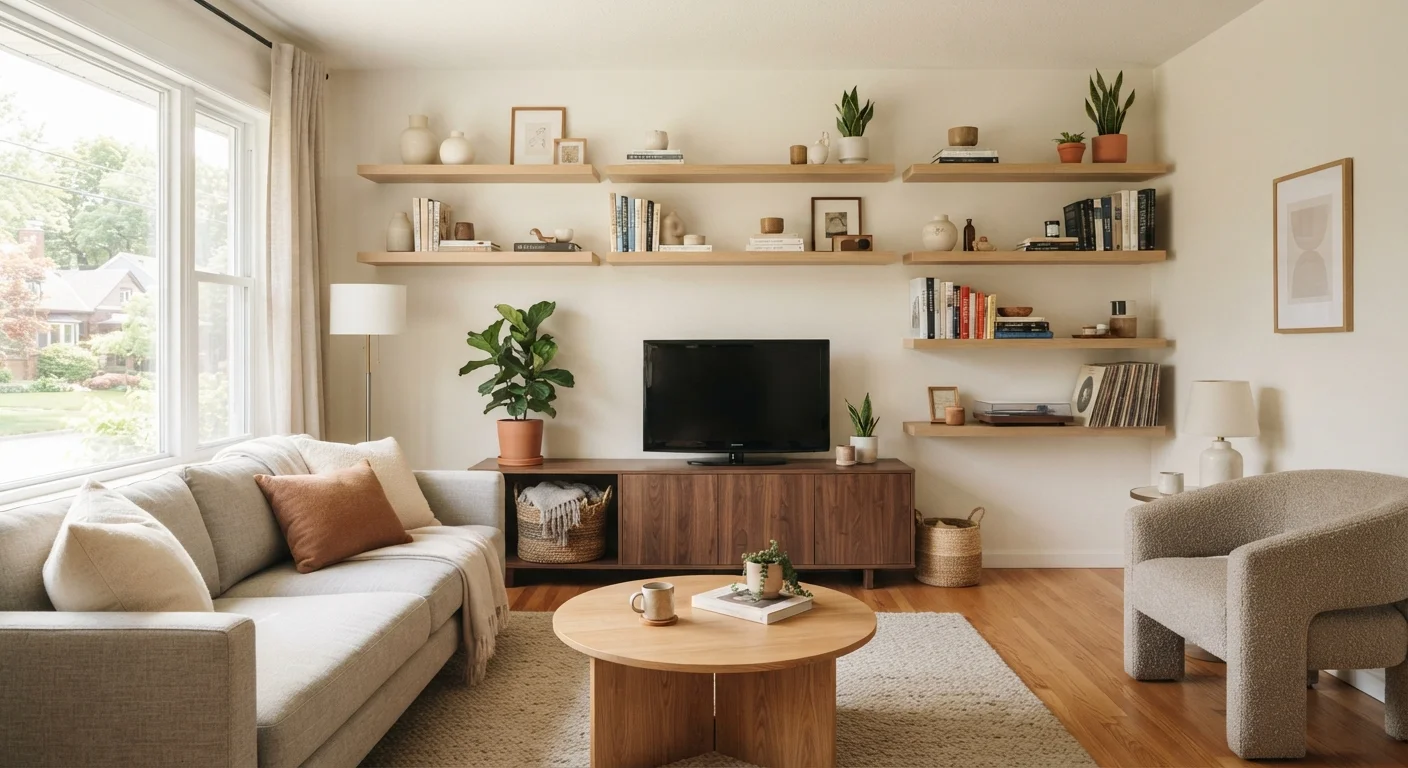
Living room: A combination approach usually works best. Floor-level media consoles and storage ottomans handle everyday items; wall-mounted shelves provide display space and additional capacity without shrinking the room.
Garage and utility spaces: Heavy-duty floor shelving typically handles tools, equipment, and storage totes more safely than wall-mounted alternatives in these contexts. If wall anchoring into studs is possible, a hybrid approach extends capacity significantly.
~68%
US homeowners reporting clutter as a stress source
A survey by the American Cleaning Institute found a majority of US adults associate household clutter with elevated stress levels.
30-50%
More usable capacity from vertical shelving
Home organization professionals generally estimate that utilizing vertical wall space can increase a room's effective storage capacity by roughly this range, depending on ceiling height.
Safety, Renting, and Budget Realities
Safety first: Any freestanding tall unit - bookcases, pantry towers, wardrobe cabinets - should be anchored to wall studs to prevent tipping. This is especially important in homes with children. Wall-mounted shelving must be anchored into studs or use appropriate wall anchors rated for the intended load; shelves exceeding their weight ratings are a common cause of damage and injury. When in doubt about structural limitations, consult a qualified contractor rather than guessing.
Renters have real constraints: Many leases prohibit drilling into walls or require patch-and-repaint on departure. Damage-free adhesive hooks and hanging strips have expanded options, but they have firm weight limits - typically a few pounds per strip - making them unsuitable for heavier loads. Freestanding floor storage remains the most renter-friendly approach overall.
Budget considerations: Wall-mounted open shelving is often the most affordable storage expansion per unit of capacity gained. However, factor in hardware, wall anchors, and any tools needed for installation. Floor storage units frequently have higher upfront costs but require no installation. Repurposing items you already own - like stacked crates or underutilized furniture - can offset costs for either approach; everyday household items often solve real storage problems without new purchases.
In shared households, accessibility and consensus matter too. Organizing shared spaces requires balancing individual habits with functional systems that everyone can realistically maintain.
When Vertical Storage Meets Small Fitness Spaces
If you're carving out space for home exercise in a small room, vertical storage can be especially valuable for freeing up floor area. Wall-mounted gear holders and vertical shelving for equipment keep the center of the room open. For more on making small spaces work for movement, see small-space fitness strategies.